Can BJT s and Mosfet s use multiple / different voltages

MikeML

Joined Oct 2, 2009
5,444
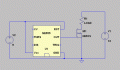
Sure. The 555 output will swing from ~1V to ~8V when powered with 9V, which is more than enough to drive the gate of NFET. The 0V side of the 9V supply must be tied to the 0V side of the 12V supply, however.

912.gif
 
Last edited:

Thread Starter

RandyFL

Joined Aug 28, 2014
148
but can that be done with
1. a BDX53c and
2. can it be on a different breadboard
thanx in advance

All the best

PS what was Nfet's number specifically ( I am looking for 8 amp or higher )
 
Last edited:

Thread Starter

RandyFL

Joined Aug 28, 2014
148
Yes, provided you put a 1KΩ resistor between pin 3 of the 555 and the base of the Darlington
thinking out loud here...
2 breadboards one with a 9 volt attached to the 555 and the other breadboard with a BDX53c connected to a 12 volt 220 CCA ( lawnmower battery ) as long as their tied to 0V side... it will work...?

PS
Could you put another drawing in... with two different breadboards or separately...
or however that would work... thanx in advance
 
Last edited:

Alec_t

Joined Sep 17, 2013
15,125
Should do. Bear in mind that if the switched load is at all inductive (e.g. relay, solenoid, motor) you will need a reverse-biased catching diode across the load.
 

Thread Starter

RandyFL

Joined Aug 28, 2014
148
Should do. Bear in mind that if the switched load is at all inductive (e.g. relay, solenoid, motor) you will need a reverse-biased catching diode across the load.
Thank you.
I think He drew that in His original drawing...

All the Best
 

dl324

Joined Mar 30, 2015
18,393
Should do. Bear in mind that if the switched load is at all inductive (e.g. relay, solenoid, motor) you will need a reverse-biased catching diode across the load.
True for bipolar transistors, but MOSFETs have a parasitic diode between the S/D. If that diode can handle the kick back, an external snubber isn't required.
 
Last edited:

Thread Starter

RandyFL

Joined Aug 28, 2014
148
Sure. The 555 output will swing from ~1V to ~8V when powered with 9V, which is more than enough to drive the gathe of NFET. The 0V side of the 9V supply must be tied to the 0V side of the 12V supply, however.
MikeML,
I don't think you have to re draw it...
I'll buy a 12 volt rechargeable battery tomorrow. And test a BDX53c on a different board ( or barrier strip ) with different voltages...

12 volts, 3 ohms, 4 amps and 48 watts ----> test

I might have to put the heat sink on the BDX53c ( I don't need the mica... on just one heat sink....? only if more than one BDX53c together on a single heat sink....correct? )

Cheers
 
Last edited:

Thread Starter

RandyFL

Joined Aug 28, 2014
148
Sure. The 555 output will swing from ~1V to ~8V when powered with 9V, which is more than enough to drive the gate of NFET. The 0V side of the 9V supply must be tied to the 0V side of the 12V supply, however.
Test 1. The PN2222a on a 2nd breadboard with a 470 resistor ( and a Led ) worked with 12 volts...It was a simple test to see if would work and it did... thanx

On the next test... A BDX53c with a 3 ohm power resistor 100 watt ( will a Led in the same position work - curious ) I will measure the amperage with an ammeter...

Which brings me to my next question...
 

Thread Starter

RandyFL

Joined Aug 28, 2014
148
True for bipolar transistors, but MOSFETs have a parasitic diode between the S/D. If that diode can handle the kick back, an external snubber isn't required
My next question is...
whats the difference between bjt and fets and which are better...
 

Thread Starter

RandyFL

Joined Aug 28, 2014
148
Can a transistor be used as a relay


He had the collector part backwards...but the schematic did work.
Was it really used as a relay... or was this a fluke ( not the voltmeter :) )...

cheers
 

MikeML

Joined Oct 2, 2009
5,444
A relay has isolation from input (coil) to contacts. A transistor does not; the drive circuit must be connected to the output circuit, somehow.

Both a relay and a transistor can have power gain, meaning a small amount of input power can switch much more power...
 

dl324

Joined Mar 30, 2015
18,393
My next question is...
whats the difference between bjt and fets and which are better...
BJT's are current controlled devices, MOSFETs are voltage controlled devices (sometimes visualized as a voltage controlled resistance). The term FET includes many families of devices that have different characteristics. For example, JFETs have a conduction channel formed with no bias applied and you bias them to turn off. MOSFETs have no channel under no-bias and you provide bias to form one. JFETs and MOSFETs both have a high input impedance, but for JFETs it's a PN junction and for MOSFETs it's a capacitance.

The "better" device depends on application, designer preference, cost, part availability...
 

Thread Starter

RandyFL

Joined Aug 28, 2014
148
BJT's are current controlled devices, MOSFETs are voltage controlled devices (sometimes visualized as a voltage controlled resistance).
I have a hard time wrapping my head around this ( your ) statement... i.e. the water analogy... the water in this example is the volts and the pressure is the amperage...its like saying there's water in the pipe buts its not moving ( FET ) or there's 100 amps but the volts is only 3 ( BJT )... how can one exist without the other. If you had stated they both ( relatively speaking ) do they same thing but the cost is different that I could understand...ones for current and one is for voltage ( I have to ponder that over the 4th july ) and have a nice 4th of July ( my wife is back from the hospital ).

All the Best
 

dl324

Joined Mar 30, 2015
18,393
I have a hard time wrapping my head around this ( your ) statement... i.e. the water analogy... the water in this example is the volts and the pressure is the amperage...
It should be pressure is volts and water is current.

If you use that analogy, it can still apply to both BJT's and MOSFETs. Both can be thought of as valves that control water flow in a pipe; it's just that the actual control mechanisms are different.

For a MOSFET, the valve is controlled by voltage. On an NMOS device, applying a positive voltage equal to the threshold voltage starts opening the valve. When you apply Vgs(max), the valve is completely opened and you have the lowest resistance Rds(on).

For an NPN transistor, you inject enough current into the base, usually through a current limiting resistor, and the transistor starts conducting when the BE junction is forward biased sufficiently (0.6V or so). If you inject enough current, the transistor will saturate and you get max current. Here the pipe/valve analogy breaks down.
 
Last edited:

Thread Starter

RandyFL

Joined Aug 28, 2014
148
How's your Wife doing?
After 17 days in the hospital ( she had emergency surgery and then a clot appeared in her left from the ankle to the groin )she is very weak and has a swollen left leg ( clot ). She has been on a heavy dose of levenox ( at the hospital )and cumadin at home... she has to go to a cumadin clinic for a week and hopefully lots of bed rest... and since I'm recovering from a foot surgery in May we make quite the pair...
Thank you very much for inquiring... means a lot.

So do you think the guy in the video actually used it as a relay or just thought He did...

Cheers
 
Top