can a battery in parallel with a PSU work - same voltage to instantly boost current?

Thread Starter

sam68

Joined Mar 2, 2017
41
I have a class D audio amplifier that would work better if my 12 volt 4 amp PSU could put out a little more amps when the music needs it (during bass passages.) Could I put a SLA in parallel and keep it there full time without any circuitry assuming that the PSU doesn't go above 12.x volts or using a cheap buck step down voltage reducer ($3 on ebay) to keep the PSU at 12 volts? If so, then I would assume that when the battery slowly looses voltage, that the PSU will over several days (because it is not 14.4 volts) raise the battery's voltage.

If the charging part above, doesn't work, could I still connect it (for the boost of current when needed) and then every once in awhile, use a normal charger and then reconnect it?

Something tells me this will not work but I know there are experts here that will know.
Thanks
 

recklessrog

Joined May 23, 2013
985
An easier way is to use a large capacitor of 1 Farad or greater, this will take care of the current peaks for you. These are sold at most places that fit high power stereo's in cars.
That way there is no need to have a charger and all the messing around, Connect it and forget it.
 

Dodgydave

Joined Jun 22, 2012
11,395
Yes it will work, the sla needs 13.8V to charge it up, so you may find that the battery only charges when the amp is turned off, best to try a large capacitor like a Farad or 10,000uF.
 

Thread Starter

sam68

Joined Mar 2, 2017
41
I want to thank everyone that responded. There seems to be no consensus (other forums) if a capacitor is going to degrade the low frequency response of not and even if it really helps the situation so I think I will go with just putting a battery bank in line with the PSU. I could use a heavy 7 amphr SLA, nimh, or a potentially harmful Lithium . So I'm thinking about using the same NIHM pack (10= a little over 12 volts) that I use when on battery power. That way, when I'm using the PSU (most of the time), the battery pack will provide some boosting current during bass passages. Am I correct about that?
Question: Will the batteries be damaged by the 12 volt PSU assuming the voltage doesn't go above 13 volts? Assuming that not a lot of current will be drained from the batteries, will the constant 12 volts from the PSU replenish the lost amps over a long period of time? If not, it will be easy to take them out and recharge them normally.
Thanks
 

Dodgydave

Joined Jun 22, 2012
11,395
As said earlier, a 12V sla needs 13.8V to charge it up, so if your psu sits at 12V, it will just be kept at minimum order.
 

paulktreg

Joined Jun 2, 2008
851
How is a capacitor of 1F across the +12V supply going to degrade the low frequency response of the amplifier?

I'm not an expert, and I'm sure someone will chip in, but a NiMH battery across the +12V supply doesn't sound like a good idea. The NiMH battery requires care when charging and a low trickle charge none of which will be controlled.
 

Thread Starter

sam68

Joined Mar 2, 2017
41
I don't know enough to understand why a capacitor would lower the lowest bass frequency but several on the audio forums tested the concept and noticed it. However, they live and die with stuff like that and us mortals, probably couldn't hear the difference. After doing some research, you are right about not using NIHM - they don't like trickle charging and overcharging. So I think I will use a smaller SLA 5 amp battery that will be enough to supply the amplifier as well as give it a boost when the PSU is being used. I realize the PSU will not charge it but I can remove it to charge it.

So I think we can close this thread if you'll agree that the following solution will not cause any problems and solve the boosting problem:
1. I will place an SLA in line with the power going into the amp
2. when the amp needs a boost in the current for bass passages, the battery will be there to give it on top of the current from the PSU
3. the constant PSU voltage at 12 to 13 volts will not cause any problems with the battery
4. I will monitor the voltage of the battery when the PSU is off and will remove it to be charged
5. When not using the PSU, the battery amps are enough to power the amplifier

Did I miss anything?
thanks you guys!!!
 

MrChips

Joined Oct 2, 2009
34,628
I am doing the exact opposite of what you are attempting to do.
I play bass guitar through a battery operated portable bass amp. This delivers enough bass power for jamming in a small room.
The amp runs off a 12V 8Ah SLAB. I don't really need the charger.
I only plug in the charger when I need to charge the battery. The charger is based on the basic LM317 charger circuit found in the datasheet:


ErnieM

Joined Apr 24, 2011
8,415
True audiophiles believe many strange things, but the one thing they do not believe in is double blind testing.

If they did they would reconise the only thing huge capacitance around the supply would do is to remove unwanted effects.

The frequency response can only improve to.... flatter.
 

Thread Starter

sam68

Joined Mar 2, 2017
41
You know what - I think I will try both ways - SLA and a Capacitor - but not at the same time. One of the nice things about this forum is how people will help and you'll have surely done that. The least I can do is to take the suggestions and try to see what works. Based on what I have read, you need about 1 F for 1000 rms watts. If I go with 20,000 uf = 20 watts, that should do it. Could someone tell me if these on ebay ($2) would be the ones to buy 2PCS New 25V 10000uF 25Volt 10000MFD Electrolytic Capacitor 18mm×35mm Radial.
I have not worked with capacitors of this size before so could these shock me if I'm not careful?

Thanks
 
Last edited:

Thread Starter

sam68

Joined Mar 2, 2017
41
Let me restate and summarize the thread: I have several 12 volt PS that I could use to power my class D audio amp. I'm thinking that if I connected a 12 volt Nimh battery pack in parallel, that when I need more amps during bass passages, the battery pack will supplement the PS. However, I don't want to ruin the batteries if too much voltage is produced by the PS. I don't need a charger and the power to the amp/batteries will only be a few hours at a time, then I can disconnect the battery pack and recharge it at a different location.

Which ones of these would work, if any?

1. MICREL MIC29300-12BT Linear Voltage Regulator IC Positive Fixed 1-Output 12V 3A = Use so no more than 12 volts is going into the battery pack.

2. Or could you use three of the cheap 1 amp linear wired together to increase the amp capacity?

3. What about using an adjustable buck converter and dial in the same voltage as the battery pack. DC-DC 3A Buck Converter Adjustable Step-Down Power Supply Module LM2596S

4. Or would the capacitor in the previous post work and not have a large enough stored power to shock?

If none of the above, what is the least expensive way to accomplish this?

Thanks
 

Alec_t

Joined Sep 17, 2013
15,103
I'd go for the capacitor method. 2 off (or more), 10,000uF, 25V working. At 12V there's no shock risk. Hopefully the PSU won't object to the heavy inrush current when these first charge up. A diode (or perhaps a P-MOSFET configured as an 'ideal diode') in parallel with a resistor could tame the inrush if necessary.
 

Thread Starter

sam68

Joined Mar 2, 2017
41
Thanks Alec. Would you mind answering these questions?
1. What do you mean by "2 off or more?"
2. how would I know that the PS objects - Shuts down, fails, get's hot, or ?
3. I assume it would be a simpleier circuit with just a diode and resister so what is the value of each and how to wire them with the capacitor?

Even though, I know you are right about the capictors, I would still like to know which of the 4 suggestions I made about the batteries/PS connection would be the best, (if any of them work at all) in my previous post 13.
Again, thanks for your suggestion Alec.
scott
 

crutschow

Joined Mar 14, 2008
38,322
If you use an SLA battery, then the supply voltage must be at least 12.6V otherwise the battery will supply most of the amp current and rapidly discharge.
If you can bump the voltage up to about 13.6V. then the battery will stay charged.
 

Thread Starter

sam68

Joined Mar 2, 2017
41
That is correct - However, I'm going to use a NiMh battery pack of 10 AA's = about 13 volts.
Let me restate my questions and concerns. I know I can use capacitors for the extra amps and I might do that but I would also like to know if any of the following will work and their disadvantages
:
I have several 12 volt PS that I could use to power my class D audio amp. I'm thinking that if I connected a 12 volt Nimh battery pack in parallel, that when I need more amps during bass passages, the battery pack will supplement the PS. However, I don't want to ruin the batteries if too much voltage is produced by the PS. I don't need a charger and the power to the amp/batteries will only be a few hours at a time, then I can disconnect the battery pack and recharge it at a different location.

Which ones of these would work, if any?

1. MICREL MIC29300-12BT Linear Voltage Regulator IC Positive Fixed 1-Output 12V 3A = Use so no more than 12 volts is going into the battery pack.

2. Or could you use three of the cheap 1 amp linear wired together to increase the amp capacity?

3. What about using an adjustable buck converter and dial in the same voltage as the battery pack. DC-DC 3A Buck Converter Adjustable Step-Down Power Supply Module LM2596S realizing that the battery pack will eventually discharge. I will separate the pack and recharge it elsewhere.
4. The capacitor question was answered (thanks)

If none of the above, what is the least expensive way to accomplish this?
Thanks
 

Alec_t

Joined Sep 17, 2013
15,103
Re post #15:
1) Two or more caps, each of 10,000uF.
2) Shuts down, fails, or gets hot. Depends on PSU design.
3) Depends on how much extra current you expect the caps to supply and what supply voltage drop (if any) occurs when the PSU is providing its maximum output current.

Re post #17:
1) If the NiMh pack voltage is 13V it will source all of the current (until the voltage drops) and try to push current into the 12V PSU (which might object).
2) Parallelled linear regulators might fight each other, depending on their design.
3) Could work. But see 1.
 

Thread Starter

sam68

Joined Mar 2, 2017
41
Thanks Alec, that info is what I needed. OK, I have so many PS, that I can risk some trial and error - First if you could give me how to wire the two caps with a diode and resister (value of each) I will also do that. I will order the parts. I will also order the cheap linear regulators and experiment with those. While they are coming, I will try the buck regulator hooked up to the 19 volt laptop PS and set it at 12 volts, hook in parallel with the battery pack and monitor it to see what happens.
Thanks
 

Alec_t

Joined Sep 17, 2013
15,103
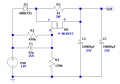
One thing not discussed yet is what happens if the caps or battery are/is at full voltage and the PSU is then switched off? Some PSUs may have a built-in means to prevent reverse current flow into the PSU and some may not. With that in mind I've come up with the circuit below to charge the caps but prevent reverse current flow in the PSU:
SurgeLimiter.PNG
D1 prevents significant reverse current flow into the PSU.
At power-up, M1 is off and C2/3 charge up via inrush current limiter R3.
After about 1 sec C1 has charged enough via R2 to pull M1 gate low enough to turn on M1. Main current then flows through M1 to top up C2/3 and drive the output load.
A simpler alternative to this arrangement might be to use a NTC (negative temperature coefficient) thermistor as an inrush current limiter, but I'm not sure how low a resistance it would present when trying to draw pulses of current from the caps.
 
Top