Can 2 separate circuits share a switch?

EM Fields

Joined Jun 8, 2016
583
Oh, I see. You are making the assumption that the TS always wants to open ALL the doors instead of just the door that they want to open. Despite the fact that the TS, in the same post that they first mentioned wanting to control multiple doors mentioned using different signals to control the different doors independently. So, once again, you are making unwarranted assumptions in order to simplify the problem and then offer a solution to the simplified problem claiming that it solves the original problem.
The problem, as I see it, seems to be that I've come up with a nice way to solve the OP's problem - which is at odds with your clunky conjectures - and, apparently, your "design" skills, and now you're just being vituperative for having been shown up.

Instead of just blather and vitriol, why don't you simply post a schematic showing how you'd do it?
 

WBahn

Joined Mar 31, 2012
32,871
The problem, as I see it, seems to be that I've come up with a nice way to solve the OP's problem - which is at odds with your clunky conjectures - and, apparently, your "design" skills, and now you're just being vituperative for having been shown up.

Instead of just blather and vitriol, why don't you simply post a schematic showing how you'd do it?
So how does the TS use your "nice" solution to open just the left door and not the right door?

So much for your "nice" solution.

As for my clunky design skills, they were good enough to design systems that are now in orbit around Mars.
 

EM Fields

Joined Jun 8, 2016
583
So how does the TS use your "nice" solution to open just the left door and not the right door?

So much for your "nice" solution.

As for my clunky design skills, they were good enough to design systems that are now in orbit around Mars.
1. Simple. He merely connects the relay contacts across the remote's switch which corresponds to the left door.
2. From what you've written, so far, it seems to me that a better mission would be one that orbits around Uranus.
 

WBahn

Joined Mar 31, 2012
32,871
1. Simple. He merely connects the relay contacts across the remote's switch which corresponds to the left door.
2. From what you've written, so far, it seems to me that a better mission would be one that orbits around Uranus.

With that kind of response, I'm surprised your efforts weren't directed toward Uranus.
Ah, so your idea of a simple solution is one in which whenever he wants to open the other door (relative to the last one that was operated by your circuit) he has to physically modify the circuit. Yes, so simple. But I suppose you will claim that is a reasonable way to "solve" the problem since the TS never said that he wanted a solution that didn't require him to reconfigure the circuit every time he wanted to open a different door.


And your childhood playground word games won't get you very far, even if they were in the slightest original. But at least they match your solutions, both in originality and in quality.
 

EM Fields

Joined Jun 8, 2016
583
Ah, so your idea of a simple solution is one in which whenever he wants to open the other door (relative to the last one that was operated by your circuit) he has to physically modify the circuit. Yes, so simple. But I suppose you will claim that is a reasonable way to "solve" the problem since the TS never said that he wanted a solution that didn't require him to reconfigure the circuit every time he wanted to open a different door.

And your childhood playground word games won't get you very far, even if they were in the slightest original. But at least they match your solutions, both in originality and in quality.
Total self-serving, narcissistic nonsense. I see nothing from you but rancor, which is often the result of a spoilsport's checkmate.
 
Last edited:

WBahn

Joined Mar 31, 2012
32,871
This seems to have degenerated into a pissing contest. :eek:
Should I declare a winner?
No. I've had enough of his childishness, so he can declare himself king of the kindergarten playground and be done with it -- clearly it's very important to him.
 

Tonyr1084

Joined Sep 24, 2015
9,744
You might want to rethink the use of that brake light -- what's the last thing you do when you STOP in front of the garage?
True enough. So maybe the brake AND the left turn signal for one door and the brake and right for the other.

I'm just throwing stuff out there to see what it may inspire.

[edit]

Do you realize the TS hasn't responded since Friday? I think the wee-wee contest may have put him off. How hard can it be to respect the collective intelligence here when it devolves to such lows?
 
Last edited:

WBahn

Joined Mar 31, 2012
32,871
Do you realize the TS hasn't responded since Friday? I think the wee-wee contest may have put him off. How hard can it be to respect the collective intelligence here when it devolves to such lows?
That's possible, though there are plenty of other reasons, too. They may have gotten enough information to satisfy them (for now, at least), or they may simply not have been in a position to visit the boards.
 

Tonyr1084

Joined Sep 24, 2015
9,744
OR they're taking a ride on the Nevada Northern Railroad in Ely Nevada. I did that. Was away for a few days.

Anyway, if this were my project I think - after having asked for advice - I'd approach it this way:

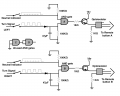
With the blinker blinking (assume right blinker) AND with the brake pedal pushed, two inputs to a 2 IN AND GATE will drive the Optoisolator. The capacitor will charge rapidly through the diode and hold the input to the second leg of the AND gate high long enough for the next blinker pulse to recharge it. When the brake pedal is released it won't matter what state the other input is - the AND gate output will go low.

During the time the output is high an optoisolator is driven to switch the garage door remote on. Since this is a Quad 2 Input AND gate, there's more than enough gates left over to connect to the other blinker. Brake and Horn could trigger a third function if so desired - and there's still a left-over gate. Just be sure to ground the inputs of all unused gates.

The two resistors hold the inputs to the AND gate low, and the 1 meg also drains the capacitor slowly and brings the input to ground. The diode prevents the capacitor from trying to back feed the turn lamps.

[edit]
I'm thinking this can be completely contained within the tail light assembly. All the signals are present there and if the remote is small enough then it may all fit in nicely. Just be sure not to interfere with the bulb or the reflectors.

[edit #2]
I probably should state that the AND gate is a CMOS type. TTL would require additional resistance on the inputs. ALSO, consider that every time you approach an intersection where you plan on turning, stepping on the brake as you approach with your blinker on - you're transmitting. Battery life in the remote will be short lived.

Perhaps you can use the "Neutral" indicator instead of the brake light. Times where you'll be in neutral with the blinkers on will be much less frequent.
 

Attachments

Last edited:

EM Fields

Joined Jun 8, 2016
583
OR they're taking a ride on the Nevada Northern Railroad in Ely Nevada. I did that. Was away for a few days.

Anyway, if this were my project I think - after having asked for advice - I'd approach it this way:

With the blinker blinking (assume right blinker) AND with the brake pedal pushed, two inputs to a 2 IN AND GATE will drive the Optoisolator. The capacitor will charge rapidly through the diode and hold the input to the second leg of the AND gate high long enough for the next blinker pulse to recharge it. When the brake pedal is released it won't matter what state the other input is - the AND gate output will go low.


During the time the output is high an optoisolator is driven to switch the garage door remote on. Since this is a Quad 2 Input AND gate, there's more than enough gates left over to connect to the other blinker. Brake and Horn could trigger a third function if so desired - and there's still a left-over gate. Just be sure to ground the inputs of all unused gates.

The two resistors hold the inputs to the AND gate low, and the 1 meg also drains the capacitor slowly and brings the input to ground. The diode prevents the capacitor from trying to back feed the turn lamps.

[edit]
I'm thinking this can be completely contained within the tail light assembly. All the signals are present there and if the remote is small enough then it may all fit in nicely. Just be sure not to interfere with the bulb or the reflectors.

[edit #2]
I probably should state that the AND gate is a CMOS type. TTL would require additional resistance on the inputs. ALSO, consider that every time you approach an intersection where you plan on turning, stepping on the brake as you approach with your blinker on - you're transmitting. Battery life in the remote will be short lived.

Perhaps you can use the "Neutral" indicator instead of the brake light. Times where you'll be in neutral with the blinkers on will be much less frequent.
OR they're taking a ride on the Nevada Northern Railroad in Ely Nevada. I did that. Was away for a few days.

Anyway, if this were my project I think - after having asked for advice - I'd approach it this way:

With the blinker blinking (assume right blinker) AND with the brake pedal pushed, two inputs to a 2 IN AND GATE will drive the Optoisolator. The capacitor will charge rapidly through the diode and hold the input to the second leg of the AND gate high long enough for the next blinker pulse to recharge it. When the brake pedal is released it won't matter what state the other input is - the AND gate output will go low.

During the time the output is high an optoisolator is driven to switch the garage door remote on. Since this is a Quad 2 Input AND gate, there's more than enough gates left over to connect to the other blinker. Brake and Horn could trigger a third function if so desired - and there's still a left-over gate. Just be sure to ground the inputs of all unused gates.

The two resistors hold the inputs to the AND gate low, and the 1 meg also drains the capacitor slowly and brings the input to ground. The diode prevents the capacitor from trying to back feed the turn lamps.

[edit]
I'm thinking this can be completely contained within the tail light assembly. All the signals are present there and if the remote is small enough then it may all fit in nicely. Just be sure not to interfere with the bulb or the reflectors.

[edit #2]
I probably should state that the AND gate is a CMOS type. TTL would require additional resistance on the inputs. ALSO, consider that every time you approach an intersection where you plan on turning, stepping on the brake as you approach with your blinker on - you're transmitting. Battery life in the remote will be short lived.

Perhaps you can use the "Neutral" indicator instead of the brake light. Times where you'll be in neutral with the blinkers on will be much less frequent.
1. 47mF is 47000μF which, in parallel with 1 megohm, will lead to a very long discharge time; something like
13 hours.
2. You can't use TTL on a 12 volt system because its Vcc is 5 volts; 7.5 volts max.
3. You can't use 74HC or 74HCT CMOS because their Vcc is also 5V
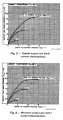
4. You might get by with a CD4081 ( a CD4000 family quad 2-input AND) if it can put out enough current to
drive your opto. See the attached graphic.
CD4081 output current.png
 

Tonyr1084

Joined Sep 24, 2015
9,744
47mF is 47000μF which, in parallel with 1 megohm, will lead to a very long discharge time; something like
13 hours.
The math. I always screw up on the math. Especially when it comes to order of magnitude (mF vs µF) (BTW, on my keyboard "Option M" = µ) But this is why I told my kids to pay attention to numbers. They don't lie.

The target hold time should be on order of 5 to 10 seconds. Certainly not 13 hours.
 

Tonyr1084

Joined Sep 24, 2015
9,744
Thought I'd come back to this issue of 47 something farads. Using a 47µf capacitor and a 100KΩ resistor and GUESSING at the blink rate of your bike (guessing about "ON" once every 900 milliseconds with a 50% duty cycle), from the time the blinker goes off to the next time it's on the voltage across the capacitor should drop just about one volt. That's assuming a voltage of 14 volts to start off with. Type of capacitor will change the factor a bit as well, but it should take about 12 seconds for the cap to drop below 1 volt. That should be well long enough to get you through the blink rate while having a decent decay rate. Certainly not 13 hours.

And all this is assuming a bunch of factors. It''s probable your light bulbs will affect the rate as well. And if the AND gate doesn't have enough current to drive the optoisolator then use a 2n2222 transistor or a 2n3904 (both NPN types). Just be sure to use a resistor to limit the current on the base.
 

Attachments

Thread Starter

CNR

Joined Jun 30, 2016
7
Sorry for disappearing, but was away for over a week. Pissing contests dont scare me off - I've seen them before.

Got a bit of reading & research to do to see what I can come up with.

Thx for the input everyone.
 

Tonyr1084

Joined Sep 24, 2015
9,744
Who's making wee wee? EM & I? I don't think we are. He's right on all accounts. My first set of numbers (47 mfd & 1 megΩ) DOES result in an extremely long decay rate. 47µF & 100KΩ results in about 12 second decay rate to fall below 1 volt. And CMOS should be used (as EM points out). I believe CMOS can drive a 2N2222 NPN transistor, which can easily drive an optoisolator - should you choose that route. However, before you take my word for it - consult the spec sheets for all components. Make certain they can handle the current required and can deliver said current needs. I'll leave the engineering up to you. It's better that way - my math - y'know.
 
Top