Facebook
 Google
 GitHub
 Linkedin

What are calculations and criteria involved in an RC snubber used in back-to-back mosfets for switching AC?
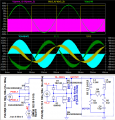
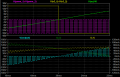
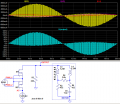
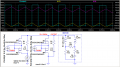
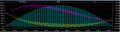
I know that without it, the amount of noise becomes horrible, not to mention the immediate damage to the fets themselves. On the right, there's a sim (using realistic data from a split-capacitor 120VAC motor that I'm currently using in one of my machines) of the circuit without the snubber. And on the left, there's the same sim, using a snubber with R=51 ohms, and C=4.7 nF
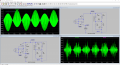
Funny enough, before I was able to more or less understand the noise issue involved in this application, what I did was just place a 180V bi-directional TVS diode across the mosfets, to inhibit the noise the best I could. But the machine was still producing a considerable amount of noise, and it wasn't until I looked at this simulation that I realized that what was happening was that the noisy waveform was only being clipped at ±180V by the TVS, but that the noise itself was never going to go away.
It wasn't until I added the RC (in parallel with the TVS, I saw no reason to remove that level of protection, just in case) that the noise subdued significantly. And LTspice has made it a lot easier for me to understand why.
So I reasoned, "gee, if I use a much larger capacitor for the snubber then lots more noise will be inhibited, right?" ... and yes, I was right ... but the large cap allowed for so much current to flow through the arrangement that the motor started spinning without the fets being active!
So here's my question, what's the math involved in calculating the best values for both R and C, depending on PWM frequency, voltage source, and motor size?
I know that without it, the amount of noise becomes horrible, not to mention the immediate damage to the fets themselves. On the right, there's a sim (using realistic data from a split-capacitor 120VAC motor that I'm currently using in one of my machines) of the circuit without the snubber. And on the left, there's the same sim, using a snubber with R=51 ohms, and C=4.7 nF
Funny enough, before I was able to more or less understand the noise issue involved in this application, what I did was just place a 180V bi-directional TVS diode across the mosfets, to inhibit the noise the best I could. But the machine was still producing a considerable amount of noise, and it wasn't until I looked at this simulation that I realized that what was happening was that the noisy waveform was only being clipped at ±180V by the TVS, but that the noise itself was never going to go away.
It wasn't until I added the RC (in parallel with the TVS, I saw no reason to remove that level of protection, just in case) that the noise subdued significantly. And LTspice has made it a lot easier for me to understand why.
So I reasoned, "gee, if I use a much larger capacitor for the snubber then lots more noise will be inhibited, right?" ... and yes, I was right ... but the large cap allowed for so much current to flow through the arrangement that the motor started spinning without the fets being active!
So here's my question, what's the math involved in calculating the best values for both R and C, depending on PWM frequency, voltage source, and motor size?


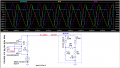

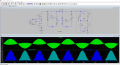
 ) shorts the motor to ground right after the mosfet pair in charge of generating PWM switches off. My question would be, for how long should that mosfet pair short the motor to ground? For as long as the PWM pair is switched off? ... or just for a brief moment while the kickback spike dissipates?