Calculating odd Resistor values (Beginner)

MrChips

Joined Oct 2, 2009
34,824
I did buy some 51.1 @ 0.1% the other day
Nice.
I need some 50Ω resistors for cable termination.
I can't seem to find 50Ω readily. Should I use 51.1 @ 0.1% ?
What value resistor do I need in parallel to make it 50Ω?

(I know the answer so don't bother to respond. See my post #20.)
 

Wolframore

Joined Jan 21, 2019
2,619
I‘m on a project where I’m measuring current and it needs to be precise and accurate so the ADC can do it’s job. I have multiple sources or errors and last thing I want to do is calibrate everything.
 

MrChips

Joined Oct 2, 2009
34,824
I‘m on a project where I’m measuring current and it needs to be precise and accurate so the ADC can do it’s job. I have multiple sources or errors and last thing I want to do is calibrate everything.
I agree. But define what precise and accurate means in quantitative units.
 

Wolframore

Joined Jan 21, 2019
2,619
I’ll have to work through it we keep changing our voltage when we run into issues... we started with a 20 ohm went to 40 and now it’s 51.1 to simplify the front end, we calibrate the front end for exactly 20 mA so it should be easy to calibrate the device in eeprom. In which case we are talking about 0.1% on that shunt and 2 LSB on a 10 bit ADC. Its very slow so I will put a cap on it and we’re looking at just over 20 uA resolution. Once the band gap reference is calibrated it’s pretty good, I don’t recall the exact numbers, without calibration its +/-10%. I was tempted to make it adjustable so I can skip the eeprom step with a multiturn trim.
 
Last edited:

MrChips

Joined Oct 2, 2009
34,824
The bottom line is, 10-bit ADC is good to 1 part in 1000, which is 0.1%.
2 LSB brings it up to 0.2%.

Using 0.1% burden resistor is good but you will need a conversion factor in your code in any case which requires some form of calibration. Hence, what is significant in your selection of a 51.1Ω resistor is the ±0.1% tolerance, not the 51.1Ω.
49.9Ω would have worked just as well.

In order to keep your accuracy to below 0.2% you will have to make sure that your circuit resistance is at least 500 times greater than 50Ω which works out to 25000Ω unless all you care about is absolute current value.
 

Wolframore

Joined Jan 21, 2019
2,619
Yes all I care about is absolute current and I went to 51.1 because of 1.1v band gap with +/-10% and I‘m pretty much at saturation at 20 mA. 49 was what I wanted but 51.1 was available and cost less. Thank you for your insight
 

MisterBill2

Joined Jan 23, 2018
27,563
At one place of employment we got anew lab tech who was, in my evaluation, a quite worthless piece of trash. But one of the first things that he did was to order a big stock of 0.1% resistors for prototyping some automotive electronic assemblies. Bragging about what he had ripped-off from his previous employer did not leave any with a good impression of the guy.
The reality is that if one's design needs values that close then it probably will have a terrible production yield. In the real world 3% deviation is close to the best you can get in a production run of a few thousand. THAT is why adjustment pots are made, so that things that must be precise can be adjusted to exact values. Certainly an adjustment that must be made in production adds to the cost of a product, but not as much as a poor production yield would.
 

Wolframore

Joined Jan 21, 2019
2,619
The precision trims cost more, I would actually prefer that option and was in my original design. This project is all out of my own pocket so I’m always looking to save money whether it’s on components or in manufacturing. I would rather calibrate than program EEPROM, this option cost less.

plus there is a trim on the front end to calibrate the max current.

so not sure about your lab tech, glad he’s not working for me.
 
Last edited:

MisterBill2

Joined Jan 23, 2018
27,563
Some trimmers are not very expensive, cheaper single-turn ones being under a dollar, single unit price.
That company, METHODE, had a huge staff reduction a few months later, and they seem to have changed direction. All of the other folks there were great people, except way to many MBA's in the top level. ALL of the R&D projects were cancelled and so who knows what they actually do now. I found another job the following week and never looked back.
 

Wolframore

Joined Jan 21, 2019
2,619
I breadboarded with single turns They will easily add 1% error even if you’re careful and even more so in production. Remember they only have about 3pi/2 rotation. I’ll see what I can find for multiturn. I will need to get 100 Ohm to get 50 after adjustment. It costs 300% more but could save an eeprom calibration and worth considering.

quick look at METHODE sounds like it used to be a good company with interesting product. Ive seen management ruin many great companies.
 
Last edited:

MisterBill2

Joined Jan 23, 2018
27,563
The solution is to design circuits and systems that stay withing specifications with 5% component variations. The better simulators can then do a "Monte-Carlo" analysis to determine the effects of component variations. Wider tolerances allow less expensive products.
 

MrChips

Joined Oct 2, 2009
34,824
Once I had to design and build data loggers to record temperatures and other parameters. I wanted to measure temperature without the need for calibration. I used a 1% thermistor and a 0.1μF capacitor. As precision capacitors were expensive and hard to find I ended up buying a large number of capacitors and sorting by value.

The only other time I might use precision resistors is if I need an op-amp amplifier with precise gain.

In another AAC thread we talked about input null offset adjustment of op-amps. You cannot do this with precision resistors. For this you need to use a trimpot.

Similarly, right now I need a window comparator that will accept signals (gamma-ray spectroscopy) falling within a certain range. Again, the solution is to use two 10-turn trim pots to set the low and high threshold voltages.
 

WBahn

Joined Mar 31, 2012
32,874
And yes, I don't know, why I would need a 10.02 Ohm resistor.
If you were to need a 10.02 Ω resistor, then that would mean that a 10.01 Ω or a 10.03 Ω resistor wouldn't suffice. In your original post, after you got to 10.07 Ω you continued because this wasn't good enough.

But if you are using 1% resistors, then just using a single 10 Ω resistor means that the actual resistance can be anywhere from 9.90 Ω to 10.10 Ω and be within spec.

What about your eventual solution of (10 Ω + 1 Ω) || 120 Ω || 1800 Ω ? What is the range of values that the combination could be if you are using 1% resistors?

The effective resistance could be anywhere between 9.92 Ω and 10.12 Ω and be in spec. So what have you accomplished?

In order to get a result that is accurate to the value you are looking for, you need to use individual resistors that are accurate to the level that you are looking for.

But obviously some people have a use for a 9.31 resistor... (E96 series :))
Not how it works. The E96 series (a.k.a., the 1% series) are a set of standard values such that any arbitrary value resistance you might want is within 1% of one of the standard values. The spacing between values is geometric, not arithmetic, so that results in the seemingly odd values.

One of the goals is to minimize the number of resistors in the series, since that minimizes the number of different values that need to be manufactured and stocked. That number is driven by the relation

I was just annoyed why all the calculators online are only doing 2 resistor calculations.
(including the http://jansson.us/resistors.html site.).
In the vast majority of cases, even combining two resistors to get a desired value is counter productive.
 

BobaMosfet

Joined Jul 1, 2009
2,211
There are plenty of resistor calculators on the in internet, but all I found stop short at 2 resistors.

While large resistor values can be assembled to a good tolerance relatively easy by adding values, small resistor values need to be designed by paralleling existing values.
And there is some pesky math there. (Yes, math and physics run the world).

It might be logical to many of the users in this forum, but for beginners it is sometimes hard to grasp how to get to a 10.02 Ω resistor for instance.

(All of this is of course based on the formula Rres= 1/(1/R1 + 1/R2 + 1/R3….), basically we are adding
smaller and smaller 1/R3, 1/R4 … until we get close enough to 1/Rres.)

Here is the procedure:

Start with the closest value you can get, in this case you might choose a 12 Ω resistor or
10 Ω + 1 Ω. (You can use one if the above mentioned internet calculators to get the best starting value).
Remember: You always need to start with a higher value than the desired value as paralleling resistor will always lower
the resulting value.

OK, here we go…

Let’s say we start with 11 Ω, we are almost 10% off the goal.

Take the inverse of the desired resistor 1/10.02 Ω = 0.099800…

{
Subtract the inverse of the currently used resistor (11 Ω) = 0.090909

0.099800 - 0.090909 = 0.008891308 invert it -> 112 Ω (omit the minus)
choose the next higher available value -> 120 Ω

Invert and add to the inverted first chosen resistor 1/120 + 0.090909 = 0.099242

Invert and we are at 10.07 Ω a 0.5% error.
{

Not good enough? Repeat:

Take the inverse of the desired resistor 1/10.02 = 0.099800
{
Subtract the inverse of the currently resistor (now 10.07 Ω) = 0.092242 from the
desired resistor again.

Result: - 0.0005579 invert it -> 1792 Ω choose the next higher value -> 1800 Ω

Invert add to the inverted first chosen resistor 1/1800 + 0.092242 = 0.099798

Invert and we are at 10.0202 Ω a 0.002% error.
}

Repeat until you are satisfied. BTW, when you are at the last step, you might want to try also the next LOWER available value. Sometimes instead of an error of + 0.002, you might get to – 0.001 for instance.


In this example we now have 4 resistors 10+1 in series, with 120 and 1800 in parallel,
not too bad for a mathematical 0.002% difference to the desired value.
Of course you still will have the tolerance of the resistors themselves, like 1%,
but that is he max – if you are lucky, some of the tolerances will cancel each other.

Last not least, if you do have a really good Ohm meter, you can measure the actual result after each step
and can use that as the input to the next iteration.


I am attaching an Excel sheet with the calculation in formulas, you only need to add values to column D.
For those who don’t trust Excel sheets, there is also a screenshot with the formulas used.

I hope this is useful for some.
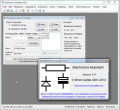
There are given formulas for doing this. If you don't wish to do that, then use an Application that can:

1607371123523.png

It supports as many as you can enter.
 

atferrari

Joined Jan 6, 2004
5,012
Similarly, right now I need a window comparator that will accept signals (gamma-ray spectroscopy) falling within a certain range. Again, the solution is to use two 10-turn trim pots to set the low and high threshold voltages.
Hola @MrChips

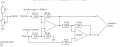
Wondering if next time, you couldn't use instead, the circuit below (adjustable span & window's center voltages). Used to avoid the windup effect in a PID controller.


Win + span adjustable comparator.png
 

Thread Starter

I0sens

Joined Jul 9, 2019
21
E3 values = 10, 22, 47
I did not even know this existed.
That was when the world was much easier and we had only two types of cereals to choose from....


THAT is why adjustment pots are made,

When I did my final thesis and design of a then super high speed 20 Mbit/s (guess my age) military grade fiber optic receiver my mentor told me that
everybody graduating with him automatically would get a 100% as the result (grade)... minus 5% for every adjustment pot/trimmer used.
 

Thread Starter

I0sens

Joined Jul 9, 2019
21
Not how it works. The E96 series (a.k.a., the 1% series) are a set of standard values such that any arbitrary value resistance you might want is within 1% of one of the standard values.

Does anybody know the reason, why this was made like this?
Reminds my of the seemingly arbitrating drill bit numbering.
 
Top