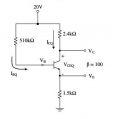
I have got this circuit, the problem is to find I BQ.
My work is: I Bq = (Vcc-Vb)/Rb=(20-0.7)V/510k= 0.038mA
But the answer is using the equation:
Ib=(Vcc−Vbe−Ie*Re)/Rb
Why is that?
The simpler result is just Ib= (Vcc-Vbe) / (Rb+β*Re) ... let β+1= β=100 since β is just an approximation with a 3:1 range in the datasheet. Now you may understand, since Ie*Re raises the emitter voltage and reduces the voltage across Rb. But if you replace the voltage Ie*Re with the input impedance β*Re, and assume Vbe 0.7V you can get the alternate KVL equation..
The trick is the input impedance to the base, we can ignore Rbe as small and just use β*Re.
Similarily, the output impedance of the emitter is Re || (Rb / β)
The simpler result is just Ib= (Vcc-Vbe) / (Rb+β*Re) ... let β+1= β=100 since β is just an approximation with a 3:1 range in the datasheet. Now you may understand, since Ie*Re raises the emitter voltage and reduces the voltage across Rb. But if you replace the voltage Ie*Re with the input impedance β*Re, and assume Vbe 0.7V you can get the alternate KVL equation..
The trick is the input impedance to the base, we can ignore Rbe as small and just use β*Re.
Similarily, the output impedance of the emitter is Re || (Rb / β)
View attachment 348406
I have got this circuit, the problem is to find I BQ.
My work is: I Bq = (Vcc-Vb)/Rb=(20-0.7)V/510k= 0.038mA
But the answer is using the equation:
Ib=(Vcc−Vbe−Ie*Re)/Rb
Why is that?
You are throwing the wrong values at equations because you don't understand either the values or the equations.
Once again, you are running into problems because you won't take a step back and learn the fundamentals, so you keep digging yourself a deeper and deeper hole.
If the TS doesn't grasp why Vb = Ie·Re + Vbe, then the only thing that telling them about replacing Re with ß·Re is likely to accomplish is to give them yet one more equation and/or rule to memorize that they don't grasp and, hence, will misapply it down the road, leaving them right where they are now as far as messing up the fundamentals and scratching their head wondering why it's wrong. It is just handing them a bigger shovel so that they can dig even deeper and faster.
You are throwing the wrong values at equations because you don't understand either the values or the equations.
Once again, you are running into problems because you won't take a step back and learn the fundamentals, so you keep digging yourself a deeper and deeper hole.
I am learning fundamentals bro, this is a basic prob to practice, the values are correct, don't u see? lots of lengthy quotations and distractions from you bro.
I am learning fundamentals bro, this is a basic prob to practice, the values are correct, don't u see? lots of lengthy quotations and distractions from you bro.
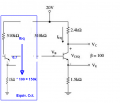
Why do you think that the voltage between base and GND is 0.7V?
Notice that in your circuit, you have a RE resistor, and the emitter current flows through this resistor (1.5kohm).
And this means the Ve voltage will be Ie*RE higher than GND (0V). And the voltage at the base will be 0.7V higher than Ve.
And this is why we can write the KVL loop: Vcc - Ib*Rb - Vbe - Ie*RE = 0
Additionally, we know that Ie = Ib/(β + 1) ( Ie = Ib + Ic = Ib + Ib*β = Ib*(β + 1) )

 Facebook
 Google
 GitHub
 Linkedin






 Calculate it.