Facebook
 Google
 GitHub
 Linkedin
Hello!
I'm a chemistry grad student working on a photochemistry project for which I need to get a cadmium resonance lamp functioning as it has a spectral emission around 225 nm that would be useful for my reaction. The lamp (16W Philips 93107E) was originally packaged with a power supply, but the lamp I purchased from eBay did not come with one. I've tried tracking down the power supply online via its model number (Philips 59003BT/62), but I haven't found anything. I've also contacted Philips Lighting customer support but was bounced around for over an hour with no results.
Luckily, I found a document (which I've attached) that goes over the technical aspects of the lamp and power supply. Here is an excerpt from the document (p.2):
Here is a figure showing the circuit diagram:
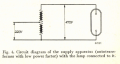
The lamp is stated as running at 25 W (p.3, Fig. 6, entry 3).
I have talked to our school's electronics shop and they said they would be able to figure something out, but gave me a quote of "probably less than a grand." Right now our lab doesn't have the resources to fund such an undertaking, especially because this is a bit of a side project. Would anyone be willing to help me figure out how to get this lamp running? Is there a modern product that would work as a power supply? If not, how difficult would it be for a novice to build a such a device? The lamp we have is an antique, so I would like to be as cautious with it as possible. The opening line in the above quotation states that the lamp could be run off 220 V with proper current limitation (0.9 A I'm assuming?), but it seems it would need to be pre-heated. This seems a bit risky to me.
If there is any more info that would be helpful, I'd be happy to provide it.
Thanks so much for your help!
Evan
I'm a chemistry grad student working on a photochemistry project for which I need to get a cadmium resonance lamp functioning as it has a spectral emission around 225 nm that would be useful for my reaction. The lamp (16W Philips 93107E) was originally packaged with a power supply, but the lamp I purchased from eBay did not come with one. I've tried tracking down the power supply online via its model number (Philips 59003BT/62), but I haven't found anything. I've also contacted Philips Lighting customer support but was bounced around for over an hour with no results.
Luckily, I found a document (which I've attached) that goes over the technical aspects of the lamp and power supply. Here is an excerpt from the document (p.2):
"Although some of these lamps could be connected to a 220 V A.C. supply,
with of course suitable current limitation, for easy ignition it is better to supply
them with a higher voltage. A transformer having an open voltage of 470 V
at a primary voltage of 220 V is therefore supplied together with the lamp.
The transformer is an autotransformer of the low power factor type. This
means that provision is made for a considerable spread of the lines of force,
which has the same effect as if a choke were connected in series with a
normal transformer. The current is thereby automatically limited. Consequently
the working current is practically equal to the short-circuit current, which
amounts to about 0.9 A. Thanks to the high open voltage the tube ignites
without the oxide-coated cathodes having to be pre-heated."
with of course suitable current limitation, for easy ignition it is better to supply
them with a higher voltage. A transformer having an open voltage of 470 V
at a primary voltage of 220 V is therefore supplied together with the lamp.
The transformer is an autotransformer of the low power factor type. This
means that provision is made for a considerable spread of the lines of force,
which has the same effect as if a choke were connected in series with a
normal transformer. The current is thereby automatically limited. Consequently
the working current is practically equal to the short-circuit current, which
amounts to about 0.9 A. Thanks to the high open voltage the tube ignites
without the oxide-coated cathodes having to be pre-heated."
I have talked to our school's electronics shop and they said they would be able to figure something out, but gave me a quote of "probably less than a grand." Right now our lab doesn't have the resources to fund such an undertaking, especially because this is a bit of a side project. Would anyone be willing to help me figure out how to get this lamp running? Is there a modern product that would work as a power supply? If not, how difficult would it be for a novice to build a such a device? The lamp we have is an antique, so I would like to be as cautious with it as possible. The opening line in the above quotation states that the lamp could be run off 220 V with proper current limitation (0.9 A I'm assuming?), but it seems it would need to be pre-heated. This seems a bit risky to me.
If there is any more info that would be helpful, I'd be happy to provide it.
Thanks so much for your help!
Evan
Attachments
-
2 MB Views: 6