Buzzer to a clock pulse

Thread Starter

q12x

Joined Sep 25, 2015
2,227
I want to attach a buzzer to a variable (fast/slow) clock pulse that is feeding a 4017 counter IC. The buzzer must beep only on the rising pulse of the clock. Why? Because 2 very important reasons.
1- must beep for a certain duration of time (a short beep like 1/2(half) a sec) when the pulse is slow and very slow.
2- must beep in the same rithm with a fast and very fast pulse. When the fv is very fast the beep will appear continuous.
- Is this even possible to make?
I have some parts of the cct so far, but not a solution yet:
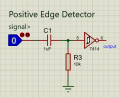
1717112394501.png
I believe C1 and R3 will dictate how fast will detect the rising pos pulse. So in theory, the smaller C1R3 values, the faster will respond to a very fast fv.
So this will solve #2 problem. In theory and how I see it. I never test it.
Thanks.
 

MisterBill2

Joined Jan 23, 2018
27,522
To trigger a "buzzer" for a short burst on the rising edge of a pulse, the obvious scheme would be to use an edge triggered pulse generator such as a CD4528 or CD4538. These devices are also known as "one-shots" or even "multivibrators", a rather old term. They both have trigger inputs to trigger on either a rising edge or a falling edge.
 

Thread Starter

q12x

Joined Sep 25, 2015
2,227
To trigger a "buzzer" for a short burst on the rising edge of a pulse, the obvious scheme would be to use an edge triggered pulse generator such as a CD4528 or CD4538. These devices are also known as "one-shots" or even "multivibrators", a rather old term. They both have trigger inputs to trigger on either a rising edge or a falling edge.
I dont have those ICs you mention, so we must make something from discrete components.
 

Thread Starter

q12x

Joined Sep 25, 2015
2,227
I find the solution. It is working with my cct with no problems. I was worrying too much. But I made the test and is fine.
Thats it.
 

Thread Starter

q12x

Joined Sep 25, 2015
2,227
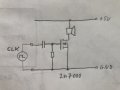
You can do it with just mosfet:
interesting, so a (specific) 2n7000 mosfet instead of a schmitt NOT gate? Ill have to test it. Thanks.
What I have in my arsenal:
2N7000 TO-92 TH N-Ch
2N7002 SOT-23 SMD N-Ch
AO3400 SOT-23 SMD N-Ch mark (A09T)
AO3401 SOT-23 SMD P-Ch mark (A19T)
I know from experience that 2N7002 are extremely sensitive to ESD and will get destroyed very quickly if normally fingered without a constant connection to ground. If I remember right, is the same for 2N7000 and I think is the same transistor but in different packages with different names.
Its very tricky to work with these types of trransistors ! But for the sake of the experiment, I will try it, off course, strapped to ground for tr protection.
-I mentioned the other 2 mosfets, 1-because is all I got as SMDs and 2-as alternative mosfets, that are more resilient to ESD and can be safely normally fingered. But im not sure I will get the same effect as with your mentioned 2N700x.
By the way, I was thinking on this for a long time, I believe, to successfully destroy a 2N700x mosfet by ESD you actually need 2 points of contact, not 1. For example, if you touch only the Gate, the tr should survive. But if making contact between Gate and Source (or Drain), then its a sharp spike flow of electrons through the transistor and thus burning the Gate. Between 2 potential points. But im not completly sure, because from my experiments, I think I managed to destroy only from touching the Gate alone. I think the Source (or Drain) was making contact with the --surface-- it was standing and that surface in itself was a diferent potential and practically, the ESD surges from my charged finger surface through Gate, then Source, then the sourface.
Im keeping away from these tr's, despite having quite a lot of them.
 
Last edited:

eetech00

Joined Jun 8, 2013
4,705
interesting, so a (specific) 2n7000 mosfet instead of a schmitt NOT gate? Ill have to test it. Thanks.
What I have in my arsenal:
2N7000 TO-92 TH N-Ch
2N7002 SOT-23 SMD N-Ch
AO3400 SOT-23 SMD N-Ch mark (A09T)
AO3401 SOT-23 SMD P-Ch mark (A19T)
I know from experience that 2N7002 are extremely sensitive to ESD and will get destroyed very quickly if normally fingered without a constant connection to ground. If I remember right, is the same for 2N7000 and I think is the same transistor but in different packages with different names.
Its very tricky to work with these types of trransistors ! But for the sake of the experiment, I will try it, off course, strapped to ground for tr protection.
-I mentioned the other 2 mosfets, 1-because is all I got as SMDs and 2-as alternative mosfets, that are more resilient to ESD and can be safely normally fingered. But im not sure I will get the same effect as with your mentioned 2N700x.
By the way, I was thinking on this for a long time, I believe, to successfully destroy a 2N700x mosfet by ESD you actually need 2 points of contact, not 1. For example, if you touch only the Gate, the tr should survive. But if making contact between Gate and Source (or Drain), then its a sharp spike flow of electrons through the transistor and thus burning the Gate. Between 2 potential points. But im not completly sure, because from my experiments, I think I managed to destroy only from touching the Gate alone. I think the Source (or Drain) was making contact with the --surface-- it was standing and that surface in itself was a diferent potential and practically, the ESD surges from my charged finger surface through Gate, then Source, then the sourface.
Im keeping away from these tr's, despite having quite a lot of them.
The RC/mosfet approach is sensitive to the mosfet turn on voltage. So different mosfets, even some of the same type, can result it different time duration. Using an inverter or digital approach is better since the trigger voltage is generally constant as long as the supply is constant.
 

Thread Starter

q12x

Joined Sep 25, 2015
2,227
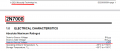
The RC/mosfet approach is sensitive to the mosfet turn on voltage.
I just looked into datasheet...
by turn on you mean: Gate-to-Source Voltage ±30V
right?
Turn-On is only mentioned as a time parameter of 10 ns
---
The supply is a constant +5V 0V.
Thanks for the clarification about the turn on detail - very interesting.
 
Last edited:

eetech00

Joined Jun 8, 2013
4,705
I just looked into datasheet...
by turn on you mean: Gate-to-Source Voltage ±30V
right?
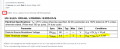
No. VGS(th). This is a section from a Microchip 2N7000 datasheet:

1717188661031.png

VGS(th) is the voltage that the mosfet requires to turn on. It can require as little as 0.8v or as much as 3v to turn on.
This is a manufacturing variance, so it might not be the same from device to device.
 

Thread Starter

q12x

Joined Sep 25, 2015
2,227
Im not that versed into mosfets, I know some basics but Im not very far or comfortable with them.
Whats the difference between (your)Gate Threshold Voltage and (my)Gate-to-Source Voltage ?
1717189627016.png

No? What then? Because I cannot find it in the datasheet as a voltage, only as a time parameter.
1717189691587.png
 

eetech00

Joined Jun 8, 2013
4,705
Im not that versed into mosfets, I know some basics but Im not very far or comfortable with them.
Whats the difference between (your)Gate Threshold Voltage and (my)Gate-to-Source Voltage ?
Your Gate-to-Source Voltage is a range, it is not a threshold voltage.
Your Gate-to-Source Voltage represents the maximum voltages that can be applied between the gate and source before damage can occur.

No? What then? Because I cannot find it in the datasheet as a voltage, only as a time parameter.
:confused:
I have no idea what you are referring to.

I have posted the parameter from the 2N7000 datasheet showing you the specification for VGS(th).
I think you need to learn how to read datasheets and what the parameters mean.
 

AnalogKid

Joined Aug 1, 2013
12,130
11 posts, and we still have no specific information about the input frequency. Independent of pulse width, what are the minimum and maximum input frequencies the circuit must respond to? It is hard to design a timing circuit if you don't know the time.

ak
 

crutschow

Joined Mar 14, 2008
38,507
Whats the difference between (your)Gate Threshold Voltage and (my)Gate-to-Source Voltage ?
Note the different titles of the two sections:

The first is the not-to-exceed voltage before damage occurs to the gate oxide.

The second is the voltage for it to just start turning on (1mA).
 

AnalogKid

Joined Aug 1, 2013
12,130
A characteristic of the circuit in post #5 is that the beeper will turn on crisply, but the turn-off will be slower, trailing off into silence. The Schmitt trigger gate in post #1 solved this.

Also, for both #1 and #5, the capacitor voltage does not reset at the end of each cycle. Depending on the timing, it can accumulate charge from one cycle to the next. This affects how long the beeper is enabled. Adding a small signal diode (1N914, 1N4148, etc.) in parallel with the pull-down resistor (reference designators - !!) can reduce this condition.

ak
 

Thread Starter

q12x

Joined Sep 25, 2015
2,227
11 posts, and we still have no specific information about the input frequency. Independent of pulse width, what are the minimum and maximum input frequencies the circuit must respond to? It is hard to design a timing circuit if you don't know the time.
Well, is very small fv. Min is how rare I press a button so a couple of h,min or sec. Usually seconds. And the fastest is at probably 50Hz or so, I didnt measure it, it comes from an internal osc of the cct that is pulsing the clock of the 4017, which is variable in speed from a POT. Usually this clock will be at around 10Hz or so, to visibly show some leds running on my 4017 outputs.
It is really nothing fancy. Haha.
 

AnalogKid

Joined Aug 1, 2013
12,130
If the buzzer-on period is 0.5 s (as in post #1), then for any input frequency above 2 Hz, the buzzer will be on continuously. Is this what you want?

ak
 

Thread Starter

q12x

Joined Sep 25, 2015
2,227
Well, like I said already, this cct works OK with my 7414, and the problem is solved already.
And for faster fv, you would expect to sound continuous, but its actually a very fast chirping. The osc I made there, its values in it, dont go too high in fv, I specifically made it to run slow.I measured --just for you-- the max fv and I got 88Hz. The cct is quite logarithmic, in the sense that it has a very small area, like 10% where is getting fast to max speed, while the rest of 90% the POT travel is slow to very slow. Like 10Hz slow. This cct will actually receive external clock pulses so it can be anything. But for internal purposes these are the values I described already.
The mosfet version, is a novelty for me. I will test it soon to see if its truly working.
 
Top