Butterworth Filter Order Help

Thread Starter

Oschmid

Joined Oct 26, 2014
7
Hello,
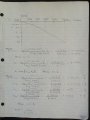
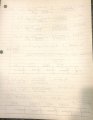
I am having trouble finding the order for this Butterworth filter when there is a range of the bandpass and stop band values. I tried to apply the formulas for what to do when there is only one bandpass and one stop band frequency and take the maximum value of this but I am unsure of whether or not this is right.
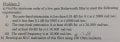
problem2_Oschmid.jpg

problem2_calc_Oschmid.jpg
 
Last edited by a moderator:

Papabravo

Joined Feb 24, 2006
22,082
You consider each requirement separately. In order to establish the filter order all you need to do is find the one condition which is most stringent. All of the other conditions will be satisfied by a higher order filter. You are definitely on the right track, just keep going until you find a filter order that will satisfy all conditions. Remember these are inequalities, and not conditions which must be simultaneously equal at the given points. In fact it is generally not possible to satisfy an equality condition for both the passband and the stopband.

Recheck the formula you are using relating filter order to attenuation, not gain or response.

Clue: An RLC realization for part (b) suggests that the order might be at least 2 instead of 1, especially since an order 1 filter is not very interesting.
 
Last edited:

Papabravo

Joined Feb 24, 2006
22,082
Your substitutions and the formula you are using are wrong, and you need to be careful of your signs.

For ω = 3,000 rad per second

n ≥ log (10^(.01/10) - 1) / 2*log(3,000/10,000) = log(10^(.001) - 1) / 2*(log(3000) - log(10,000)) = log(1.00230 - 1) / 2*(3.477 - 4) = -2.637 /-1.046 = 2.52
This implies for this condition we need order 3

Note also that
log(3000) - log(10,000) ≠ log(3000 - 10000)

Check:
For n = 3
0.01 ≥ 10*log(1 + (3000/10000)^6) = 10*log(1.000729) = .00316 ⇒ Inequality is True
For n = 2
0.01 ≥ 10*log(1 + (3000/10000)^4) = 10*log(1.0081) = .035 ⇒Inequality is False
 
Last edited:

t_n_k

Joined Mar 6, 2009
5,455
There needs to be a 20 dB increase in attenuation moving from 20 to 30 krads/sec (-40dB @ 20krads/sec to -60dB @ 30krads/sec)
This indicates to me that one needs at least a 6th (& probably higher) order Butterworth LPF.
Have I missed something obvious?
 
Last edited:

Papabravo

Joined Feb 24, 2006
22,082
@t_n_k
No you have not. Reread post #2. In it I said you consider each requirement separately. Normally a filter specification might have only one passband and one stopband condition. This one has four conditions. You need to evaluate all four conditions and satisfy all four inequalities. I have done that and it tuns out your guess was close. Well closer than 1 which the TS found as the required order. I'm sure you can work out the details, but I want to see if the TS can do the same.

P.S. I hope you didn't find a silly arithmetic mistake in my solution for the first condition. That would be ... well embarassing, but I can live with that.

P.P.S I give the TS extra points for showing her work. She had mistakes, but it was clear she had made a considerable effort. Bravo!
 
Last edited:

Papabravo

Joined Feb 24, 2006
22,082
The second condition, A ≤ 0.1 dB, for 3000 rad./sec. ≤ ω ≤ 6000 rad./sec. requires a 4th order Butterworth filter.
 

t_n_k

Joined Mar 6, 2009
5,455
I would make a further contribution but it appears the TS has found assistance elsewhere or solved the problem.
 

t_n_k

Joined Mar 6, 2009
5,455
Yep - that's what I concluded.
Interesting constraint regarding the realization in part (b). Presumably the implementation involves active circuits.
 

Papabravo

Joined Feb 24, 2006
22,082
It would have to be an active filter to compensate for the 6 dB insertion loss of a passive 7th order LC filter.
BTW 10,000 rad./sec. = 1591 Hz. So no problem using something just a cut above the now obsolete 741
 

Thread Starter

Oschmid

Joined Oct 26, 2014
7
Sorry about the delay in posting, I was not expecting such a prompt response. Thank you everyone for your help! What is the name of this equation? I want to consult with my professor about this during the week.
 

Tesla23

Joined May 10, 2009
560
It's a poorly worded question. If you are driving it from a voltage source then there is 6dB loss, but from a 100 ohm source, there filter is lossless
 

Papabravo

Joined Feb 24, 2006
22,082
The Attenuation function starts with the reciprocal of the transfer function. With a bit of algebra you can solve for n, the required filter order, as a function of the required attenuation, the corner frequency, and the band limits.

Just keep in mind that with real filters you will have to worry about source impedance and load impedance. This is especially true if you use a SPICE package to simulate the filter. When I did it for the first time it took me a second to realize the that the 6 dB insertion loss was due to those impedances and not to the LC components in the filter.
 

Thread Starter

Oschmid

Joined Oct 26, 2014
7
The Attenuation function starts with the reciprocal of the transfer function. With a bit of algebra you can solve for n, the required filter order, as a function of the required attenuation, the corner frequency, and the band limits.

Just keep in mind that with real filters you will have to worry about source impedance and load impedance. This is especially true if you use a SPICE package to simulate the filter. When I did it for the first time it took me a second to realize the that the 6 dB insertion loss was due to those impedances and not to the LC components in the filter.
Thank you! I guess I need to find some additional resources to learn about filters out of the classroom. We don't use a textbook and when I googled Butterworth filters I was a little lost in finding relevant information. Do you have any recommendations?
 
Top