burst generator using a single 556 timer and no external transistor

Thread Starter

davidjohnhills

Joined Oct 8, 2017
69
Good Morning
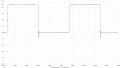
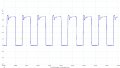
Can anyone recognise this issue with this trace below(not a nice flat top).
It's a 555 running at 150khz(normal astable config)
I've a 220uf across the supply and it's a proper TI NE555P
R1 is 1.6k
R2 is 120k
C1 is 22pf
plus some trimmers

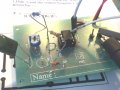
I have not trimmed back the component leads (might that be part of the problem)
probs on x10, so supply volatage 9 volts (bench power supply)

thanks
David
150khz_24.jpg

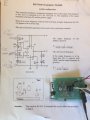
image1.jpegimage2.jpeg
 

Thread Starter

davidjohnhills

Joined Oct 8, 2017
69
hi David,
The top 'not flat top' of that 9V square wave is of no consequence, the IRF Gate will be driven OK.
E
Hi Eric
if I increase the supply voltage above 10.5 volts the whole thing resonates at 500+ khz
(I'll post the trace in a minute)
I think the abnormally on the top 9 volt square wave when it is raised to greater than 10.5volts is feeding back to the gate of the Mosfet .(It rings a lot)
I thought I should fix this now, what do you think?
I notice that your revised schematic with the 220uf cap does not have the UF4007 diode,, is that right?
the Transmit Period is 150 micro seconds.(thanks understand terminology now)
the pulse on time is 3 uSecs.(which I am going to reduce to 1.5uSecs and monitor drain)


thanks as always
David
 
Last edited:

ericgibbs

Joined Jan 29, 2010
21,448
hi David,
Your PCB assembly with long leads and 'stood off' components is liable to be the source of the 500kHz oscillation

The Cap and UF4007 are trial runs for the sim.

E

Update: I see the PCB was originally designed for 1Hz operation, so I suspect no consideration was given to PCB layout for a higher frequency operation.

image1.jpeg
 
Last edited:

Thread Starter

davidjohnhills

Joined Oct 8, 2017
69
hi David,
Your PCB assembly with long leads and 'stood off' components is liable to be the source of the 500kHz oscillation

The Cap and UF4007 are trial runs for the sim.

E

Update: I see the PCB was originally designed for 1Hz operation, so I suspect no consideration was given to PCB layout for a higher frequency operation.

View attachment 261631
Hi All
I thought the long leads and 'stood off' components might be a problem.
I'lltidy it up and reduce the freq, see when it goes away

thanks
David
 

Thread Starter

davidjohnhills

Joined Oct 8, 2017
69
Good Evening
I cleanup the board but it made no difference, tried a few different cap's on the supply, no good.

But
I switch from ne555 to TLC555CP and its clean, slight ring on the bottom of the falling edge.
its running at 184khz because i removed all the trimming.

might be a slight issue as TLC555CP can only sink 100ma
Is that enough to drive the IRF520 module?

will set it up to 150khz and continue my journey

thanks

Davidtlc555cp_24.jpg
 

ericgibbs

Joined Jan 29, 2010
21,448
hi David,
The TLC55% can Sink 100mA but only Source 10mA, which is the parameter of interest, as the IRF has Cgate of ~2000pF.

I will check it further, let you know.

E
High Output-Current Capability
Sink 100 mA Typ
Source 10 mA Typ


Updated:

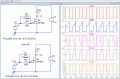
Based on a 2000pF Gate capacitance, and the TLC Iout max of 10mA, this sim shows that the TLC will not be suitable. The pulse rise time is too slow.

The 600R limits the Gate current input to ~10mA from the 10V input pulse.

EG 1431.gif
 
Last edited:

Thread Starter

davidjohnhills

Joined Oct 8, 2017
69
hi David,
The TLC55% can Sink 100mA but only Source 10mA, which is the parameter of interest, as the IRF has Cgate of ~2000pF.

I will check it further, let you know.

E
High Output-Current Capability
Sink 100 mA Typ
Source 10 mA Typ


Updated:

Based on a 2000pF Gate capacitance, and the TLC Iout max of 10mA, this sim shows that the TLC will not be suitable. The pulse rise time is too slow.

The 600R limits the Gate current input to ~10mA from the 10V input pulse.

View attachment 261723
Hi Eric
I have some ICM7555 that have 20ma source capacity, any better?
So the problem is that its taking to long for V(Vd) to switch from 13volts to Zero (about 2uSecs in your simulation)
What is an acceptable switch on time?
I will load the IRF with a 2 ohm resistor and scope it.
I don't have a 600ohm current limiting resistor in as R2, should I put one in(or can the 555 cope with shorted output?)

thnaks

David
 

ericgibbs

Joined Jan 29, 2010
21,448
hi David,
Try the ICM555 with a dummy 2R load, ensure the wattage rating of the resistor can cope with any heating effect.

Run and scope the Drain, post an image of the waveform.

The 600R in my last simulation was to deliberately 'slow' the rising edge of the Gate pulse charging the Gate's internal capacitance, in order to show the effect on the Drain current.
The 'ideal' diode conducts on the falling edge of the Gate pulse, the 600R is then effectively shorted out.

In some designs a 100R resistor is used, so in the event of the MOSFET developing a Drain/Gate short it does not take the 555 out.

E
 

Thread Starter

davidjohnhills

Joined Oct 8, 2017
69
Hi Eric
I'm using a IRF520 which appears to have input capacitance of 360pf(is that enough to make a difference)

I am looking for a replacement for the IRF520 in a TO-220AB any suggestions.
I am not trying to commercially build this , so I might as well get something that will give me some leeway
and spend a few quid!!

quick question why am I using 2ohm dummy load for the IRF520.
the input impedance of the primary is 94ohms(100microH at 150Khz)
Is it to stress test the IRF520/555 Timers or am I wrong about the input impedance of the transformer/circuit.

thanks all
David

IRF520
Dynamic Input capacitance
Ciss VGS = 0 V, VDS = 25 V, f = 1.0 MHz, see fig. 5 - 360 -pF
Output capacitance Coss - 150 - pF
Reverse transfer capacitance Crss - 34 -
 

ericgibbs

Joined Jan 29, 2010
21,448
hi David,
This sim shows the difference in the two MOSFETs, I would try the IRF520 in the circuit.

I chose 2R from seeing the actual current when the transformer is connected, of course the loading will be different when the transformer and transducer are connected.
E
EG 1469.gif
 

Thread Starter

davidjohnhills

Joined Oct 8, 2017
69
Hi Eric
I am now trying to build a dummy load to simulate the transducer
I have a 5 watts led working(5w approx = 25(voltage across led =+-12.5v) x 0.2amps R= 15/0.2 = 75ohms for R4)
(I am guessing that the led is only resistance)

is L3 32.1 mill henries?

I have now got a supply 40khz transducers, I don't have any spec for them.
will I need a new/rewind the auto transformer with 120/40 turns?


thanks
David


1647587810460.png
 

ericgibbs

Joined Jan 29, 2010
21,448
Hi David,
Why are you building a dummy load when you have the 150kHz transducer on the bench.??

A 40kHz transducer will reduce the resolution by a factor of about 4 times compared to a 150kHz.
The 40kHz will penetrate the 'mud' layer and give a first echo edge off the 'marl' clay bottom, also not see fish.

The 150kHz should give a first echo edge from the mud surface and any decent sized fish.

What is the intended purpose of this echo sounder.?
E

Footnote:
Dredging companies use dual transducers, say 30kHz and 200kHz specifically designed to show the mud layer [ which is usually dredged to give vessel keel clearance] the 200kHz detects echoes from the mud surface and the 30kHz from the clay/hard sea bottom.
 

Thread Starter

davidjohnhills

Joined Oct 8, 2017
69
Hi David,
Why are you building a dummy load when you have the 150kHz transducer on the bench.??

A 40kHz transducer will reduce the resolution by a factor of about 4 times compared to a 150kHz.
The 40kHz will penetrate the 'mud' layer and give a first echo edge off the 'marl' clay bottom, also not see fish.

The 150kHz should give a first echo edge from the mud surface and any decent sized fish.

What is the intended purpose of this echo sounder.?
E

Footnote:
Dredging companies use dual transducers, say 30kHz and 200kHz specifically designed to show the mud layer [ which is usually dredged to give vessel keel clearance] the 200kHz detects echoes from the mud surface and the 30kHz from the clay/hard sea bottom.
Hi Eric

I am building the dummy load because I am concerned i will damage the the real transducer in testing.
the real device is for depth measuring up to 150 meters, hope fully with nmea output for open cpn.

I thought it might be easier doing some investigation using one transducer for transmit and another for receive
but because the 150khz transducers are £40 each I got some cheap 40khz ones to experiment with.

I made a mistake with the calculation of resistance of the dummy load(using Led) the power rating is 5w at 12 volts
so impedance is about 144/5 =31ohms (the fact i'm running the led at 25volts peak to peak(with small burst) won't change it impedance,so I'll need a couple in series)

you are reasonably confident the 150khz transducer is robust and I can't damage it , if so I'll go back to testing with it.

is L3 32.1 mill henries in your transducer simulation

thanks

David
 

ericgibbs

Joined Jan 29, 2010
21,448
Morning David,
L3 inductor is 32.1milliHenery

Post a sketch of your dummy transducer circuit, and then I can do some basic tests.

For a 75 mtr Depth limit, with a speed of sound in seawater of 1500mtr/sec, means a possible transmit interval of 0.1Sec. [10pps]
A 150mtr limit a 0.2Sec [5pps]

Sounders are often fitted with a Depth Range select switch.

E
 
Top