Facebook
 Google
 GitHub
 Linkedin
Hello everyone. First time here. Long post, but I try to give as much info as possible.
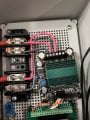
I am controlling a DC Brushed motor with a PWM Controller Board, which is connected to an ESP32. I have burned my second Controller. I know why the first one burned, but for the second one I just have guesses. I am very new to electronics, and I'd appreciate your input.
I read that when a DC motor slows down, it can act as a generator, and supply high current back to the system. I read several recommendations to wire a same-volt battery parallel to the power supply, but I am not sure if this is a good idea, or how to do it.
From one controller documentation I read:
From the above posts I understand this might be the cause of the burn, as I did not have anything to absorb the regenerated current (if there was any)
For my questions, which I have many, but I'll start with a few:
More background info:
The DC motor will run for one minute, twice a day.
The system needs to be connected to power 24/7 . It will be used only twice a day, but what time of the day it will be needed is not set.
The system is in a remote location, with no-one to monitor it. For any maintenance, I need to drive 6-7 hours to get to it.
When I start the motor, my code on the ESP32 gradually increases the PWM duty cycle from 0 to 98% over 500 milliseconds, and when I stop it, I gradually reduce the PWM duty cycle from 98% to 0% over 333 ms.
The PWM switching frequency is 15KHz, which is recommended for this controller.
The DC motor has a worm drive gear box, and it is pushing a 2000 lbs load which is on wheels. To give an idea of the force needed: If I disconnect the drive system, I can hardly push the load myself while standing on a ladder (it is high above ground), so I'd assume I am pushing at most with 50lbs if I'd put a scale.
When the controller burned, the heat sink wasn't even warm. It was a part not under the heat sink that burned.
The first controller burned because I set it to 100% PWM duty cycle, and the documentation mentioned not to exceed 98%. I'm dissapointed it did not have any protection against it, but anyway, I should have read the doc more carefully.
Thanks much,
-Ozer.
I am controlling a DC Brushed motor with a PWM Controller Board, which is connected to an ESP32. I have burned my second Controller. I know why the first one burned, but for the second one I just have guesses. I am very new to electronics, and I'd appreciate your input.
- The brushed DC Motor is rated 1.2 HP, 900W, 12V. There is no amperage rating, but I understand 900/12 = 75A
- The controller was rated 100A continuous.
- The controller is powered by an external 12V Switching Power Supply connected to wall power (120V)
- Just before the controller burned, I noticed the power supply shut down, and restarted, which suggests the overload protection in the PS kicked in.
I read that when a DC motor slows down, it can act as a generator, and supply high current back to the system. I read several recommendations to wire a same-volt battery parallel to the power supply, but I am not sure if this is a good idea, or how to do it.
From one controller documentation I read:
Also from another controller supplier, they show how to connect a battery in parallel with an ATX power supply hereIf a power supply that cannot sink current is being used (bench top and AC to DC switching power supply), the input voltage will rise when the driver is regenerating (motor is slowing down). Thus, it is important to connect a battery with same voltage in parallel with the power supply to absorb the current generated by the motor. Else, the input voltage might rise to a level where SmartDrive160 will be destroyed permanently.
From the above posts I understand this might be the cause of the burn, as I did not have anything to absorb the regenerated current (if there was any)
For my questions, which I have many, but I'll start with a few:
- Is this even a good idea to wire a battery in parallel to the power source?
- If so, what kind of battery should I use?
- Will the power source also charge the battery?
- When the controller/motor draws high amps, will that cause any problems with the battery?
More background info:
The DC motor will run for one minute, twice a day.
The system needs to be connected to power 24/7 . It will be used only twice a day, but what time of the day it will be needed is not set.
The system is in a remote location, with no-one to monitor it. For any maintenance, I need to drive 6-7 hours to get to it.
When I start the motor, my code on the ESP32 gradually increases the PWM duty cycle from 0 to 98% over 500 milliseconds, and when I stop it, I gradually reduce the PWM duty cycle from 98% to 0% over 333 ms.
The PWM switching frequency is 15KHz, which is recommended for this controller.
The DC motor has a worm drive gear box, and it is pushing a 2000 lbs load which is on wheels. To give an idea of the force needed: If I disconnect the drive system, I can hardly push the load myself while standing on a ladder (it is high above ground), so I'd assume I am pushing at most with 50lbs if I'd put a scale.
When the controller burned, the heat sink wasn't even warm. It was a part not under the heat sink that burned.
The first controller burned because I set it to 100% PWM duty cycle, and the documentation mentioned not to exceed 98%. I'm dissapointed it did not have any protection against it, but anyway, I should have read the doc more carefully.
Thanks much,
-Ozer.