Buck converter problem

Thread Starter

PsySc0rpi0n

Joined Mar 4, 2014
1,786
Hello once again.

I have a problem to solve about buck converters. This was an exam problem but my knowledge about this subject is very small.
I read the chapter about Buck converters from Ned Mohan book but most of it is about voltages and currents!

The info that was given is:
Vin = 80V
Pout=100W
f=150kHz
L=0.4mH

I was asked the following:
a) Draw the Buck schematic and plot I_L wave form. Evaluate I_L and Iout.
b) Evaluate the mathematical expression the gives you I_Lmax and I_Lmin.
c) Evaluate Rout for the border condition between CCM and DCM (Continuous Conduction Mode and Discontinuous Conduction Mode)

So, for the schematic this is what I have:
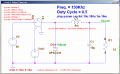
buck_schematic.png
Please ignore capacitor value because in exam problem we were told nothing about it. This was just to run the simulation.

Now about I_L and Iout (I'll use 'out' instead of 'Load' just to follow the exam words), exam didn't said anything about in which conditions to evaluate the inductor and ouput currents. I mean if in switch ON or in switch OFF mode.

So, for switch OFF mode, only D1, L1, C1 and R1 are considered and D1 is an ideal diode, so it's a short there.
This said, I can write:
V_L = VLoad

And from Mohan's book, and because we consider this an ideal circuit, Pin = Pout

But I can't find an expression for the inductor current that I can use with the information given by the problem!
How can I solve this?
 

Jony130

Joined Feb 17, 2009
5,598
For Ro = 18Ω and Pin = Pout = 100W we have Io = 100W/80V = 1.25A.
Hence the otput voltage is Vo = √(P*Ro) = 42.43V and the duty-cicle is D = Vo/Vin = 0.53

Ton = 1/F *D = 3.533μs
and Toff = 3.133μs.

Additional from

VL = L * dI/dt = L * ΔI/Δt

we can find ΔIL

ΔIL = VL/L *Δt = (80V - 42.43V)/400μH *3.533μs = 331.84mA

From this we can find IL_min and IL_max

IL_max = Io + ΔIL/2 = 2.52A
IL_min = Io - ΔIL/2 = 2.19A


And to be able to find Rout for the border condition between CCM and DCM you need to set IL_min = 0A and remember that Io is equal to the avrage inductor current.


https://www.allaboutcircuits.com/te...ysis-of-four-dc-dc-converters-in-equilibrium/
https://en.wikipedia.org/wiki/Buck_converter
 
Last edited:

Thread Starter

PsySc0rpi0n

Joined Mar 4, 2014
1,786
Hum, ok, I'll ask some questions about your reply in the next posts.

For Ro = 18Ω and Pin = Pout = 100W we have Io = 100W/80V = 1.25A.
I tried something similar, but I got not match to your math.

Po = Ro*Io² <=> Io = sqrt(Ro/Po) = 0.42A

Why I couldn't do this? Is it because Ro in this case would be an equivalent resistance seen from the output of the circuit and not simply Ro = 18Ω?
 

Thread Starter

PsySc0rpi0n

Joined Mar 4, 2014
1,786
Good catch. Yes, I'm stupid and wrongly assumed that Iin = Iout wich is not true.
Vo is Vo = √(P*Ro) = 42.43V
I'm sorry. I'm lost again.

Why Vo = \(\sqrt(P*Ro)\)?

Isn't
P = R*I² <=> I = \(\sqrt(P/R)\)
or
P=V*I <=> I = P/V <=> V = P/I

or am I missing something?
 

Jony130

Joined Feb 17, 2009
5,598
P = I*V and from the Ohm's law we have V = I*R

P = I*V = I*I*R = I^2*R now solve for I^2

I^2 = P/R ----> I = sqrt(P/R)


Or we I = V/R

P = I*V = V/R *V = V^2/R ---> solve for V^2

V^2 = P*R ---> V = sqrt(P*R)
 

Thread Starter

PsySc0rpi0n

Joined Mar 4, 2014
1,786
P = I*V and from the Ohm's law we have V = I*R

P = I*V = I*I*R = I^2*R now solve for I^2

I^2 = P/R ----> I = sqrt(P/R)


Or we I = V/R

P = I*V = V/R *V = V^2/R ---> solve for V^2

V^2 = P*R ---> V = sqrt(P*R)
Ok, so I think you mistyped Vo equation in your post #4, because you typed sqrt(P*Ro) and I think it should be sqrt(P/Ro), no?


So if I am correct about that mistyping:

Pi=Po=Ro*Io² <=> I = √(Po/Ro) = √(100/18) = 2.36A

Vo = Ro*Io = 18Ω*2.36A = 42.43V

D = Vo/Vi = 0.53

Edited;
Ok, I just read your post better, and I can't understand why we don't get the same Vo. I understood your equations, but what did I did wrong?
 
Last edited:

Thread Starter

PsySc0rpi0n

Joined Mar 4, 2014
1,786
Ok, I got it! I inverted a fraction in my post #3.

Going to fix above post and post correct values!

Well, you already did it all!

Anyway, the math we have been doing here is for when the switch is ON or when it is OFF?
 
Last edited:

Jony130

Joined Feb 17, 2009
5,598
Anyway, the math we have been doing here is for when the switch is ON or when it is OFF?
In steady state ( CCM mode ) this is always true
ΔIon = ΔIoff and Von * ton = Voff * toff
Where the Von, Voff represent the voltage across the inductor during ton/toff time.
 

Thread Starter

PsySc0rpi0n

Joined Mar 4, 2014
1,786
@Jony130 in the link you provided in post #2 where we can read about Buck analysis, here from AAC, when the max and min inductor currents are evaluated, those equations shouldn't be:

\(\Delta iL_{OFF} = -\frac{V_{o}}{L}\left ( 1-D \right )T\)

instead of

\(\Delta iL_{OFF} = -\frac{V_{o}}{L}\left ( 1-DT \right )\)

I mean, 'T' should be out of the parenthesis, no?


Edited;
Also, why, when Imax and Imin are being evaluated, right after Figure 6, it's written (Imax - Imin)SwitchON = ..... and then it's written (Imin - Imax)SwitchOFF=.... ??? I mean, why for SwitccOFF, they swapped Imin with Imax in the expression?
 
Last edited:

Jony130

Joined Feb 17, 2009
5,598
I mean, 'T' should be out of the parenthesis, no?
Yep. Toff time is (1-D)*T


Also, why, when Imax and Imin are being evaluated, right after Figure 6, it's written (Imax - Imin)SwitchON = ..... and then it's written (Imin - Imax)SwitchOFF=.... ??? I mean, why for SwitccOFF, they swapped Imin with Imax in the expression?
During Ton time the inductor current rises from Imin to Imax. The coil store the energy in this phase. And during Toff the coli current is dropping from Imax to Imin. The inductor release the stored energy into the load. And the circuit is in stedy state only when ΔIon = ΔIoff (CCM)

http://images.elektroda.net/9_1344534972.png
 

Thread Starter

PsySc0rpi0n

Joined Mar 4, 2014
1,786
Ok, so this is following something like "the last value minus the first value" right? I mean for Ton, Imax is last value and Imin is first value. Same for Toff, right?
 

Jony130

Joined Feb 17, 2009
5,598
Do not worry much about this because we are comparing the absolute value only.
ΔIon = ΔIoff


ΔIon = (Vin - Vo)/L * DT

ΔIoff = - Vo/L * (1 -D)T


(Vin - Vo)/L * DT = Vo/L * (1 -D)T ( absolute value only)

So if we solve this for Vo we will get

Vo = D*Vin
 

MrAl

Joined Jun 17, 2014
13,702
Hello once again.

I have a problem to solve about buck converters. This was an exam problem but my knowledge about this subject is very small.
I read the chapter about Buck converters from Ned Mohan book but most of it is about voltages and currents!
Hello there,

I might be missing something here but i just have to interject a quick question here...

Are you sure the output resistor R1 is really 18 ohms?
I ask because this would make more sense if it was 16 ohms.

No problem if it is really 18 ohms, but i just had to ask because for these problems we often assume ideal elements with Pin=Pout and when the duty cycle is a fractional 0.50 then the output voltage is exactly 1/2 of the input voltage, which means the output voltage would be 40 volts here and that would make R1=16 ohms to get 100 watts out.
 

Jony130

Joined Feb 17, 2009
5,598
There is nothing special about this Ro = 16Ω. Simply as point out by MrAl to get nice round numbers (D = 0.5 and Vo = 40V, Po = 100W) the load resistor needs to be equal to 16Ω instead of 18Ω.
 

MrAl

Joined Jun 17, 2014
13,702
There is nothing special about this Ro = 16Ω. Simply as point out by MrAl to get nice round numbers (D = 0.5 and Vo = 40V, Po = 100W) the load resistor needs to be equal to 16Ω instead of 18Ω.
Hi,

Well there is really though, because if we had the duty cycle shown which was 50 percent then for 100 watt output we'd need 16 ohms not 18.
But he has modified the duty cycle now so 18 could be acceptable.

It's like a puzzle, if one piece does not fit then we like to see what we are doing wrong.
Check it over and see what i was talking about.
 

MrAl

Joined Jun 17, 2014
13,702
Hello @MrAl ...

Yes, Ro = 18Ω. We found D = 0.53 so Vo = 0.53*Vin = 42.4V.

How do you find Po = 100W with Ro = 16Ω?

Hi,

Ok then maybe there is no problem, but the original problem stated 50 percent not 53 percent so it looked like something was wrong.
I get 42.43 to two decimal places and that matches yours good enough. And yes i get 53.03 percent duty cycle which is also close.

With a 50 percent duty cycle (as stated originally) then we would need 16 ohms to get 100 watts out because 40^2/16=100.
 

Thread Starter

PsySc0rpi0n

Joined Mar 4, 2014
1,786
@MrAl ok, I got where this went wrong! The LTSpice circuit I posted in post #1 was from a different context, and I forgot to change that Duty Cycle to the one we evaluated! My bad. I'm sorry for that! The problem didn't stated any Duty Cycle. We had to evaluate it!

Ok, now, the next problem is to add a fully controlled full wave rectifier to that circuit and evaluate some more parameters! I'll do this later today in a new thread!

Thanks
Psy
 

MrAl

Joined Jun 17, 2014
13,702
@MrAl ok, I got where this went wrong! The LTSpice circuit I posted in post #1 was from a different context, and I forgot to change that Duty Cycle to the one we evaluated! My bad. I'm sorry for that! The problem didn't stated any Duty Cycle. We had to evaluate it!

Ok, now, the next problem is to add a fully controlled full wave rectifier to that circuit and evaluate some more parameters! I'll do this later today in a new thread!

Thanks
Psy
Hi,

Ok sounds interesting. I'll try to keep an eye out for that new thread.
 
Top