Facebook
 Google
 GitHub
 Linkedin

Hey guys,
I'm getting very confused with formulas for this problem.
The single-phase ac grid rated at 240V, 50 Hz is feeding a diode full-bridge rectifier with a capacitor filter at its output. The capacitor then feeds power to a buck dc-dc converter. The ac supply voltage can vary in the range of -10% to +5% of its rated value. The dc-dc converter feeds power to a variable resistive load that draws power in the range of 100W to 5kW at 250V. The switching frequency of the converter has been selected as 10 kHz. Your task is to design the buck dc-dc converter so that it regulates the load voltage at 250 V with a maximum allowable peak-peak ripple factor of 2%, against any changes in ac supply voltage and load resistance. You may assume the rectifier output filter capacitor is large so that the voltage across it is ripple-free.
A picture I made to mack it easier to see

Questions
Calculate the:
i) Required range of duty ratio of the switching device
ii) Voltage and average current ratings of the switching device
iii) Voltage and average current ratings of the diode in the dc-dc converter
iv) minimum capacitance at the output of the dc-dc converter
v) minimum inductance at the output of the dc-dc converter needed to keep inductor current continuous under all operating conditions
What I have so far
(i)
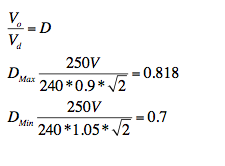
this is where i'm unsure about everything
(ii)
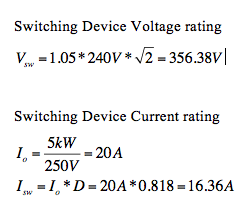
(iii)
Id = Isw
Vd = Vo/D = 250/0.7=357V
(iv)
for this I understand I need to calculate the critical inductance first, then work out the capacitance from there somehow
is this the correct way to calculate it?
Lcrit = [Vo * T * (1 - Dmin)] / (2 * Io)
= [250 * (1/10k) * (1-0.7)] / (2 * 20)
=0.187mH
I'm getting very confused with formulas for this problem.
The single-phase ac grid rated at 240V, 50 Hz is feeding a diode full-bridge rectifier with a capacitor filter at its output. The capacitor then feeds power to a buck dc-dc converter. The ac supply voltage can vary in the range of -10% to +5% of its rated value. The dc-dc converter feeds power to a variable resistive load that draws power in the range of 100W to 5kW at 250V. The switching frequency of the converter has been selected as 10 kHz. Your task is to design the buck dc-dc converter so that it regulates the load voltage at 250 V with a maximum allowable peak-peak ripple factor of 2%, against any changes in ac supply voltage and load resistance. You may assume the rectifier output filter capacitor is large so that the voltage across it is ripple-free.
A picture I made to mack it easier to see
Questions
Calculate the:
i) Required range of duty ratio of the switching device
ii) Voltage and average current ratings of the switching device
iii) Voltage and average current ratings of the diode in the dc-dc converter
iv) minimum capacitance at the output of the dc-dc converter
v) minimum inductance at the output of the dc-dc converter needed to keep inductor current continuous under all operating conditions
What I have so far
(i)
this is where i'm unsure about everything
(ii)
(iii)
Id = Isw
Vd = Vo/D = 250/0.7=357V
(iv)
for this I understand I need to calculate the critical inductance first, then work out the capacitance from there somehow
is this the correct way to calculate it?
Lcrit = [Vo * T * (1 - Dmin)] / (2 * Io)
= [250 * (1/10k) * (1-0.7)] / (2 * 20)
=0.187mH