Bridging Tracks On Perfboard

Thread Starter

fignewton83

Joined Nov 6, 2021
31
I swear.... when I don't want to bridge between adjacent holes, it happens all the time. When I'm actually trying to create a track across the board I can't get them to bridge.

What's the deal? Any tips that can make this less miserable?
 

MaxHeadRoom

Joined Jul 18, 2013
30,557
Is this Veroboard or Perf board? Bridging tracks on Veroboard is usually as already stated, using too much solder, I always run a test by running up a sliding razor knife the length of the board between tracks, it detects very small, almost invisible bridges.
Also magnifying lamp is an asset.
 

Tonyr1084

Joined Sep 24, 2015
9,744
As for why you CAN'T make a bridge when you want one is probably due to the use of flux. Solder has a meniscus or skin to it. Flux lowers that meniscus making it harder to drag from point to point. If two solder balls, both molten, touch each other they will tend to combine into one big ball. If there's flux present it improves the wetting capability of the solder meaning it wants to pull back into separate balls because that lower viscosity.

Take a solder ball and add solder to it. It balls up. Continue to heat and drag that solder upwards and you can grow a solder spike. That's because the flux has burned off. Add more flux to that spike and reheat it and it will again collapse into a ball.

On the subject of meniscus I did an experiment with some grinding and polishing equipment used in the microsetioning lab. Took a dry grinding surface and placed a tiny drop of dish washing detergent off to one end. Began a slow drip of water onto that surface. The water built up like a blob. Under its own weight it couldn't grow any higher but it slowly spread. But the moment it touched the soap the meniscus broke down and the water shed itself over the entire surface of the grinder. Flux and solder will behave the same way.
 

Tonyr1084

Joined Sep 24, 2015
9,744
The other thing to remember with Veroboard, I usually have to cut a piece off of a larger stock. I always rub a file along the edges and check that there are no copper burrs causing a short between tracks.

View attachment 341749
With these boards I've found the copper can build up tarnish that reduces the solderability. That can be another reason why you may be having difficult bridging two traces.
If you want to create a bridge between adjacent holes, use a jumper wire.
Yes - use a wire. Solder will follow the wire.
 

MaxHeadRoom

Joined Jul 18, 2013
30,557
Also, what I have used is some Rosin based flux to apply to the board with a wiping rag around the finger to polish the strips, especially if they have lain around for some time.
 

Thread Starter

fignewton83

Joined Nov 6, 2021
31
If you are getting unwanted solder bridges, you are likely using too much solder.
If you want to create a bridge between adjacent holes, use a jumper wire.
Are you saying just use the jumper from one pad to the remote pad? My concern was the jumper wire not being able to handle the current. Im thinking those jumpers for breadboard are limited to an amp or so. I need 6 to 8 amps. Or are you saying use a jumper and then create the solder track along the wire? Meaning I would need a non insulated wire.
 

Thread Starter

fignewton83

Joined Nov 6, 2021
31
Is this Veroboard or Perf board? Bridging tracks on Veroboard is usually as already stated, using too much solder, I always run a test by running up a sliding razor knife the length of the board between tracks, it detects very small, almost invisible bridges.
Also magnifying lamp is an asset.
It's two sided, pad per hole pcb. Not sure exactly what veroboard is.

Will do on the razor between tracks. I didn't get any continuity between my ugly tracks but just to be sure I'll cut away any possible bridging.
 

Thread Starter

fignewton83

Joined Nov 6, 2021
31
With these boards I've found the copper can build up tarnish that reduces the solderability. That can be another reason why you may be having difficult bridging two traces.

Yes - use a wire. Solder will follow the wire.
This is probably my best solution. I didn't think about running a jumper and soldering over that.

Is there a preferred wire to do this? I have tons of wire but it's all insulated. Would be a pain to strip it. Is there a roll product equivalent to the legs of a 1/4 watt resistor? That sounds perfect.
 

Thread Starter

fignewton83

Joined Nov 6, 2021
31
As for why you CAN'T make a bridge when you want one is probably due to the use of flux. Solder has a meniscus or skin to it. Flux lowers that meniscus making it harder to drag from point to point. If two solder balls, both molten, touch each other they will tend to combine into one big ball. If there's flux present it improves the wetting capability of the solder meaning it wants to pull back into separate balls because that lower viscosity.

Take a solder ball and add solder to it. It balls up. Continue to heat and drag that solder upwards and you can grow a solder spike. That's because the flux has burned off. Add more flux to that spike and reheat it and it will again collapse into a ball.

On the subject of meniscus I did an experiment with some grinding and polishing equipment used in the microsetioning lab. Took a dry grinding surface and placed a tiny drop of dish washing detergent off to one end. Began a slow drip of water onto that surface. The water built up like a blob. Under its own weight it couldn't grow any higher but it slowly spread. But the moment it touched the soap the meniscus broke down and the water shed itself over the entire surface of the grinder. Flux and solder will behave the same way.
Excellent info.

Given that flux causes the molten balls, and presumably tracks as I'm trying to drag them, to separate, would it be advisable to use a no flux solder for this very purpose? Is no flux solder even a thing?
 

MrChips

Joined Oct 2, 2009
34,627
Electronics prototyping circuit boards come in a variety of copper patterns.

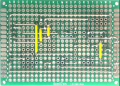
1738525412002.png

This pattern is useful for digital circuit applications.
The colour of the board has nothing to do with the difference between perfboard and stripboard.

Veroboard and Vectorboard are brand names.
Veroboard originated in the UK by Vero.
Vectorboard originated in the USA by Vector Electronics.

If you need to run 6 to 8 amps then you need to run proper high current buss bars.
 

Tonyr1084

Joined Sep 24, 2015
9,744
My concern was the jumper wire not being able to handle the current.
The wire will melt at a much higher temperature than the solder will. Hence, solder alone, which may be enough, will not be as robust as a wire. There are plenty of types of wire you can use. I happen to have some old wire out of a sprinkler system, something like 20 gauge. Easily stripped, light weight copper is easily bent. Another favorite is to use the pieces of wire cut off from long leaded components. In fact, I've run resistors through the through-hole, bent it over and following the pattern of holes - bent the lead to match. Didn't even have to cut the leads. But there are also plenty of lead trimmings sitting in a jar. But they do tend to tarnish.
Given that flux causes the molten balls, and presumably tracks as I'm trying to drag them, to separate, would it be advisable to use a no flux solder for this very purpose? Is no flux solder even a thing?
Really, if you're having unwanted bridging you have too much solder to begin with.

There's a technique I've used for soldering surface mount chips that are square and have 40 or more leads to them. It starts with a wide iron tip. Molten solder is dragged along the leads much like a wave soldering machine. Inevitably the last two or three pins in that row end up bridged. Solder wick is then used to remove the excess solder. If more solder is needed, use of a fine point iron tip makes precise work a breeze. ALSO, thinner solder means more control of how much you put on a joint.

If you have a stubborn bridge you can't get rid of - use solder wick to remove some or all of the solder. Then re-solder. Also, another word of warning: Excessive heat or excessive attempts at soldering a joint can lead to pads lifting off the board. So do it quick and do it once. If it needs rework - I mean if it NEEDS rework then rework it. But don't doddle and don't use excessive heat. If you have an adjustable iron set it to work with the solder you have. Solder has three phases it goes through. 1) Solid (or frozen). 2) Plastic (like warm butter, not melted but not hard). 3) Molten. You want to bring the solder to molten, let it flow, then get the heck out of Dodge. Don't linger. Soldering takes time to learn. Takes practice to get good at it. I've known guys who could solder two gnats behinds together without them knowing it. OK, not true. But their solder always looked good.
 

atferrari

Joined Jan 6, 2004
5,001
For when you get the Veroboards delivered:

Plan carefully the distribution of ALL components first.

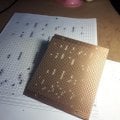
20210306_101652.jpg
When you are satisfied, using Veroboard, cut all traces first.

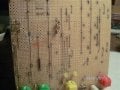
20210306_122307.jpg

I convinced myself that I should run always the jumpers on the components side so I minimize the chances of short circuits with the copper traces. Prior starting, clean the traces and be ready to use flux for every point. Do not touch the copper with your hands.

SANY8101.JPG

I always start soldering all COMMON jumpers and then all Vcc ones. That facilitates further verifications with any point of the circuit.
 
Top