Braking Chopper - overvoltage dumb load

Thread Starter

Nordle

Joined Jun 20, 2018
10
Hey guys,
i built an electric mauntainboard, because its very hilly where i live sometimes even if i start with 90% charged battery i get my esc's into overvoltage cutoff to not damage my battery. But brakes are gone then and thats a bit of a problem:)

Only i thing related i could find was this:
https://forum.electricunicycle.org/topic/6508-brake-chopper-to-avoid-over-voltage-condition/
i had no clue about op amps so far, so this was a bit of a pita.
Then i tried to design a similar (but simpler) circuit and ended with this:
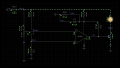
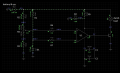
circuit (1).png
I'm a bit new to all these things, so i have no clue if this would really work. At least it does in the simulation.
If you could point me any mistakes or help me make this real that would be great.

And here a pic from the board with some alp panorama:

30f7b8c8989a960b334c52ea4fa754f5802883da_1_375x500.jpeg
 

AlbertHall

Joined Jun 4, 2014
12,625
One part of that simpler design which won't work in the real world is that the comparator is running from a 12V supply but the inputs are at 20V. The inputs must be within the common mode voltage range of the amplifier which will generally be at most the supply voltage range. You must check the common mode range for the amplifier you decide to use.
 

dendad

Joined Feb 20, 2016
4,637
You could change the input 20V Zener for an LED so it doubles as a power indicator and then add resistors in series with the setting pot (both ends) to limit the voltage to the other input. And that makes setting easier as the full pot range now works over a smaller range of voltage.
A lower than 12V Zener could be used in stead of the LED, or even a resistive divider from the 12V power Zener.
Series resistors on the comparator inputs and a feedback resistor for some hysteresis is another good addition.
 

AnalogKid

Joined Aug 1, 2013
12,126
Consider adding reference designators (R1, C3, etc.) to each component on the schematic. This will make it much easier to discuss them.

The two 100K resistors that are in series with the zener diodes are way too large. I get that battery power is at a premium, but a zener diode needs a minimum current to function, and 100K might doesn't allow that.

Add 1 or 2 decoupling capacitors across the opamp power supply pins. 0.1 uf ceramic and 10 uF electrolytic in parallel covers just about every opamp.

As long as you use connection dots consistently, you do not need to draw a bridge when two signal lines cross but do not connect.

If the active device (U?) is an opamp rather than a comparator, you do not need the 10K pull up resistor.

If the active device (U?) is an opamp rather than a comparator, you need to check the datasheet to make sure the output swings low enough to turn off the MOSFET. Some opamps cannot get down to within 1.5 V or 2 V of their lower power pin voltage, which might not be low enough to guarantee that the MOSFET (Q?) is completely off.

I see no reason for the 50K resistor (R?) in parallel with the 12 V zener (D?).

There is a 5.26 A thing on the right, and a 42.1 V thing on the left. I'm assuming one is a battery and one is the motor/generator. Please indicate which is which.

As above, change the 20 V zener to something in the 5 V to 7 V range. To get better adjustability out of the pot, consider this - change the pot to 10K, add a 10K resistor between the bottom of the pot and GND, and add a 75K resistor between the top of the pot and the 42 V rail.

ak
 
Last edited:

Thread Starter

Nordle

Joined Jun 20, 2018
10
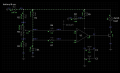
Thanks for your time. I tried to follow your advices as good as i can and ended up with this:
circuit.png
If the active device (U?) is an opamp rather than a comparator, you need to check the datasheet to make sure the output swings low enough to turn off the MOSFET. Some opamps cannot get down to within 1.5 V or 2 V of their lower power pin voltage, which might not be low enough to guarantee that the MOSFET (Q?) is completely off.
Do you know how's that value called in the datasheets?
 

dendad

Joined Feb 20, 2016
4,637
If you add a high value resistor from the OpAmp out to the + input you can have some hysteresis so the output will not chatter around the set point.
 

AnalogKid

Joined Aug 1, 2013
12,126
Thanks for your time. I tried to follow your advices as good as i can and ended up with this:
Looks good. Note, you show a p-channel MOSFET, not n-channel. The arrows in an n-channel MOSFET and an NPN transistor point in opposite directions.
Do you know how's that value called in the datasheets?
Exact wording varies among manufacturers. Pick a part and post the datasheet (or a link), and we'll point it out.

As above, adding hysteresis is a good idea. It creates two trip points, one for turning on and one for turning off, using only one opamp. The calculations are messy, but not complex; nothing beyond Ohm's Law.
https://en.wikipedia.org/wiki/Hysteresis#Electronic_circuits

ak
 
Last edited:

ebeowulf17

Joined Aug 12, 2014
3,307
Thanks for your time. I tried to follow your advices as good as i can and ended up with this:
View attachment 154838

Do you know how's that value called in the datasheets?
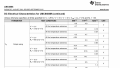
As AnalogKid says, it varies by manufacturer, but here's one example, in which it's called "output swing" and specified for a wide variety of conditions:
FA6289A8-1C6A-486C-B5CE-0AF8CD59D7E9.png
Note that the output swing limits vary as a function of supply voltage, load resistance, and temperature.

In more favorable conditions (2k load, not extreme temps) it can guarantee getting as low as 0.18V on a 5V supply or 0.32V on a 15V supply.

In worse conditions (600 ohm load, extreme temps) it can only guarantee 0.65V on 5V supply and 1.3V on 15V supply.

The gate of a FET is very low impedance when changing states, but incredibly high impedance steady state, so as long as you're not switching it on and off really frequently (like kHz, MHz? ranges) you can pretty safely assume you'll be operating on the favorable side of the specs.
 

AnalogKid

Joined Aug 1, 2013
12,126
Once you have the output voltage data (0.45 V worst case), go to the datasheet for the MOSFET and find the Threshold Voltage. This is the lowest voltage at which the FET starts to conduct. Ideally, the maximum output voltage will be less than the minimum Threshold Voltage.

ak
 

Thread Starter

Nordle

Joined Jun 20, 2018
10
It's actually a N-Fet in the drawing, the App (everycircuit) is a bit weird^^

I would like to add a hysteresis resistor, but don't know how to calculate it's value. I tried but my knowledge is still poor.

The rest seems logic to me, this will be a great help when finally choosing parts. Thanks.
 

Thread Starter

Nordle

Joined Jun 20, 2018
10
Is the hysteresis really something i want here? It does create a second (lower?) trip point to turn off the output if i understand correctly.
That would mean the dumb load would still draw current from my fully charged battery even if i wouldn't exceed it's capacity anymore till i reach that trip point?
If i this assumption is correct, and the hysteresis is added to prevent rapid switching, is there another way to do this?
 

crutschow

Joined Mar 14, 2008
38,503
You can make the hysteresis voltage any value you want.
It can be just a few tens of millivolts, enough to minimize oscillation around the set point.
 

AnalogKid

Joined Aug 1, 2013
12,126
The two trip points do not have to be very far apart, just enough so that noise. A 0.1 V difference might be all that is needed if you add a noise filter capacitor to one of the inputs.

Hysteresis is pretty much mandatory for your application because when the load is switched on, the battery terminal voltage will decrease instantly, probably by several tenths of a volt. If that decrease turns off the load, you've just built a 200 W AM radio transmitter.

ak
 

dendad

Joined Feb 20, 2016
4,637
Try a 100K resistor from the output to +in on your simulation and see what the result is as you alter the input setting pot.
The fiddle with the resistor value.
 

Thread Starter

Nordle

Joined Jun 20, 2018
10
if i put a 500k resistor there i can set trip point at 42v and the other one is at 40v, that seems good to me.
thanks again

have you a recommandation for a op amp, never had to buy one before?

and btw am I in the wrong forum category? i’m such a retard sometimes:D
 

AnalogKid

Joined Aug 1, 2013
12,126
The LM358 is a similar dual part, but an opamp; no pull up resistor required. It is well know for being able to drive a MOSFET gate and turn it completely off.

ak
 
Top