Bradycardia and Tachycardia Sensor

Thread Starter

GerardoPrado

Joined Mar 26, 2020
1
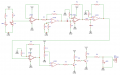
Hi! I need some ideas for my bradycardia and tachycardia sensor. It is part of a university project for an incubator prototype, it has to activate some kind of alarm (buzzer or LED) whenever the baby's pulse is not between the normal pulse range. The parameters that I have to take into account is that, for a baby, bradycardia occurs below 80 bpm and tachycardia above 150 bpm, that is a given fact that the sensor shall detect. My basic idea is to use a pulse sensor made from an IR and a phototransistor that will give a signal in a certain frecuency. I did some research and what most people do is to connect that pulse sensor to an amplifier to increase the signal, then it is filtrated by an active band pass filter and finally it is amplified one last time and it gets to an Arduino. I CANNOT USE ANY KIND OF DIGITAL CIRCUIT, JUST ANALOG. My idea is that if I make a band stop filter, instead of a band pass filter, I can eliminate the frecuencies in which the baby is okay, so if in any case the pulse goes out from the range the filter will give a signal. Then, I was thinking of connecting the resultant signal of the filter to a comparator made form op-amp. In which case will have the function of activating the alarm. If the frecuency is in the range (1.33Hz - 2.5Hz) it will not activate the alarm, if the contrary happens, it will activate the alarm. I'm not pretty sure if it will work or if it's another way to do it. As I said, I'm not allowed to use Arduino or something related to digital electronics. I attached my circuit, thank you!
 

Attachments

wayneh

Joined Sep 9, 2010
18,104
I can use those ICs, it's the only exception. And no, I haven't considered it. I will read more about that.
I think that's a good tip.

If the frequency were higher, I'd consider another 555 circuit, a frequency-to-voltage converter. Follow that with a window comparator to detect voltage above or below the window. I made a FTV for audio range but I'm not sure it could be altered to work at 1-2 Hz.

I think your signal conditioning circuit is overkill but I admit I haven't studied it end-to-end. The first voltage-follower op-amp makes sense. Your goal after that is to "digitize" the HR signal so that becomes like a clock pulse.
 
Hi! I need some ideas for my bradycardia and tachycardia sensor. It is part of a university project for an incubator prototype, it has to activate some kind of alarm (buzzer or LED) whenever the baby's pulse is not between the normal pulse range. The parameters that I have to take into account is that, for a baby, bradycardia occurs below 80 bpm and tachycardia above 150 bpm, that is a given fact that the sensor shall detect. My basic idea is to use a pulse sensor made from an IR and a phototransistor that will give a signal in a certain frecuency. I did some research and what most people do is to connect that pulse sensor to an amplifier to increase the signal, then it is filtrated by an active band pass filter and finally it is amplified one last time and it gets to an Arduino. I CANNOT USE ANY KIND OF DIGITAL CIRCUIT, JUST ANALOG. My idea is that if I make a band stop filter, instead of a band pass filter, I can eliminate the frecuencies in which the baby is okay, so if in any case the pulse goes out from the range the filter will give a signal. Then, I was thinking of connecting the resultant signal of the filter to a comparator made form op-amp. In which case will have the function of activating the alarm. If the frecuency is in the range (1.33Hz - 2.5Hz) it will not activate the alarm, if the contrary happens, it will activate the alarm. I'm not pretty sure if it will work or if it's another way to do it. As I said, I'm not allowed to use Arduino or something related to digital electronics. I attached my circuit, thank you!
Will 60Hz be a problem. It's everywhere.
I have used FR4 copper clad board for breadboards and prototypes.
Build-up the circuit, just like using legos.
You dont have to cut the copper, or etch, or drill holes.
 

GAC19

Joined Mar 8, 2020
16
I think that's a good tip.

If the frequency were higher, I'd consider another 555 circuit, a frequency-to-voltage converter. Follow that with a window comparator to detect voltage above or below the window.
Thank you so much! I'll check that.

I think your signal conditioning circuit is overkill but I admit I haven't studied it end-to-end. The first voltage-follower op-amp makes sense. Your goal after that is to "digitize" the HR signal so that becomes like a clock pulse.
Just a question, do you think that the pulse sensor is indeed going to have a certain frecuency? I'm not pretty sure about that reasoning, but it's what I came up to. I wanted to test it in an oscilloscope but, due to the quarantine, I can't go to the lab.

And also, when you say 'overkill' what do you mean, sorry and thank you again. Appreciate it a lot.
 

GAC19

Joined Mar 8, 2020
16
Will 60Hz be a problem. It's everywhere.
You are right, so I should stick to the band pass filters? In that case, the frecuencies in which the pulse is normal there will be a signal or you mean something else? Thank you in advance.

[/QUOTE]
I have used FR4 copper clad board for breadboards and prototypes.
Build-up the circuit, just like using legos.
You dont have to cut the copper, or etch, or drill holes.
Okay, I will try to look that stuff. Thank you a lot.
 

jpanhalt

Joined Jan 18, 2008
11,087
You are right, so I should stick to the band pass filters? In that case, the frecuencies in which the pulse is normal there will be a signal or you mean something else? Thank you in advance.
I have used FR4 copper clad board for breadboards and prototypes.
Build-up the circuit, just like using legos.
You dont have to cut the copper, or etch, or drill holes.
Okay, I will try to look that stuff. Thank you a lot.
I am confused. Whose thread is it? The TS has not responded since posting this morning. Are you in the same class working on the project together?
 

GAC19

Joined Mar 8, 2020
16
I am confused. Whose thread is it? The TS has not responded since posting this morning. Are you in the same class working on the project together?
I didn't realize, I'm the same but it's weird what happened with my username and profile pic. Hahahaha. That's my username and pic from the Google account. Sorry, it is strange.
 

jpanhalt

Joined Jan 18, 2008
11,087
@GAC19 When you talk about LP, HP and BP filters you are talking about cut-off frequencies. They are not so exact such that a ppm (pulse per minute) of 80 will pass and a ppm of 79 will not. I won't argue that you don't need to filter noise and condition the signal, but generally such monitors go off at a very narrow band of frequencies. Whether anything is done, say for a drop from 81 ppm to 78 ppm will depend on other factors, but you still need to detect it.

As this is homework, what is your solution for sending an alarm for a rate 151 ppm but not for 150 ppm?
 

GAC19

Joined Mar 8, 2020
16
@GAC19 When you talk about LP, HP and BP filters you are talking about cut-off frequencies. They are not so exact such that a ppm (pulse per minute) of 80 will pass and a ppm of 79 will not.
I know these are not as precise as expected, but it was the only way that occurred to me. I was trying to do a ppm circuit, but I could only find digital ones.

I won't argue that you don't need to filter noise and condition the signal, but generally such monitors go off at a very narrow band of frequencies. Whether anything is done, say for a drop from 81 ppm to 78 ppm will depend on other factors, but you still need to detect it.

[/QUOTE]
As this is homework, what is your solution for sending an alarm for a rate 151 ppm but not for 150 ppm?
My idea was:
After the filters, the signal will have a certain "voltage base level". I mean, if the filters are working I will have a value of voltage that is above or below that base level. So the signal will enter to a comparator, where the voltage of comparison will be the base level. Then, the comparator will send the signal to the alarm. I'm not sure if that's how is supposed to be done. (I've built it in breadboard and didn't work, so I'm kinda sure is not hahaha.)
 
Top