Book Example for Differential Amplifier with Darlington Doesn't make Much Sense

WBahn

Joined Mar 31, 2012
32,933
In this context and for a better understanding, it may be helpful to point out the basic characteristics of the Darlington stage once again:
* High current gain (product of the individual "β-values")
* However, the total transconductance gm is reduced to about 50% of the second transistor.
* The total input resistance is doubled to the value of the first transistor.

Note: The very high current gain does not, of course, lead to a comparatively higher voltage gain (quite the opposite) - the Darlington stage is used primarily because of the greatly increased input resistance (compared to a single transistor with the same DC quiescent current Ic)
I think, in this context, that it is better for the TS to derive these characteristics of a Darlington stage, rather than just having them pointed out.
 

WBahn

Joined Mar 31, 2012
32,933
I will attempt doing separate small signal analyses and Large Signal Model Analyses as you suggested. One thing I am worried about though, is my previous coursework from 2018 never covered Darlington Amplifiers. Allot of facts about Small signal and Large signal models have been coming back to me since my 2018 course, but I am still not as sharp with it as I once was. I will try drawing both of the models. I will withhold analyzing the drawing until I get some confirmation that my drawings are correct.


Throughout the course, I have tried doing the analysis on my own, but my answers rarely, if ever match up to the author's final results. I won't feel the confidence in my own approach until I get answers that match the text (assuming the author did a problem correctly of course). I am trying to follow the analysis of others so that I can develop some intuition on how to do it myself.

I also have limited intuition on if and when the author uses rules of thumb, unless explicitly stated within the text. The author seems to have more rules of thumb than I am aware of

The only 5 rules of thumb i know for BJT circuits:
1. The collector current will be approximately equal to the emitter current
2. The base current is ALMOST negligible compared to collector and emitter current.
3. The Collector-emitter junction at saturation is a short circuit
4. The collector-emitter junction when cutoff is an open circuit.
5. The base emitter junction has approximately 0.7V drop when BJT appreciably conducts. (active mode OR Saturation)

Beyond these rules of thumb, I don't know of any others. If the 0.9 thing is a rule of thumb, I never would have figured that out on my own.
#1 and #2 will not be the case when the transistor is saturated, in which case the base current can be a significant portion of the emitter current and may even exceed the collector current.

IF that 0.9 IS a rule of thumb that the author is using, they probably introduced it somewhere in the text and it is likely a rule-of-thumb for certain types of situations in THEIR text -- no other author may do anything comparable.

Another useful rule-of-thumb is that the base-emitter voltage changes by about 60 mV for an order of magnitude change in collector current. This number is very temperature dependent -- in fact, it's the basis for many solid-state thermometer circuits.

Perhaps one of the most useful rules, though not your typical rule-of-thumb, is that any circuit (with rare exceptions for specific purposes) that relies on the beta of the transistor being some specific number -- or some constant number, even if not known -- is a poorly-designed circuit.
 

WBahn

Joined Mar 31, 2012
32,933
I've been going through some YouTube videos on the Large Signal Model to derive some of this stuff. Most of the videos discuss the relationship I_C=I_S*e^(-V_BE/V_T). However, this problem doesn't appear to have given us any saturation currents, so i don't know what I would do. I'm really trying guys... I feel very stupid..
You don't have that quite right -- there's no minus sign in the exponent.

Application of the Ebers-Moll model is almost never done directly, but rather indirectly. By looking at ratios of quantities, you can usually make the saturation current go away.

For instance, consider the "full" Ebers-Moll model ("full" in the sense that it actually has zero collector current when Vbe is zero, but it ignores a number of factors that are part of yet more complete models).

\(
i_C \; = \; I_S \left( e^{\frac{v_{BE}}{nV_T}} \; - \; 1 \right)
\)

The first simplification we almost always make is to throw out the -1, since it is only relevant when v_BE is one the order of, or significantly less than, the thermal voltage (but the fact that this is the assumption that is being made is good to know, because if you are operating in that region -- and some circuit do -- then you can't ignore that -1 and many people blindly will).

Another common simplification is to assume that n=1. This parameter is the "ideality factor" and in modern transistor processes, assuming it is 1 is a pretty good assumption. The assumption used to be that it was about 2 for diodes, but I think most modern diodes are closer to 1 any more.

So that yields

\(
i_C \; = \; I_S \; e^{\frac{v_{BE}}{V_T}}
\)

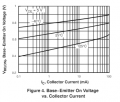
Now, while you don't find Is in very many data sheets (I've never seen it in one), you do find data and curves that give typical base-emitter voltages and resulting collector currents. You can use that to eliminate Is from the equation.

For instance, here's a graph from the On Semi datasheet for their 2n3904.

1713839571179.png


From this we can pick a convenient point of operation, say Vbe = 0.7 V at Ic = 4 mA and Tc = 25 °C.

Let's call these Vo and Io respectively. We can also evaluate the thermal voltage at Tc, since

\(
V_T \; = \; \frac{kT}{q}
\)

At 25 °C, this works out to ~25.69 mV, which is often rounded to 26 mV and is usually good enough given the uncertainty in other values involved.

The means that, at our "known" data point, we have

\(
Io \; = \; I_S \; e^{\frac{Vo}{V_T}}
\)

Now take the ratio of our two equations.

\(
\frac{i_C}{Io} \; = \; \frac{I_S \; e^{\frac{v_{BE}}{V_T}}}{I_S \; e^{\frac{Vo}{V_T}}}
\)

From this, you immediately get

\(
i_C \; = \; Io \; e^{\frac{\left(v_{BE}-Vo\right)}{V_T}}
\)

See how quickly and nicely Is went away?

This also let's you derive one of the rules-of-thumb I mentioned in a prior post.

How much does Vbe need to chance by in order for the collector current to change by an order of magnitude?

\(
i_C \; = 10\;Io \; = \; Io \; e^{\frac{\left(v_{BE}-Vo\right)}{V_T}} \\
10 \; = \; e^{\frac{\left(v_{BE}-Vo\right)}{V_T}} \\
ln(10) \; = \; \frac{\left(v_{BE}-Vo\right)}{V_T}\\
v_{BE}-Vo \; = \; V_T \; ln(10)\\
v_{BE}-Vo \; = \; 25.69\;mV \; ln(10)\\
v_{BE}-Vo \; = \; 59.15\;mV \; \approx 60\;mV
\)

But perhaps the biggest (or at least most commonly useful) thing that comes out of the Ebers-Moll model of the BJT transistor are the small-signal models for it.

I'm a pretty big believer that anyone that cannot derive the small-signal models understands neither these specific small-signal models or the broader topic of small-signal analysis in the first place.

The key to deriving the models is to recognize that it is nothing more than the superposition of two solutions in which the signal is represented as

V(t) = V_DC + v(t)

Using that as a starting point, see if you can derive either the hybrid-pi model or the T-model. In particular, can you derive the expressions for the transconductance and the emitter and input resistances in terms of the DC operating point parameters and the thermal voltage? Feel free to assume infinite output resistance (i.e., the Early voltage is infinite) and also a fixed beta and operation at room temperature. These simplifications can be relaxed later.
 

Thread Starter

WARDEVIL_UFO

Joined Nov 16, 2010
47
Perhaps one of the most useful rules, though not your typical rule-of-thumb, is that any circuit (with rare exceptions for specific purposes) that relies on the beta of the transistor being some specific number -- or some constant number, even if not known -- is a poorly-designed circuit.
I do recall seeing the author of the Art of Electronics make the same exact claim as you stated. I bet one way of dealing with that for a practical amplifier could be to limit the current gain within the design to a value significantly less than the lowest expected value of beta.

As a side not, I borrowed one of the textbooks that an Engineer from work has, and have been working out the example problems with pen and paper, starting with the nuts and bolts of BJT's, since I am rusty on parts of it. I will circle back to this thread to fill in the rest of the details when I figure it out. Otherwise, I I'll present what I came up with so far. I really do appreciate everyone that has contributed. I apologize if it has been a bit burdensome.
 
Top