BNC Coax cable recommendations?

Status
Not open for further replies.

Thread Starter

ballsystemlord

Joined Nov 19, 2018
249
Hello,
I had purchased some BNC cables (about 1m), from China for use with my oscilloscope. In the course of using them, I discovered that when you bend the coax, even slightly, they become disconnected from their BNC jacks. So, I reasoned that I should get some from a trusted distributor.

The problem is, there are several options from several manufacturers available to me, and I'm uncertain which one to pick. Some of the cables look exactly like the ones I currently have that don't work, E.G.
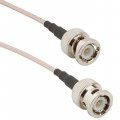
MFG_115101-01-xx.00.JPG
I tried looking for brand names which I know to be reputable, but after looking it seems that I don't know any companies in the coax cable making business. E.G. Cal Test, Cinch Connectivity, Mueller Electric, Pomona Electric, Amphenol RF and Molex are all brands that are on the top of my sort-by-price list.

What's more curious, is that few of the coax cables on digikey and mouser have a maximum frequency spec. I don't intend to use them beyond 500MHz, but still, wouldn't a normal manufacturer give a rating for their RF products?

BNC Coax cable recommendations, anyone?

Thanks
 

MisterBill2

Joined Jan 23, 2018
27,186
You might be able to repair those defective cables that become ope circuit when you bend them a bit. In addition, you may also be able to build your own cables much cheaper. My choice has been to get the crimp on BNC connectors, but then to solder them rather than crimp them. This allows re-using the parts when a cable assembly becomes worn or damaged. And a good soldered connection can be verified prior to assembly.
 

Reloadron

Joined Jan 15, 2015
7,857
OK my go to for BNC patch cables, adapters, and all sorts of similar id Pomona. Try a simple Google of "pomona bnc cables". Next, you make no mention of impedance? Did You want 50 Ohm, 75 Ohm or another impedance? Finally, Pomona stuff is not the cheap garbage of the boat but their stuff carries a price tag reflecting quality. Buy once and cry once. I am using Pomona cables and adapters I have had for 30 years and I have beat them up. You also do not mention any power levels? Just for example a RG58 cable is a 50 Ohm impedance and RG59 is 75 Ohm impedance. Review the data sheets for all the specifications including min and max bend radius. While I doubt it's the case, if you get a power level exceeding 1.0 KW you would want RG8 verse RG58. Look to cable manufacturers like Belden, Essex and Alpha Cable for data sheets. RG58 and RG59 are good upto 1.0 GHz but note the loss across the band.

Finally, yes, I have made my own cables. You can buy complete kits from any electronic component parts house. Kits include connectors and crimping tool(s).

Ron

Ron
 

MisterBill2

Joined Jan 23, 2018
27,186
OK my go to for BNC patch cables, adapters, and all sorts of similar id Pomona. Try a simple Google of "pomona bnc cables". Next, you make no mention of impedance? Did You want 50 Ohm, 75 Ohm or another impedance? Finally, Pomona stuff is not the cheap garbage of the boat but their stuff carries a price tag reflecting quality. Buy once and cry once. I am using Pomona cables and adapters I have had for 30 years and I have beat them up. You also do not mention any power levels? Just for example a RG58 cable is a 50 Ohm impedance and RG59 is 75 Ohm impedance. Review the data sheets for all the specifications including min and max bend radius. While I doubt it's the case, if you get a power level exceeding 1.0 KW you would want RG8 verse RG58. Look to cable manufacturers like Belden, Essex and Alpha Cable for data sheets. RG58 and RG59 are good upto 1.0 GHz but note the loss across the band.

Finally, yes, I have made my own cables. You can buy complete kits from any electronic component parts house. Kits include connectors and crimping tool(s).

Ron

Ron
I have used a whole lot of Pomona cables. They do work well, but with the molded on connectors they are not at all repairable.
 

Thread Starter

ballsystemlord

Joined Nov 19, 2018
249
OK my go to for BNC patch cables, adapters, and all sorts of similar id Pomona. Try a simple Google of "pomona bnc cables".
But... but... that's so hard! (It was a joke. Please don't kill me.)

Next, you make no mention of impedance? Did You want 50 Ohm, 75 Ohm or another impedance?
50ohm, please.

Finally, Pomona stuff is not the cheap garbage of the boat but their stuff carries a price tag reflecting quality. Buy once and cry once. I am using Pomona cables and adapters I have had for 30 years and I have beat them up. You also do not mention any power levels?
So far, I'm under 2W. I expect that I'll be under 10W (average) for the rest of my natural life. But feel free to tell me I'm wrong and high wattage applications are hard to avoid.

Just for example a RG58 cable is a 50 Ohm impedance and RG59 is 75 Ohm impedance. Review the data sheets for all the specifications including min and max bend radius. While I doubt it's the case, if you get a power level exceeding 1.0 KW you would want RG8 verse RG58. Look to cable manufacturers like Belden, Essex and Alpha Cable for data sheets. RG58 and RG59 are good upto 1.0 GHz but note the loss across the band.

Finally, yes, I have made my own cables. You can buy complete kits from any electronic component parts house. Kits include connectors and crimping tool(s).

Ron

Ron
Thanks!
 

MisterBill2

Joined Jan 23, 2018
27,186
In that table, none of those cables are the types that most of us use for hobby applications, and none of the frequencies listed are blow one gigahertz. So while it is a good listing it is not applicable for most of us. It does show that properties vary quite a bit with cable size.
 

Thread Starter

ballsystemlord

Joined Nov 19, 2018
249
In that table, none of those cables are the types that most of us use for hobby applications, and none of the frequencies listed are blow one gigahertz. So while it is a good listing it is not applicable for most of us. It does show that properties vary quite a bit with cable size.
The frequencies quoted are the maximum frequencies. So it is applicable.

What I'd like to know is what the "power handling capability" column is making its measurements in. Watts? dB? VA?
EDIT: They also didn't list units for the "center conductor" column.
 
Last edited:

MisterBill2

Joined Jan 23, 2018
27,186
The frequencies quoted are the maximum frequencies. So it is applicable.

What I'd like to know is what the "power handling capability" column is making its measurements in. Watts? dB? VA?
EDIT: They also didn't list units for the "center conductor" column.
Certainly most of those cable types are not for the majority of casual users. I did see the common RG and LMR types shown, but, as an example, I consider even using RG58 for 146 MHZ to be quite a compromise, given it's losses.
BUT the table is very educational indeed. So I appreciate it's addition. Thanks for that!!
 

Reloadron

Joined Jan 15, 2015
7,857
But... but... that's so hard! (It was a joke. Please don't kill me.)
50ohm, please.
So far, I'm under 2W. I expect that I'll be under 10W (average) for the rest of my natural life. But feel free to tell me I'm wrong and high wattage applications are hard to avoid.
Thanks!
There we have it. The 50 and 75 ohm are most common. All you need is RG58 cable and decide what braid material. The better stuff cost more. :) Copper conductor cost more, copper overbraid cost more. Looking at patch cables just figure out the length you want. Typically 6, 12, 18, 24 and 36 inches.
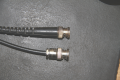
Also Mr. Bill makes a good point regarding the Pomona cable strain relief. The rubber boot is about 3" long.
BNC2.png

The upper image is a Pomona.

There are other brands which cost much less I just can't think of any. This is what happens when one retired 11 years ago. Google is your best friend. :)

Ron
 

MisterBill2

Joined Jan 23, 2018
27,186
Consider also that within the RG58 family are both stranded center conductor and solid conductor types. My choice is stranded for durability but solid for ease of installing connectors.
There are other types that are the same size as RG58, but different. Some are great for audio use only, and some are totally unknown characteristics, at least to me.
 
Status
Not open for further replies.
Top