Blow a bulb on purpose

Thread Starter

Alexlee

Joined May 11, 2017
7
Hi
I’m trying to create a wiring circuit that will ultimately blow a light bulb.

I need it to run on something like a rotary transistor (I think). So the current starts at zero, and as I turn the bulb lights up, gets progressively brighter until the point it blows.

Only needs to be relatively simple. Can either be mains or battery powered.
Any help/pointers would be greatly appreciated!

Thanks
Al
 

dendad

Joined Feb 20, 2016
4,637
What sort of bulb? A mains or 12V or 24V?
And I don't know what a "Rotary Transistor" is. You may mean Potentiometer or Rotary Encoder???
If you use a 12V lamp, just connect it to a variable DC supply of sufficient voltage and current capability and crank the voltage up slowly until somewhere over 12V, the lamp pops.
.
 

Thread Starter

Alexlee

Joined May 11, 2017
7
The type of bulb doesn’t really matter. I’m just looking for a really simple and cheap way to power the bulb and use a rotary device (I don’t know the technical terms, I’m a complete novice, sorry) to run from zero current to bulb blowing.

What sort of bulb? A mains or 12V or 24V?
And I don't know what a "Rotary Transistor" is. You may mean Potentiometer or Rotary Encoder???
If you use a 12V lamp, just connect it to a variable DC supply of sufficient voltage and current capability and crank the voltage up slowly until somewhere over 12V, the lamp pops.
.
 

dendad

Joined Feb 20, 2016
4,637
The safest way for you will be to buy a variable DC power supply and use a car 12V taillight lamp.
A supply that can output 24V and 5Amps will do it.
Look for something like this..
http://www.ebay.com.au/itm/Variable...402741?hash=item41c5ccb9f5:g:6CQAAOSwAPVZJSo9

There are other ways to do it but if you don't have electronics experience by the sound of it, so just go and buy one.
But I must ask, why do you want to blow a bulb on purpose?
 
Last edited:

Thread Starter

Alexlee

Joined May 11, 2017
7
Firstly, thanks for your advice in this!

I was hoping to achieve this for as little cost as possible. It’s a one off thing and can’t justify the cost of a variable dc power supply.

I’ve done bits of wiring etc before so generally know the do’s and donts and not afraid to give something new a try.

Is there a way this can be achieved using simple components?

The safest way for you will be to buy a variable DC power supply and use a car 12V taillight lamp.
A supply that can output 24V and 5Amps will do it.
Look for something like this..
http://www.ebay.com.au/itm/Variable...402741?hash=item41c5ccb9f5:g:6CQAAOSwAPVZJSo9

There are other ways to do it but if you don't have electronics experience by the sound of it, so just go and buy one.
 

dendad

Joined Feb 20, 2016
4,637
What electronic parts do you have?
A variable power supply is needed to slowly increase the power and I would strongly advise you to DO NOT connect lamps directly to the mains power as doing it that was will be very dangerous.
If you just want to pop a lamp, get a 6V or 3V lamp from a flashlight and hook it onto a 12V battery. That would not slowly increase but it would pop it.
 

Thread Starter

Alexlee

Joined May 11, 2017
7
Ok, am liking the battery idea. Could I not use some kind of potentiometer to control the flow of power between the battery and bulb?

What electronic parts do you have?
A variable power supply is needed to slowly increase the power and I would strongly advise you to DO NOT connect lamps directly to the mains power as doing it that was will be very dangerous.
If you just want to pop a lamp, get a 6V or 3V lamp from a flashlight and hook it onto a 12V battery. That would not slowly increase but it would pop it.
 

dendad

Joined Feb 20, 2016
4,637
Yes, a simple PWM controller will be the way to go. Just make sure you use a decent FET as the power switcher as sometimes when a lamp blows a heavy current flows breifly. A small FET may pop too.
If you cannot build one, EBay have a good range of PWM motor controllers to buy but I would encourage you to have a go at building it.
 

wayneh

Joined Sep 9, 2010
18,104
I'd do this with a LM317 based voltage regulator powered by a spare laptop power brick, which is typically 19-20V. If the bulbs you use are 6V flashlight bulbs, I'm sure the peak voltage will destroy it.

Your potentiometer would then adjust the voltage from ~2V up to whatever power supply voltage you use, minus about 3V. A car battery will get you up to about 9-10V. This will blow a 3V bulb but may not be enough to immediately blow a 6V bulb.

LEDs take even less power to destroy, and of course less power as they are operating also. If you just want to demonstrate fading to high brightness followed by destruction, I'd use LEDs. Cheap and effective. BUT, you'll need a regulated current circuit rather than a regulated voltage. That's still very easy, just different.
 

Reloadron

Joined Jan 15, 2015
7,887
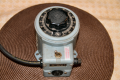
If I wanted to do this I would look for a used Variac which is a variable transformer. An incandescent light bulb like a common light bulb doesn't much care if you apply AC or DC. A common Variac also commonly called an Autotransformer allows you to start at a low voltage and increase the voltage. Here is a generic everyday Variac transformer:
Variac1.png

This one happens to be for US Mains Voltage of 120 VAC and will output 0 to 140 VAC, there are also 220 VAC versions for areas with 220 Volt mains power.

I could, for example, place a voltmeter across the output and note when my lamp burns out. With any luck you may find a cheap used one. I have seen a few at yard sales for a few US dollars, you just have to look hard.

If you just want to burn up low voltage bulbs you can also try a cheap lamp dimmer which can be had at most home improvement stores. A 120 VAC 300 watt unit like this one can be had for under $12 USD. I also see others on Amazon for about $7 USD.

Increasing the voltage to the load beyond the load voltage will increase the current and eventually burn out the filament in the bulb. A slight increase will result in a brighter burning lamp until it fails. Quickly increasing the voltage will result in the lamp burning out faster. There are ways to automate the process and record the results but that gets into higher cost.

Ron
 

Bernard

Joined Aug 7, 2008
5,784
For blowing bulbs, I like # 49 pilot light. Might be 1.5 V @ 60 mA ? If 100 ohm WW pot can't be found, connect about 10 , 10 ohm Rs, 1/2 W, in series. With clip lead start at ground side & move up until it pops.
In 1950s I used # 49's to replace blasting caps for testing capacitive discharge blasters.
Christmas tree lights might be similar & cheaper, 2.4V @ 200 mA +- ??
 
Last edited:
Top