BJT transistors as voltage-controlled devices

steveb

Joined Jul 3, 2008
2,436
steveb,


I think that the Shockley diode equation was for DC only. AC applications will have to to take into consideration capacitance, which is considerable for a BJT, especially the junction barrier capacitance. Of course, small signal models do exist.

Ratch
Yes, obviously. However, it is interesting that the original comments quoted from the letter from Fred, by the OP, about "doing education a disservice" is based on a DC model of the transistor. Surely any isolated comment about a vast subject will appear to be inadequate. He was bothered by the statement that "a transistor is a current controlled device". One could argue that saying the transistor obeys the Shockley equation to 9 orders of magnitude is a "disservice" if nothing else is said.

Note that some of the small signal models (which include frequency dependence) you mention treat the transistor as a current controlled device.
 
Last edited:

Ratch

Joined Mar 20, 2007
1,070
steveb,

Yes, obviously. However, it is interesting that the original comments quoted from the letter from Fred, by the OP, about "doing education a disservice" is based on a DC model of the transistor. Surely any isolated comment about a vast subject will appear to be inadequate. He was bothered by the statement that "a transistor is a current controlled device". One could argue that saying the transistor obeys the Shockley equation to 9 orders of magnitude is a "disservice" if nothing else is said.
OK

Note that some of the small signal models (which include frequency dependence) you mention treat the transistor as a current controlled device.
Sure, many of them do. That is not in conflict with assertion that a BJT is a voltage controlled device. Since both Ic and Ib are exponentially related to Vbe, Ic and Ib are directly related to each other, and it makes sense to use that relationship to make a model. The Ib is an indicator of Ic, not the cause of Ic.

Ratch
 

studiot

Joined Nov 9, 2007
4,998
The Ib is ............. not the cause of Ic.
To do a real world experiment to demonstrate the inadequacy, nay fallacy,of this statement do the following:

Take a black glass encapsulated transistor an OC44 - this is a real world transistor.

Scrape off the some black

Connect only the collector and emitter to a supply, observing polarity and including current measurent.

You will measure a current.

Shine some light on the transistor.

You will measure more current

Shine more light

You will measure yet more current

Remove the light

The current returns to its original value

You have just learned how to control a transistor, with the base not even connected.

Now bias the transistor appropriately, include a Vbe measuring device.

Repeat the experiment.

You will obtain similar results, but with an increased response.

However the voltmeter monitoring Vbe will not alter.
 

steveb

Joined Jul 3, 2008
2,436
The Ib is an indicator of Ic, not the cause of Ic.

Ratch
I'm not sure why you take this point of view. Also, I'm not sure why you are now using the term "cause" rather than "control". I prefer the term control as it is more clear. I see no reason to say the Ib can not control Ic.

If a perfect current source is used to drive current though the base/emitter junction in the forward biased direction, this is current control. If a perfect voltage source is used to forward bias the base/emitter junction, this is voltage control. The current control method is more stable to temperature variations, but very sensitive to changing the transistor (beta sensitive). The voltage control method, is highly sensitive to temperature, but will work about the same with any transistor (not beta sensitive).

Note that in the above examples, current control is a more accurate description since, for a given transistor, Ib provides a reasonably good control of Ic, even though not perfect. However, unless temperature is also controlled, Vbe is not a good control on Ic, as changes are too sensitive with an exponential function.

In real circuits, we usually seek to stabilize against both beta and temperature variations. Hence, feedback and compensation are typically used. These topologies are not ideal voltage or current control situations, but we choose to view them of imperfect versions of either type of control.

Note the following approximate DC models typically used for a transistor.

Current Control: Ic=Ib*beta(T,Ic,Vce, ...etc.)
Voltage Control: Ic=Io(T)*alpha(T,Ic,Vce, ... etc.)*(exp(Vbe/nVt)-1)

Either of these approximate models could be derived from the same physics and assumptions for a transistor. If the functional dependence of alpha and beta are understood, either can be used to design useful circuits.
 
Last edited:

Ratch

Joined Mar 20, 2007
1,070
studiot,

.... You have just learned how to control a transistor, with the base not even connected.

Now bias the transistor appropriately, include a Vbe measuring device.

Repeat the experiment.

You will obtain similar results, but with an increased response.

However the voltmeter monitoring Vbe will not alter.
Yes, I will agree with the results of your experiment. I was not taking into account the operation of a phototransistor. The same thing you described will probably happen if you substituted ionizing radiation for light. See http://en.wikipedia.org/wiki/Diode , and look under the paragraph "Shockey diode equation". Note the quote under that paragraph "This means that the Shockley equation doesn’t account for the processes involved in reverse breakdown and photon-assisted R-G. Additionally, it doesn’t describe the “leveling off” of the I–V curve at high forward bias due to internal resistance." Sedra and Smith also do not account for photo stimulation, and neither do I.

Ratch
 

Ratch

Joined Mar 20, 2007
1,070
steveb,

Quote:
Originally Posted by Ratch
The Ib is an indicator of Ic, not the cause of Ic.

Ratch

I'm not sure why you take this point of view. Also, I'm not sure why you are now using the term "cause" rather than "control". I prefer the term control as it is more clear. I see no reason to say the Ib can not control Ic.
Because according to Sedra and Smith, Vbe determines what particular value Ic is at for a particular value of Vbe, no matter what the value of Ib is. Ib varies with the beta, Vbe does not. All the methods of determining Ib for Ic and feedback are shortcuts which set Vbe to the desired value. Even when the designer does not know or care what Vbe actually is. It is beguiling to think that you are controlling Ic with Ib, but it is really Vbe running the show. Did you read the reply I got from a professor of Electrical Engineering when I asked him that question? I used to believe as you do, but he showed me different.

Ratch
 

studiot

Joined Nov 9, 2007
4,998
I'm glad you agree, Ratch.

The whole point of this exercise is that semiconductor devices work by releasing charge carriers -promoting them from the valence band to the conduction band -

Now an impressed voltage is one way to do this.

Illumination/irradiation is another.

There are yet others eg thermal agitation.

Transistors cannot work without this charge carrier release or promotion.

I have shown (and you have agreed) they can work without voltage.

So which is more fundamental?
 

steveb

Joined Jul 3, 2008
2,436
Because according to Sedra and Smith, Vbe determines what particular value Ic is at for a particular value of Vbe, no matter what the value of Ib is.
I don't think this statement is true. Perhaps you are misquoting Sedra and Smith. Vbe does not determine Ic independently of other parameters. Temperature is an equally important parameter, but even Ib is not independent. There is an intimate relationship between the current model and voltage model I showed above. The current model uses beta and the voltage model uses alpha. Alpha and beta are related to each other beta=alpha/(1-alpha), and the Ic=beta*Ib equation is derivable from the Ebers-Moll model. Both beta and alpha have dependence on Ic, T and Vce. You shouldn't give preference to one of the two models, in my opinion. They are different representations of the same physics and assumptions, provided you accurately account for the full dependence of alpha (or beta) on operating point. But again, these are just simplified models for a complex device, so any conclusions based on them are not iron-clad.

Ib varies with the beta, Vbe does not.
Ratch
This statement doesn't make sense to me. We are talking about using Ib and Vbe as controls. I say you can use either, or both at the same time. You say that only Vbe is a control. A control is not dependent on beta. If I force Ib constant, then Vbe will vary with beta. If I force Vbe constant, then Ib will vary with beta. However, beta is not an independent parameter. It has a value that depends on the operating point.

Ironically, the more you talk, the more I am preferring the current control point of view. Previously, I was always one to say the voltage control model is better, as I very much like the Ebers-Moll model and use it in low frequency non-linear modeling. However, I never thought the current control model invalid as you do. (I don't mean to overstate your opinion, but you know what i mean)

Perhaps, we shouldn't go back and forth like this. I'm going to go back to the full Ebers-Moll equations and rigorously derive the voltage and current control models and try to objectively see your point of view. It's been 20 years since I've done this, and I had a different mind-set back then. If I can reveal anything interesting, I'll post it.
 

steveb

Joined Jul 3, 2008
2,436
To save you a deal of bother. Ratch and the Members (is that a new group?) have been through all these calculations and many more in excruciating detail in this thread.

http://forum.allaboutcircuits.com/showthread.php?t=12378
There is quite a bit of information there. I scanned through it, but did not see a derivation of a current control model starting from the Ebers-Moll model. If it is there, can you point me to the exact spot please.

In reading through some of this, I'm reminded of the famous chicken and egg problem. Which came first? I'm not interested in these types of esoteric questions. One can step back many levels and keep changing their mind on issues like this. As a black box, the transistor seems like current controlled. If i write Eber-Moll equations it looks voltage controlled. If i rearrange the Eber-Moll equations, it looks current controlled again. If I look at the physics of the junction, and fields etc, it looks voltage controlled. Go back to quantum physics and interpretations become very dubious.

If someone wants to say that the voltage model is preferred, I can buy that. If someone wants to say that there is no other valid interpretation, such as a current control model, I don't buy it. The real world is not black and white.

What I'm interested in is control in the engineering sense, because here you can make conclusive statements. If I force current into the junction, it is current controlled. If I force voltage on the junction, it is voltage controlled. If I do something in between, it is open to interpretation. It is gray, not black or white.

The simple fact that keeps getting missed is that a transistor can not be only a voltage controlled device. Temperature plays too much of a role to be ignored. At the very least, say it is a voltage and temperature controlled device.
 
Last edited:
Ratch

Joined Mar 20, 2007
1,070
studiot,

Transistors cannot work without this charge carrier release or promotion.

I have shown (and you have agreed) they can work without voltage.

So which is more fundamental?
They are all equally fundamental. Perhaps a better question to be asked is how often is each method implemented. I believe you would agree that Vbe implemented by Ib is by far the most often used method. Next phototransistors, then thermal if one is building a thermometer. I don't believe that irradiation is used much to modulate transistors, and certainly not the doping concentration.

Ratch
 

Ratch

Joined Mar 20, 2007
1,070
steveb,

I don't think this statement is true. Perhaps you are misquoting Sedra and Smith. Vbe does not determine Ic independently of other parameters. Temperature is an equally important parameter, but even Ib is not independent.
No Sedra and Smith does take temperature, Vbe, doping, but not ionizing radiation into account. I am assuming for my assertion that only Vbe changes because that is the most common way of modulating BJT's. Also keep in mind that even agreed upon voltage controlled devices are affected by temperature.

Perhaps, we shouldn't go back and forth like this. I'm going to go back to the full Ebers-Moll equations and rigorously derive the voltage and current control models and try to objectively see your point of view. It's been 20 years since I've done this, and I had a different mind-set back then. If I can reveal anything interesting, I'll post it.
Before you start on this endeavor, you will find posts #64 thru #67 of the below thread interesting. Trust me on this.

http://forum.allaboutcircuits.com/showthread.php?t=12378

Ratch
 
Last edited:

beenthere

Joined Apr 20, 2004
15,819
Ratch,

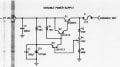
My old, very first linear power supply's schematic is attached. From your statement -
only Vbe changes because that is the most common way of modulating BJT's.
- I assume that you can point out why the circuit will work as well with the values of R3, 4 & 5 increased by, say, 3 orders of magnitude.

If, as you keep asserting, transistors are only voltage controlled, then Q3 should respond to the magnitude of voltage, and never to the current. Vastly increasing the divider string's resistance should have no effect, right? And can't R1's resistance be increased to, say, 100M?
 

Attachments

Ratch

Joined Mar 20, 2007
1,070
beenthere,

I assume that you can point out why the circuit will work as well with the values of R3, 4 & 5 increased by, say, 3 orders of magnitude.
Sure, as long as 0 to 1 volt can be maintained across the Vbe junction of Q3, then the feedback resistors can be increased. If the waste current Ib is too high (low beta) or R3,R4 and R4 are too high, then that won't be possible.

If, as you keep asserting, transistors are only voltage controlled, then Q3 should respond to the magnitude of voltage, and never to the current.
Right, the Ic will respond exponentially to Vbe and so will Ib. Vbe controls them both. That means that Ic will increase with Ib, but Vbe is really controlling the situation.

Vastly increasing the divider string's resistance should have no effect, right?
Question answered above. It is all a matter of keeping the transistors within the active region.

And can't R1's resistance be increased to, say, 100M?
If the transistors can be kept within the active region, then fine.

Ratch
 

Dave

Joined Nov 17, 2003
6,969
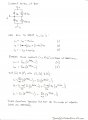
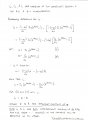
steveb, please find attached the basics of the current-control model of the BJT.

Note the following:

  • The model considers only the currents in the device; voltages are only implied from Ebers-Moll.
  • Extenuating variables other than those presented here are considered constant.
  • The only external variables considered from a control perspective, i.e. which are controllable external to the device, are ie, ib, and ic.
  • Vbe and Vbc are are never controlled directly, but will be of importance to the mode of operation - however this model accounts for all modes.
  • Through control of ib: Vbe, Vbc, and consequently Ic, are dependant variables.

If you note any mistakes in the Maths let me know - it is more likely my terrible writing that is at fault!

Dave
 

Attachments

Last edited:

Dave

Joined Nov 17, 2003
6,969
On the second attachment, the expression for ib should have a + instead of a minus (I was going to go a different route, hence the -- and the error has propagated through). It doesn't alter the details of what is being presented.

Dave
 

steveb

Joined Jul 3, 2008
2,436
No Sedra and Smith does take temperature, Vbe, doping, but not ionizing radiation into account. I am assuming for my assertion that only Vbe changes because that is the most common way of modulating BJT's.
Again, I don't understand your logic. You can't assume that only Vbe changes. If Vbe changes, then Ib changes too.

Before you start on this endeavor, you will find posts #64 thru #67 of the below thread interesting. Trust me on this.

http://forum.allaboutcircuits.com/showthread.php?t=12378

Ratch
Ok, I read through these. Yes, it is interesting but I see nothing new there. You have an authority who says transistors are voltage controlled. I would say the same thing as an isolated statement. But, I would not say it is incorrect to say that a transistor can be controlled by current. If I use a current source to drive a base emitter junction in a BJT, I force the development of Vbe on the diode section. The Vbe then forces the Ic to develop. OK, Vbe seems to be the physically important control from the physics point of view. So what? The total device has still been controlled by current.

Analogy: If the owner of a company orders his manager to tell a worker to do something, and the manager tells the worker to do that thing, and the worker then goes and does that thing, who is in control?

I'm not sure if this web-page has been referenced already, but I didn't see it. Again, I see the chicken and egg argument.

http://en.wikipedia.org/wiki/Talk:Bipolar_junction_transistor
 
Last edited:

studiot

Joined Nov 9, 2007
4,998
In fact instead of smart-alec bickering we should all be celebrating the wondrous effect that transistor action brings to circuitry.
I've said it before, but it's a good phrase so I'll say it again.


Surely Tony wished this discussion to be about the possibility of enhancing the AAC description of transistor action? Not to become another thread in Ratch's voltage crusade.

For my part I realise that many readers will not have (or need) any knowledge of quantum energy levels, conduction bands, etc etc.

So I prefer to start with a simple tap (faucet to you yanks) analogy.

A transistor is like a tap, except that current, not water gushes through it. All we need is to know how to turn it on or off.

I say on or off because most transistors in the modern world are operated in switching mode so fine points are irrelevant.

Once the student has a grasp of on / off we can progress to the idea of 'on control'
 

steveb

Joined Jul 3, 2008
2,436
I've said it before, but it's a good phrase so I'll say it again.

In fact instead of smart-alec bickering we should all be celebrating the wondrous effect that transistor action brings to circuitry.

Surely Tony wished this discussion to be about the possibility of enhancing the AAC description of transistor action? Not to become another thread in Ratch's voltage crusade.
I hope my comments don't come across as bickering. That is not my intent and I apologize if they seem that way. I really would like to understand why the voltage-only enthusiasts are so adamant that a current control model is a design-tool without real validity. Ratch is not the only person I've encountered that holds this view. Ratch is a smart person, and many other very smart people hold this view. Are they right? Are they wrong? Is it a meaningless question?

This has practical import. If any of us teach a student, or write a book, we are expected to have answers to questions like this. It seems no matter what view you put forth, you will be criticized by one of the camps. I don't think any well-intentioned person wants to hear the comment that he is "doing a disservice to education". What do you do, just avoid stating an opinion: - just teach the principles of operation and present the useful models?
 

Dave

Joined Nov 17, 2003
6,969
Surely Tony wished this discussion to be about the possibility of enhancing the AAC description of transistor action? Not to become another thread in Ratch's voltage crusade.
I fully agree, and I think that is the message that will be taken out of this thread. The treatise is incomplete but accurate for what is discussed. Note that the second paragraph in the introduction of the BJT section states:

My intent here is to focus as exclusively as possible on the practical function and application of bipolar transistors, rather than to explore the quantum world of semiconductor theory. Discussions of holes and electrons are better left to another chapter in my opinion. Here I want to explore how to use these components, not analyze their intimate internal details. I don't mean to downplay the importance of understanding semiconductor physics, but sometimes an intense focus on solid-state physics detracts from understanding these devices' functions on a component level. In taking this approach, however, I assume that the reader possesses a certain minimum knowledge of semiconductors: the difference between "P" and "N" doped semiconductors, the functional characteristics of a PN (diode) junction, and the meanings of the terms "reverse biased" and "forward biased." If these concepts are unclear to you, it is best to refer to earlier chapters in this book before proceeding with this one.
What the material sets out to achieve, it does, however in the interests of completeness I am of the opinion more can be done.

Dave
 
Top