A bit strange question for some but supposing I want to use a specific transistor that delivers 100mA but I need 500mA, is it possible to use 5 transistors in parallel? If possible I need some tips for the scheme. Thank you.
All with the same part number, some transistors are more sensitive than others and will hog most of the current and be destroyed.
Therefore parallel transistors must be matched but you cannot buy matched ones. Adding series emitter resistors to each transistor will help match them but you still need to measure many to find some that have similar measurements.
The added emitter resistors might cause the circuit not to work properly.
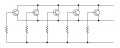
If I were to do this I would connect all the emitters and collectors together but connect each base lead with a separate bias resistor. Like below assuming npn type.
Emitter ballast resistors are used when putting resistors in parallel, but they do reduce efficiency. And also, resistors with 500mA current capacity are indeed available up to some very high frequencies. But of course, we do not know HOW HIGH the frequency you want to use is. So we need more information so that we can provide better advice than just emitter resistors. But that is a common means of running resistors in parallel. It may be able to work for the TS, or maybe not.
An old European BC547 had a max current rating of only 100mA and maybe somebody is selling cheap (defective?) ones on ebay.
Adding series base resistors does not properly match transistors.
Given that five seemingly identical transistors will have different betas, you're going to have quite a time getting them to play nice in this application. It is just a headache that you would be wise to avoid. The thing about unusual schemes is that people who believe in them are not amenable to logic and reason, so by all means try it out, but promise to come back an tell us the results.
I already asked about the frequency, and if it is in the gigahertz range then the choices are much fewer. And since we do not know what part of the world the TS is located in, it may be that the selection of reasonably available reasonably priced parts is less than some of us have.
But with no response we have no clue. AND, once again, my mind-reading skills are very poor, especially at a distance.
I already asked about the frequency, and if it is in the gigahertz range then the choices are much fewer. And since we do not know what part of the world the TS is located in, it may be that the selection of reasonably available reasonably priced parts is less than some of us have.
But with no response we have no clue. AND, once again, my mind-reading skills are very poor, especially at a distance.
I need an RF transistor not because I have to go up a lot but to have a low phase error with respect to the input. I'm talking about a few degrees at 10Mhz (lower is better). To do this I saw that you need a very low Ccb that I find only (obviously) on RF transtistor or mosfet. I did some tests with some BFR93 and they are ok as Ccb but they have little current to drive a load of 50Ohm. To have a few degrees of phase error I have to use components that have an fT of at least 3Ghz.
The circuit I posted was based on using the transistors as a DC switch. I've seen examples in audio output stages where it's common to use separate base and emitter resistors.
There are quite a few rather fast transistors around, you will need to check with an actual manufacturer to know what is offered. So yes, it will be an RF transistor of some flavor. But the added capacitance from using multiple devices may cause some other problems. Of course, usually the price gets into the discussion and selection process. The faster devices are not cheap.
If I were to do this I would connect all the emitters and collectors together but connect each base lead with a separate bias resistor. Like below assuming npn type.

 Facebook
 Google
 GitHub
 Linkedin