Facebook
 Google
 GitHub
 Linkedin
Hi
I am completely stuck trying to understand the power dissipation of a BJT emitter follower class-A amplifier.
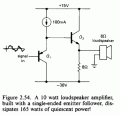
Take for example the circuit on page 91 on The Art of Electronics - picture in attachment.
I understand the role of Q1 and the current source, but I don't understand why it is said that, with no signal, the transistor dissipates 55W and the emitter resistor 110W?
The loudspeaker, being 9V RMS at 8 ohm, needs about 1.6A of current peak. So this is the quiescent current the transistor needs to drop as power, is that right?
So how can 55W and 110W come out?
Thanks
I am completely stuck trying to understand the power dissipation of a BJT emitter follower class-A amplifier.
Take for example the circuit on page 91 on The Art of Electronics - picture in attachment.
I understand the role of Q1 and the current source, but I don't understand why it is said that, with no signal, the transistor dissipates 55W and the emitter resistor 110W?
The loudspeaker, being 9V RMS at 8 ohm, needs about 1.6A of current peak. So this is the quiescent current the transistor needs to drop as power, is that right?
So how can 55W and 110W come out?
Thanks
Attachments
-
 8 KB Views: 56