Facebook
 Google
 GitHub
 Linkedin

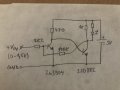
I don't know where people are getting their 500 mA figure from. The last time I checked, 3 V across a 15 Ω load was 200 mA.I am using BJT as switch to control 15ohm light load on and off give Varying voltage ranges V1.
My only concern is that V1 varies from 1.5VDC to 0VDC. I want the transistor on from 0.5VDC to 0VDC and off from above 0.5VDC. My V2 is constant at 3VDC.
I am still confused on how to do this?
That's right at the max rating limit for a 2N3904, so I'd recommend finding a more suitable transistor, One possibility would be the ZTX853 (though even the old 2N2222 would likely fit your needs just fine).
https://www.diodes.com/assets/Datasheets/ZTX853.pdf
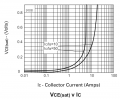
Notice that (typically) at 200 mA collector current, Vce(sat) is well below 50 mV, even with IC/IB being 50.
That means that you can pretty safely design your circuit for a base current of about 4 mA, though you might bump that up to 5 mA.
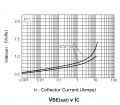
The Vbe(sat) under this conditions (presumably at room temperature) is about 0.8 V.
So if your control voltage is 3 V (I haven't seen any indication of what your control voltage is, so I'm assuming it's the same 3 V supply as for your light), then you would need a base resistor that is about
Rb = (3 V - 0.8 V) / 4 mA = 550 Ω.
I'd recommend going with a 470 Ω resistor -- that drives you a bit further into saturation and is also a very common resistor value. It would yield an expected base current of around 5 mA.
You total power dissipation would be somewhere around
Ib*Vbe + Ic*Vce = 5 mA * 0.8 V + 200 mA * 50 mV = 14 mW, which is should only produce a few degrees temperature rise in the junction.
What kind of light is this? It might be a good idea to use an anti-kickback diode in the circuit.