BJT as switch doesn't work why

Thread Starter

hhsting

Joined Apr 25, 2024
395
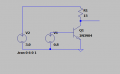
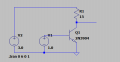
In the LTSPICE, I am using BJT transistor NPN as a switch. I put in the below snapshot vbe to be 0.8V but my voltage from R1 load side where the dash is to the ground is NOT 0V. I get 1.442V. When I put V1 to be 1.0V voltage from R1 load side where the dash is to the ground is NOT 0V. I then get 102.5119mV. If the transistor turns on at VBE of 0.7V, the voltage from the R1 load side where the dashed line is to the ground should see 0V, but it doesn't. What am I doing wrong? Why?
1716106184978.png

1716106528542.png
 

MisterBill2

Joined Jan 23, 2018
27,522
First, a bipolar transistor switch never goes to a zero voltage drop condition, and second, with that very low series resistance the current is rather large, and so with that much current there will be a voltage across the transistor.
What is the purpose of the circuit, anyway???
 

Dave Lowther

Joined Sep 8, 2016
332
i dont follow. What do you mean?
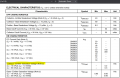
The highlighted cell shows you the maximum output voltage between collector and emitter (0.2V, 0.3V). You shouldn't expect it to be 0V.
To get those values, or less because they are maximum values, you have to provide the stated base current (1mA, 5mA) and choose the collector resistor to give you the stated collector current (10mA, 50mA).
 

Dave Lowther

Joined Sep 8, 2016
332
How does the resistor solve the problem? Why is the resistor required and what size reistor to be placed?
Look at the bottom row of the table in post #4 . It tells you what the base current should be.
If you wanted 1mA and you used the 0.85V for VBE(sat) then you could chose e.g. 2V for V1. The R between V1 and base would be, from Ohm's law, R = (2-0.85)/0.001
Alternatively you can presumably replace V1 with a current source. I'm not sure because I don't use a simulator.
 

BobTPH

Joined Jun 5, 2013
11,515
With a 3.0V supply and 15Ω load, the max current is 500mA. This requires 50 mA of base current for saturation.

Look in the datasheet for Vbe saturation. I can’t seem to clip it on my phone, so I will summarize:

At 1 mA of base current the Vbe is 0.65V
At 5 mA it can be as high as 0.95V

At 50 mA, who knows? But certainly higher than 0.95V

This is why we do not drive the base with a voltage.

Use your 3V supply with a resistor to control the base. Assuming 1V for Vbe, the resistor is:

V = I R

R = V / I = 2 / 0.05 = 40Ω

Try that and you should get the saturation Vce of about 0.3V
 

Audioguru again

Joined Oct 21, 2019
6,826
Each transistor part number has a range of Vbe voltages that also depend on the temperature because the Vbe drops when the transistor warms up. The required base current also depends on the amount of collector current because the current gain drops at higher collector currents. Therefore the base of a transistor is always fed a calculated current and never a voltage.

The datasheet of a 2N3904 shows that for a saturated condition with a 50mA load, the guaranteed maximum collector voltage will be about 0.3V only when the base current is 5mA and the temperature is 25 degrees C. Its collector saturation voltage is not guaranteed for a collector current higher than 50mA because its current gain drops above about 50mA.
 

Audioguru again

Joined Oct 21, 2019
6,826
Bob, the maximum allowed collector current for a little 2N3904 is only 200mA, not 500mA and the written specs show for a maximum collector current of only 50mA where the current gain drops. The graphs show typical voltages (not maximum voltages).
 

BobTPH

Joined Jun 5, 2013
11,515
Bob, the maximum allowed collector current for a little 2N3904 is only 200mA, not 500mA and the written specs show for a maximum collector current of only 50mA where the current gain drops. The graphs show typical voltages (not maximum voltages).
For some reason, I had it in my head that it was a 2N2222. Yes, the 2N3904 will be out if spec and probably never reach a low saturation voltage at 500mA
 

LvW

Joined Jun 13, 2013
2,027
Each transistor part number has a range of Vbe voltages that also depend on the temperature because the Vbe drops when the transistor warms up. The required base current also depends on the amount of collector current because the current gain drops at higher collector currents. Therefore the base of a transistor is always fed a calculated current and never a voltage.
We always should remember the DEFINITION of SATURATION: Vce<Vbe which means that Vbc>0.
The base-collector junction now is open - and there is an additional current into the base node (in addition to the base current through the B_E junction).
THIS is the reason for the enlarged base current.
And this drastic base current increase it the RESULT of (and a good indication for) saturation and not its cause!
The parameter we call "current gain" (which is defined for the "classical" base current through the B-E junction only) does not drop remarkable under these conditions.
 

crutschow

Joined Mar 14, 2008
38,508
Why is the resistor required and what size reistor to be placed?
The base-emitter junction looks like a forward-biased diode, so a resistor must be used to limit the current to the desired value.

For operation as a switch, the rule-of-thumb is to use a base current 1/10th the maximum collector current.
The base-emitter voltage drop is about 0.7V so you subtract that from the base supply voltage when calculating the required base resistor.
 

Thread Starter

hhsting

Joined Apr 25, 2024
395
The base-emitter junction looks like a forward-biased diode, so a resistor must be used to limit the current to the desired value.

For operation as a switch, the rule-of-thumb is to use a base current 1/10th the maximum collector current.
The base-emitter voltage drop is about 0.7V so you subtract that from the base supply voltage when calculating the required base resistor.
I dont follow can you elobrate?
 

Thread Starter

hhsting

Joined Apr 25, 2024
395
I am using BJT as switch to control 15ohm light load on and off give Varying voltage ranges V1.

My only concern is that V1 varies from 1.5VDC to 0VDC. I want the transistor on from 0.5VDC to 0VDC and off from above 0.5VDC. My V2 is constant at 3VDC.

I am still confused on how to do this?
 
Top