Benchtop power supply for testing headlights

Thread Starter

TURK_UK

Joined Nov 10, 2017
13
*** As I can't edit my previous post ..............

It just occurred to me that I can upload images :D

Quad headlight testing rig with my 12v battery connected to a battery charger to get me that 14.4 volts. Not really a safe way of doing this, what worried me also was, the fumes created while charging the battery. I'm basically recreating the actual system that's in the vehicle for testing purposes >>
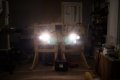
1527_IMG_1118-Edit.jpg


TURK_UK
 
Last edited:

Thread Starter

TURK_UK

Joined Nov 10, 2017
13
Why doesn't the image appear ?


I can see it at my end when editing my post ....... upload post and images disappears ! :eek:


TURK_UK
 
I inserted the image' URL into the wysiwyg editor window, within 'IMG' tags

I may try another method tomorrow ............... it's gone 1 am over here in France, and I'm ready for my bed ! :p

TURK_UK
After reply, there is an "Upload a file" option. Extension case, I think matters or it won't find it. If you still have trouble disable the Flash based file uploader in the preferences.
 

Thread Starter

TURK_UK

Joined Nov 10, 2017
13
What am I not making clear here !? o_O I don't want or need yet another battery charger !

What I'm after is a benchtop power the will supply enough juice to run 4 high beam headlights. Has anybody actually looked at the links I provided ? .............. I'd like to know if they would be up to the job.


Thanks

BTW ................. Thanks Crutschow. Image now sorted ;)


TURK_UK
 

be80be

Joined Jul 5, 2008
2,395
Bench power supply for head lights a supply that would stand up to 4 of these new high output
bulbs would cost as much as 10 good car battery's.

Buy a good Bench power supply for your desk build a good test supply for you lights you'll be money ahead and
have something that can test car head lights. I've seen some of these using up about 100 amps
https://www.ebay.com/itm/Cascade-AP...-GRADE-Power-Supply-with-cables-/302520174919
That's $500 new not from ebay
 

shortbus

Joined Sep 30, 2009
10,050
Why not a linear supply? A Variac feeding a step down transformer of the correct top voltage and amperage you need feeding a bridge rectifier to suit. Then by using the Variac, you can dial down the output voltage, or even raise it slightly. Don't think for lights you would even need an output capacitor. You would need a low voltage supply also for the electronics driving the control part of the lamps.
 

Thread Starter

TURK_UK

Joined Nov 10, 2017
13
Thanks for the input shortbus, but as a novice I have no idea what a 'variac' is, stepdown transformer and all the gubbins .................. sounds to me like an assortment of parts, a kit as it were.

Why not buy a 'box' with everything contained ....... just plug in your headlight wiring loom to the voltage posts, that are variable up to 14.4v adjust the amperage to about 4.5amps ( or what ever the four 65watt bulbs are rated at = should be around 16 to 18 amps max ) and you're done !

I'm not savy enough to be constructing my own power supply right now, eventually I would like to, but that will take a while in order to learn the ins and outs of electricity and electronics.

Right now I just need to buy a 'box' that'll make my testing phases quick and simple. The maximum I'm willing to invest in this benchtop power supply would be up to €250 Euros ( 300 Dollars to you guys in the US ) or just over 200 quid in the UK.

This must be possible.
Could somebody point me to a possible power supply model, that would be up to the task please ?


TURK_UK
 

MrAl

Joined Jun 17, 2014
13,716
Hello,

You could roll your own, making a full blow custom DC switching power supply. We did one back in the 1980's but that used two transformers.

I was going to build a home unit that did 30 amps and did not require a transformer (no isolation though) but when i priced inductors and combinations of inductors everything came out too expensive anyway. I now have two 10 amp commercial units that together can give me 20 amps and that is enough for now. But with today's controllers and transistors you can do some high power stuff if you are willing to pay for the parts.
Yes, more work than buying one and not that much cheaper anyway.
 

Thread Starter

TURK_UK

Joined Nov 10, 2017
13
Ok guys, it's beginning to look as though I'm going to have to build my own ! ......... as most of you have already mentioned.

I'm in a strange situation whereas I'm in central France, I wouldn't even consider ( as I already tried ) buying one in France ...... the prices are extortionate for devices like these over here ! Imagine a unit in the US being $200, over here in France that would be near on €700 !!! ........ that equates to two months rent for me. As I'm from the UK originally, I was trying to buy a benchtop power supply in the UK. But, I have failed miserably at that also :(

After an entire week of searching the web and looking at literally hundreds of power supplies, I found only two models that would foot the bill at what I would consider to be a reasonable price ........ unfortunately, those two suppliers in the UK, won't post to France ! :confused:

I mentioned I was a 'novice' with electronics, but I'm not a total nugget ! :rolleyes: I certainly wouldn't be designing and fabricating automotive headlights and wiring looms if I were. I would need some help along the way to see this project through however, can anybody point me in the right direction ?

I've also been looking at dozens and dozens of YouTube videos on the subject ......... Many videos concerning benchtop power supplies were in fact instructional videos on repairing power supplies ! this got me thinking that many power supplies on the market ( particularly the cheaper ones ), are very unreliable.

Most of the how to videos are about converting computer power supplies, even 10 year old kids are doing it ! I'm sure I can do likewise :D

So, if I buy a 12v 30amp DC Universal Regulated Switching Power Supply, the rest should be relatively straight forward, shouldn't it ? I need the 30amp output to be 'variable', but what confuses me is the 12 volt. How would I increase the voltage output to 15 volts, and maybe make that variable as well ?

Just another question if I may .......... On a regular benchtop power supply, when adjusting the voltage, to say, up to 13.8 volts for testing a headlight unit, the lit bulb in question will only take as much amperage as it requires right ? So the variable adjustment on the amperage is only for setting the 'max' level, a threshold that you don't want the current to go past, is that correct ?


Apologies for all the questions, but I'm sure there'll be many more ! :D

And many thinks for all your help thus far.


TURK_UK
 

MrAl

Joined Jun 17, 2014
13,716
Hi,

You dont really want to have to get involved with a boost circuit unless you really have to. If you start with a higher voltage then use a buck to get down the to the correct voltages that's better. If you really need 0 to 15v then you should probably start with a 20v supply and buck it down. As you buck it down you get more current and less voltage, so at 10v out for example you can get twice the current. That means with a 20v 20 amp supply you could ideally get 10v at 40 amps with the right choice of components. It will be a little less than that due to the efficiency, but that's the basic way to look at it as the buck circuit works almost like a transformer with variable turns ratio for DC voltages.

Boost circuits are harder to get to be stable so unless that's a necessity it's better to go with a buck with higher voltage to start out with.

The inductor(s) might be a little expensive too though. You'd need at least a 30 amp device for maybe 25 amp output max for example.
 
What hasn't been discussed is the use of a PWM controller. e.g http://www.robotshop.com/uk/cytron-30a-5-30v-single-brushed-dc-motor-driver.html

There should be some available with current limit. Note: It needs a raw power supply and there is likely a small drop in voltage. e.g. 1.2-2.4 V for 100% duty cycle. Some don;t allow 100% duty cycle.

if all we are dealing with is LED or incandescent lighting, PWM will work just as a steady DC supply will.

If you have a TRMS (True RMS) voltmeter that is capable of operating at the frequency of the PWM, then that reading is the "effective DC" value.

With this https://trcelectronics.com/View/Mean-Well/HRP-300-15.shtml as a power supply, you can go to 18V , so with a PWM motor controller you should be able to get 13.8V effective DC. The output is adjustable slightly.

If you need power for relays etc, you can use a capacitor where R*C = 5. R is the resistance of your coils and C the capacitance in Farads. At 5 time constants it reaches about 99% of the final value. The frequency chosen for motors is usually above hearing, so you don;t hear the windings.

So, it's an entirely different approach. So, I'd look for a PWM controller with current limit and a power supply capable of 18 V. ebay should have plenty and Nuts and Volts magazine has some.

With PWM, your changing the duty cycle.
 

MrAl

Joined Jun 17, 2014
13,716
Hi,

Have to make sure the controller can do the speed too. Can that motor controller switch at say 50kHz? If not the inductor would get pretty big and expensive.
 
Have to make sure the controller can do the speed too. Can that motor controller switch at say 50kHz? If not the inductor would get pretty big and expensive.
I have no idea what you just said?

The lights can likely see the PWM without issues. If there are some relay logic, or whatever just smoothe the PWM a little bit more. e.g. relay coil 500 ohms. C=(5/500) Farads = 10 uF. Isolating the relays with a diode (Schottky) would help too.
 

MrAl

Joined Jun 17, 2014
13,716
I have no idea what you just said?

The lights can likely see the PWM without issues. If there are some relay logic, or whatever just smoothe the PWM a little bit more. e.g. relay coil 500 ohms. C=(5/500) Farads = 10 uF. Isolating the relays with a diode (Schottky) would help too.
Hi,

If you mean PWM the lights directly i am not sure i like that idea The bulbs have filaments and filaments react differently to high voltage pulses that average to some lower voltage. I cant say i would want to do it that way although some testing might help.
Keep in mind that the filament will have a certain hot resistance, and when the next pulse comes in will be of a higher current than normal. When the pulse goes away the current will go to zero. The filament will thus be thermally cycled which im not sure is a good idea.
I never had to PWM a bulb before though as a means to simulate a buck action.

So what i was talking about was to build an actual buck circuit with that module. It would have to switch fast enough.
 
Top