Beginner's questions about an SLA charging circuit.

Thread Starter

Buk

Joined Mar 2, 2018
14
(I hope this is an appropriate place for my question? If not, please move it or tell me where to (re-)post it. Thanks.)

I have portable vacuum cleaner that uses an SLA -- which is now on its last legs -- and I'm looking to convert it to using a LiFePO4 battery pack. In the process of looking at the feasibility of this I reverse engineered the existing (SLA) charging circuit in to a simulator (see attached AAC-sim.txt and paste it to http://www.falstad.com/circuit/circuitjs.html to see the sim. (It's too complex to post as a direct link.)).

Ignoring why I started this, I have a bunch of questions about this circuit -- quite possibly dumb beginner type questions -- that I'd like some help with; if this is the right place to ask them?

Some relate to the design of the circuit themselves; some relate to my attempt to simulate it. Eventually, I have questions about modifications, but I'm well short on understanding for that at this stage.

As this is my first post here, I first want to know if I'm presenting the information -- the simulation -- in a way that is acceptable here? And if this is a good place to ask my beginner's questions?

Not much point in constructing an elaborate and detailed post in either of those is not true.

Thanks for your time, Buk.
 

Attachments

Alec_t

Joined Sep 17, 2013
15,103
Welcome to AAC!
This circuit has been discussed on another forum.
I first want to know if I'm presenting the information -- the simulation -- in a way that is acceptable here?
It's acceptable, but most guys here use the free LTspice for simulation, as it's more versatile. The moving dots in Falstad may look pretty but are a distraction. A clear schematic is the preferred way of conveying circuit information.
Your Falstad sim is reporting two bad connections.
 

Thread Starter

Buk

Joined Mar 2, 2018
14
It's acceptable, but most guys here use the free LTspice for simulation, as it's more versatile.
I tried LTspice and found it impossible to use. Perhaps limitations of my computer; probably the limitations of my understanding of the subject.

The moving dots in Falstad may look pretty but are a distraction.
They are easily turned off. Options->Show current.

A clear schematic is the preferred way of conveying circuit information.
Is a screen grab of the Falstad sim (without the dots) acceptable?

Your Falstad sim is reporting two bad connections.
Weird. When I cut and paste from the attachment to the sim, I get no errors?

This circuit has been discussed on another forum.
Does the existence of that previous discussion elsewhere, mean that my attempts to get discussion about the circuit (rather than is method of presentation) here are forlorn?

Thanks, Buk
 

Alec_t

Joined Sep 17, 2013
15,103
Is a screen grab of the Falstad sim (without the dots) acceptable?
Yes. Preferably with a white background and contrasting content.
Weird. When I cut and paste from the attachment to the sim, I get no errors?
Weird indeed. I cut and pasted too.
Does the existence of that previous discussion elsewhere, mean that my attempts to get discussion about the circuit (rather than is method of presentation) here are forlorn?
No. Some members here are also members of the other forum, but a new audience may get you further assistance.
 

Thread Starter

Buk

Joined Mar 2, 2018
14
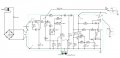
Okay. The circuit as I have reverse engineered it looks like this:
schematic.jpg

First question: What purpose do Q4 and T3 (and associated passives) serve?

If I remove Q4, T3, R14, R15, R16, R17 & C3 from the simulation, it appears to function in every way the same?

The current to the motor is supplied through the relay, and there seems to be no benefit to passing the solenoid current through Q4 et. al.

Thanks, Buk.
 
Last edited:

Alec_t

Joined Sep 17, 2013
15,103
Q4 switches the Charge/Run relay coil.
T3 switches Q4 off to terminate the charge.
If I remove Q4, T3, R14, R15, R16, R17 & C3 from the simulation, it appears to function in every way the same?
That suggests the schematic includes some discrepancy from the actual circuit.
 

ian field

Joined Oct 27, 2012
6,536
(I hope this is an appropriate place for my question? If not, please move it or tell me where to (re-)post it. Thanks.)

I have portable vacuum cleaner that uses an SLA -- which is now on its last legs -- and I'm looking to convert it to using a LiFePO4 battery pack. In the process of looking at the feasibility of this I reverse engineered the existing (SLA) charging circuit in to a simulator (see attached AAC-sim.txt and paste it to http://www.falstad.com/circuit/circuitjs.html to see the sim. (It's too complex to post as a direct link.)).

Ignoring why I started this, I have a bunch of questions about this circuit -- quite possibly dumb beginner type questions -- that I'd like some help with; if this is the right place to ask them?

there was a design example based on the ST; L200 integrated regulator - the schematic is probably still floating about somewhere.

Some relate to the design of the circuit themselves; some relate to my attempt to simulate it. Eventually, I have questions about modifications, but I'm well short on understanding for that at this stage.

As this is my first post here, I first want to know if I'm presenting the information -- the simulation -- in a way that is acceptable here? And if this is a good place to ask my beginner's questions?

Not much point in constructing an elaborate and detailed post in either of those is not true.

Thanks for your time, Buk.
 

Thread Starter

Buk

Joined Mar 2, 2018
14
Q4 switches the Charge/Run relay coil.
T3 switches Q4 off to terminate the charge.

That suggests the schematic includes some discrepancy from the actual circuit.
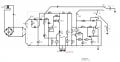
When I remove those components, I obviously connected the relay coil to ground:
schematic.jpg
My point is that the manual switch control the relay, what purpose do the transistors serve?
 

Thread Starter

Buk

Joined Mar 2, 2018
14
T3 switches Q4 off to terminate the charge.
I don't think T3 or Q4 can have anything to do with charging or terminating charging, as charging can only occur when the switch is in the off/charge position.

And when that is the case everything to the right of D3 is unpowered.
 

Thread Starter

Buk

Joined Mar 2, 2018
14
T3, Q3 are to switch off the relay when the voltage gets too low, to save the battery.
Bingo! That makes sense, and by replacing the SLA in my sim with a variable voltage source, and slowly reducing the voltage, Q4 cuts off the relay when the battery drops below 2.5V.

That's way too low for good life of anSLA, but the sim is a compromise as I haven't managed to find a real value for the inductance of the relay coil.

I currently have guessed and set it as 400mH; anyone have a better guess?

The relay is an SRD-S-109DM. I have the datasheet, but the coil inductance is not given?

The other intriguing thing -- that might change if the sim was more accurate, it that T3, never switches on, and C3 never shows any sign of activity.

Any thoughts as to what T3 is intended/should be doing?

Thanks, Buk
 

Alec_t

Joined Sep 17, 2013
15,103
When battery voltage drops to some threshold value Q3 turns off, C2 charges up, C3 charges up, and T3 is triggered, shorting Q4 base and emitter, the relay drops out, the motor stops.
 

Thread Starter

Buk

Joined Mar 2, 2018
14
When battery voltage drops to some threshold value Q3 turns off, C2 charges up, C3 charges up, and T3 is triggered, shorting Q4 base and emitter, the relay drops out, the motor stops.
I am naive in thinking that it seems very elaborate to use 3 actives and two capacitors to construct voltage controlled switch?
 

Thread Starter

Buk

Joined Mar 2, 2018
14
I agree that the circuit looks over-elaborate.
I was hoping that I might be able to switch a couple of resistors to tune the circuit to my needs -- a 12V LVC; 12.8V HVC and some kind of charge current low value cut-off -- but I'm failing to find what components set the limits; there seems to be more inter-dependencies than I was expecting.

It doesn't help that the sim I'm using seems to have badly chosen convergence criteria which means as the values tend towards the cross-over points, it craps out with "convergence errors".

I have LTSpice: which must have the worse user interface ever devised; Tina-TI: which seems better and contains a crap-load of fully specified components -- just not the ones I need; and one called GeckoCircuits: which has an amazingly intuitive UI, and seems to be immensely powerful. Its just mind-blowingly difficult to understand how to get the output you want.

(Programming AI in assembler seems simple by comparison; but I guess that just familiarity :) )
 

Dodgydave

Joined Jun 22, 2012
11,395
Well if you're wanting to use a Life-po battery , they use deadicated chips ehich are ready available , ..

https://www.powerstream.com/LLLF.htm

these cells have a Two stage charging, first is Constant Current , then final stage is Constant Voltage, i would use one Ready-made chip rather than bodging it up.
 

Thread Starter

Buk

Joined Mar 2, 2018
14
Well if you're wanting to use a Life-po battery , they use deadicated chips ehich are ready available , ..

https://www.powerstream.com/LLLF.htm

these cells have a Two stage charging, first is Constant Current , then final stage is Constant Voltage, i would use one Ready-made chip rather than bodging it up.
I have a CC/CV module for charging the cells -- which I'll mount into the wall-wart where the LCD will be visible -- but it would (have) be(en) nice to modify the existing circuit so it could be utilised to at least cut-off the motor at a 12V LVC.

Even better if the existing Zener circuit between D5 and D2 could be tweaked to only enable charging between 12V and 14.8V (not the 12.8V I typo'd above :( ).
 

Thread Starter

Buk

Joined Mar 2, 2018
14
Increasing R9 should raise the cut-off voltage.
I did try that previously; but the simulation -- whether as a result of my model, or the simulators limitations -- doesn't model the description given earlier
When battery voltage drops to some threshold value Q3 turns off, C2 charges up, C3 charges up, and T3 is triggered, shorting Q4 base and emitter, the relay drops out, the motor stops.
When the voltage drops below 9.75V, the relay drops out -- due to insufficient current flow through the coil. At this point, Q3 & Q4 are both saturated.

Q3 moves from saturated to forward active at 9.7V with the 4.6kΩ R9, but that appears to be a coincidence. I can adjust the value of R9 from 1K to 100K, and whilst it controls whether Q3 is saturated, fwd active or cut-off; none of those have any influence on the state of Q4 at the point where the motor cuts off because the relay opens.

As the voltage drops further, Q3 remains forward active (and Q4 saturated) until the voltage drops below 3.3V when Q3 reaches cut off.

Q4 remains saturated until the voltage drops below 2.8V when it transitions to forward active, and doesn't cut off until below 0.9V.

The voltage on C2 and C3 never rises above 100mV & -35mV respectively and the gate of T3 never reaches its trigger current!

The long and short of it is, that entire section of circuit -- Q3, Q4, T3, C2 & C3, and associated resistors -- can be removed, connecting the relay coil direct to ground, and the function remains the same.

The relay drops out when the battery voltage drops below 9.75V.

T3/C2/C3 never do anything.

I've checked my model (again) and find no errors. I'm trying to re-create the model in one of the other simulators to see if they verify the findings, but by comparison with falstad, they are like trying to ride a unicycle in a hurricane whilst suffering an inner ear infection :)

It's one thing to re-create the circuit schematic; and an entirely different game to extract any useful information from them.

{sigh} What started out as a purely pragmatic idea; and took on a life of its own because it was new and interesting and required to me to learn, I fear will end with frustration with the tools and/or my inability to use them properly. :(

Thanks to you and DodgyDave for your help.
 

Thread Starter

Buk

Joined Mar 2, 2018
14
Anyone have an SCR component description/definition for LTSpice?

Preferably an MCR100-6, but anything that has parameters I can set.

The only SCR delivered with the install is a "Generic symbol for use with a model you supply"; which is about as much use as a chocolate teapot.
 
Last edited:
Top