Facebook
 Google
 GitHub
 Linkedin
Hi all
A couple of years back I got my hands on a used TS80P "Smart" soldering iron which I have used a bit, but I really dislike the whole "wire and adapter" situation, it makes it really clunky to use so I want to make it wireless.
It connects via USB-C and has a rating of max 12V, 30W. I first thought of using a single 3.7V Li-Ion with an 18650 battery holder. The holder would be soldered/mounted on to the PCB which also has the USB-C connector. This is how I imagined it being placed:

The battery has plenty of power (3.6V and most are rated for ~20A, so ~72W, right?) and it should survive long enough for my use cases.
Rough calculations (please correct me if I am wrong):
( 2600mAh * 3.7V ) / 30 W = 9.62Wh / 30W = 0.32 h = 19,24 minutes of continuous max power.
1. Do you suggest any other batteries? I would like to stay away from LiPo:s at least. I've seen some 12V power banks but most of them are really bulky and have unnecessarily large capacities.
2. How should I increase the voltage from 3.7V to 12V while also being able to stay at least 30W? The battery itself would have to pump out 8.1A @ 3.7V to reach 30V, and the output should be 3A @ 12 V (max). Are there any particular boost-converters that do this neatly? Any IC:s you recommend? I am comfortable designing PCBs but coming up with the whole circuit diagram and its components is not my strong side.
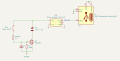
This is what I quickly sketched up just now:
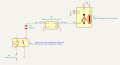
3. I have never used relays, what are the specs of interest? Number of pins haha? What should I look for except for rated current and voltage? I just want to disconnect the battery to turn it off using a smaller switch that controls the relay.
Additionally, it would be nice to be able to have a separate 5V charge port to charge the battery, but that is not necessary. In the future, I would like to make a portable "kit" with a holder, brass "brush", etc but that is a future problem. I am also aware that the battery will add substantial weight further back, but I am fine with that.
Thoughts?
// Ephex
A couple of years back I got my hands on a used TS80P "Smart" soldering iron which I have used a bit, but I really dislike the whole "wire and adapter" situation, it makes it really clunky to use so I want to make it wireless.
It connects via USB-C and has a rating of max 12V, 30W. I first thought of using a single 3.7V Li-Ion with an 18650 battery holder. The holder would be soldered/mounted on to the PCB which also has the USB-C connector. This is how I imagined it being placed:
The battery has plenty of power (3.6V and most are rated for ~20A, so ~72W, right?) and it should survive long enough for my use cases.
Rough calculations (please correct me if I am wrong):
( 2600mAh * 3.7V ) / 30 W = 9.62Wh / 30W = 0.32 h = 19,24 minutes of continuous max power.
1. Do you suggest any other batteries? I would like to stay away from LiPo:s at least. I've seen some 12V power banks but most of them are really bulky and have unnecessarily large capacities.
2. How should I increase the voltage from 3.7V to 12V while also being able to stay at least 30W? The battery itself would have to pump out 8.1A @ 3.7V to reach 30V, and the output should be 3A @ 12 V (max). Are there any particular boost-converters that do this neatly? Any IC:s you recommend? I am comfortable designing PCBs but coming up with the whole circuit diagram and its components is not my strong side.
This is what I quickly sketched up just now:
3. I have never used relays, what are the specs of interest? Number of pins haha? What should I look for except for rated current and voltage? I just want to disconnect the battery to turn it off using a smaller switch that controls the relay.
Additionally, it would be nice to be able to have a separate 5V charge port to charge the battery, but that is not necessary. In the future, I would like to make a portable "kit" with a holder, brass "brush", etc but that is a future problem. I am also aware that the battery will add substantial weight further back, but I am fine with that.
Thoughts?
// Ephex