Battery Internal Resistance

Thread Starter

jethro99

Joined Oct 31, 2020
66
How is this determined?

Does the internal resistance change as a battery accepts a charge? It would appear so since the current flow starts to diminish once a power source is supplying current to the battery but...

As a battery is charged up its voltage rises. To what extent does the voltage rise in the battery being charged affect the current flow?

If the internal resistance rises as the battery charges (reducing current flow) and if the battery voltage rising reduces the current flow, how does one know the extent to which is doing what?

Thanks in advance for any replies.
 

MrChips

Joined Oct 2, 2009
34,628
The internal resistance of a battery changes both when the battery is being charged and when being discharged.
But the change in charging current is not because of the change in internal resistance.

Let us assume that the charging voltage is Vs and the battery voltage is VB.
What drives the charging current is the difference between Vs and VB, in other words, (Vs - VB) or the voltage overhead.
Thus, as the battery becomes charged, VB rises. The overhead gets smaller and hence the charging current gets lower.

In order for the battery to receive a charge, the charging voltage Vs must be higher than the battery voltage VB, even when a battery is being trickle charged. This is independent of the internal resistance of the battery.

For example, a typical 12 V car battery has a nominal standing voltage of about 12.6 V. The charging voltage should be about 14.6 V, about a 2 V overhead.
 

WBahn

Joined Mar 31, 2012
32,703
How is this determined?

Does the internal resistance change as a battery accepts a charge? It would appear so since the current flow starts to diminish once a power source is supplying current to the battery but...

As a battery is charged up its voltage rises. To what extent does the voltage rise in the battery being charged affect the current flow?

If the internal resistance rises as the battery charges (reducing current flow) and if the battery voltage rising reduces the current flow, how does one know the extent to which is doing what?

Thanks in advance for any replies.
There are different factors at play in what you are describing and it looks like you are trying to confuse them.

Let's assume we have an ideal rechargeable battery, meaning that it has no internal resistance, but that it's terminal voltage drops as charge is drawn from it.

Now let's charge it with an ideal voltage source through a current limiting resistor connecting the two. Initially, there will be a certain voltage across the resistor due to the mismatch and current will flow. As the battery charges and its voltage rises, the voltage across the limiting resistor will drop and so will the current. This has nothing to do with the battery's internal resistance, which in this scenario is zero.

The internal resistance of most batteries is lower at higher states of charge unless there is something transient going on. NiMH batteries are an example in which the internal resistance immediately after charging is higher because of shifts in electrolyte concentrations and viscosities. These settle out after a rest period of a few hours. Even so, their minimum internal resistance is at about the half-charge point.
 
@jethro99: Beyond resistance, there is also reactance. Type "Electrochemical Impedance Spectroscopy" (EIS) into your favorite search engine to see more. With enough data collection, you can understand both the State of Charge (SOC) and State of Health (SOH) of a battery.

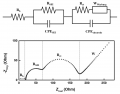
Here is a Nyquist Plot from one of the hits I just got from a simple search. The webpage is here and they copied the plot from here. The convention is for negative imaginary to point upward. The frequency on the right is 0.01Hz or so, and it increases as you go leftward to several hundred Hz at the "Rb" bulk resistance crossover. Please note that the transfer function is of current and not voltage.

1771737994409.png

The idea is that a given battery chemistry has a characteristic model or frequency response, and with enough laboratory data, you can make SOC and SOH conclusions from a frequency spectrum. Collect enough patterns offline, and then take data and pattern-match on an in-service battery, and you know what you've got.

Real products do this today, and the whole thing is a pretty active field of research.

@WBahn, I love your "10 types of people" thing. I swear I've seen it 100 (twenty-five, the number of pennies in a quarter) times over the years, and I enjoy the fresh take.
 

Ian0

Joined Aug 7, 2020
13,097
@WBahn, I love your "10 types of people" thing. I swear I've seen it 100 (twenty-five, the number of pennies in a quarter) times over the years, and I enjoy the fresh take.
[/QUOTE]
The first group is a subset of the third!
 

Ian0

Joined Aug 7, 2020
13,097
How is this determined?
Do you mean "how is this measured?" or "how is this calculated?" ?
Measuring looks easy, but isn't, firstly because the figure is quite small, but mainly because the state of charge will change over the period of the measurement and with it, the open-circuit voltage.
So take an open circuit reading before the test, and again afterwards, after waiting for the voltage to stabilise and assume that the open circuit voltage is the average of the two. Then measure an on-load (or on-charge) terminal voltage at a known current. The internal resistance is one minus the other divided by the current.
Lead-acid is particularly difficult to measure as the chemical reactions are slow. It exhibits a rapid drop followed by a recovery as the load is applied (called "coup de fouet" - Lead acid batteries were a French invention) so getting the correct on-load terminal voltage isn't easy.
 

WBahn

Joined Mar 31, 2012
32,703
@WBahn, I love your "10 types of people" thing. I swear I've seen it 100 (twenty-five, the number of pennies in a quarter) times over the years, and I enjoy the fresh take.
The first group is a subset of the third!
[/QUOTE]

Yes, it is. I couldn't think of a good way to phrase it to make them distinct without making the twist too blatant.
 

xox

Joined Sep 8, 2017
936
How is this determined?

Does the internal resistance change as a battery accepts a charge? It would appear so since the current flow starts to diminish once a power source is supplying current to the battery but...

As a battery is charged up its voltage rises. To what extent does the voltage rise in the battery being charged affect the current flow?

If the internal resistance rises as the battery charges (reducing current flow) and if the battery voltage rising reduces the current flow, how does one know the extent to which is doing what?

Thanks in advance for any replies.
If you want to estimate it yourself, you can do something like this:

First determine the maximum amount of current you will be able to dissipate through a resistor during the test. For example you have a 12V battery to test and only 5 watt resistors laying around. Your max current is thus 5W/12V = ~417mA. Now use Ohm's law to find the test resistor value 12V/0.417A = ~29Ω. Assuming the battery could be slightly higher than 12V you err on the side of caution and bump that up to 33Ω.

To conduct your test, first take a reading of the unconnected battery. Let's say it is 12.3V. Now with the resistor connected between the terminals of the battery, take another voltage reading. Maybe it's 10.7V. So the approximate internal resistance is ((12.3V*33Ω)/10.7V)-33Ω which yields a value of roughly 4.9Ω.

Repeat the test as many times as you like while a battery is in various states of charge and then plot it on a graph or whatnot to get a good idea of the min/max internal resistance range.
 

MrAl

Joined Jun 17, 2014
13,667
How is this determined?

Does the internal resistance change as a battery accepts a charge? It would appear so since the current flow starts to diminish once a power source is supplying current to the battery but...

As a battery is charged up its voltage rises. To what extent does the voltage rise in the battery being charged affect the current flow?

If the internal resistance rises as the battery charges (reducing current flow) and if the battery voltage rising reduces the current flow, how does one know the extent to which is doing what?

Thanks in advance for any replies.
Hi,

The battery internal resistance is a strange thing. It changes for different reasons.

In the simplest view, we have a single voltage source Vs and a resistor in series with it Rs, and that Rs is the internal resistance.
This is over simplified but helps just understand what this affects and how it can be measured.

The simplest test is to measure the open circuit voltage V1, then apply a load RL and measure current 'i' through RL and the terminal voltage again call it V2. The internal resistance is then:
Rs=(V1-V2)/i

The problem with this test is that it draws some energy from the battery and it also requires a careful choice of RL. This means you have to size RL according to the rating of the battery, and you really have to do the measurements quickly. Because of that, sometimes a pulse is used with automatic measurements using a microcontroller. The microcontroller then does the calculations too.
There is also an AC impedance test where you use a lower level AC source to drive the battery and make measurements and calculate the impedance.

The internal resistance will go up with age and cycle use.

There are other factors that may be more relevant to your applications though. Since run time is usually an important requirement for the use of batteries, you can look up the "P" factor which is the Peukert factor for batteries. That tells you more about how batteries work with load.

For real life batteries sometimes we use spice models. There are more advanced models for batteries you can find on the web. They will give you a better idea of how to think about batteries, but they may end up being overcomplicated for your use though. You have to decide what it is you want to learn and how accurate you have to be with it. In most cases you can't get too accurate because there is a lot of variability in most batteries we can get. You can estimate run time and approximate the half-life of a battery which helps when you have to run something for a long time from batteries.
 
Top