Battery differential Voltage measurement help needed

Thread Starter

mishra87

Joined Jan 17, 2016
1,063
200µA (\(\rightarrow\ I_C≈40mA\)) is likely enough to fully turn on the BJT (unless it has to transmit a highr power)
you are driving the Q5(NPN) with 3.3mA ... you may do so ... but depending on how fast you need it to be switched - you might save some power there

if your output is the battery voltage reading ... then you might want to use constant current sinks instead of the Q3 Q5 ... otherwise you have the Vce drop (that may be varying) affecting your output :: about https://wiki.analog.com/university/courses/electronics/text/chapter-11 see 11.6 Basic MOSFET current mirror Figure ( Fig. 11.7 Simple MOS current mirror ) -- you may use the BJT current mirror but it is a bit more tricky to tune and it's also less stable = more dependent on the supply voltage
Thanks for your reply !
I think you have not got the proper question.

I am driving Q4 and Q6 from micro-controller which is 4.4V above the battery ground. SO there fixes supply across microcontroller i.e. 4V but its ground is 4.4V above the battery ground.
Supply is having two section : TL431+VR12 both are in series.(VBAT = 8.4V, V_TL431=4V, V_R12=4.4V and uC is working on V_TL431)
So i wanted to understand, will microcontroller be able to drive Q4 and Q6 base. if yes will Q3 and Q5 turned ON ?

Regards,
 

ci139

Joined Jul 11, 2016
1,993
to drive silicon transistors you need some 640mV supply
to drive them better you want the Vs ≥ 1.26V
to build a poor (a will do) Op Amp you want the Vs ≥ 1.86V
the 4V supply is sufficient to do what you are doing . . . but you might replace the TL431 with a suitable voltage regulator LM337L
or a simple stuff http://tinyurl.com/y4hjvdbh
 
Last edited:

Thread Starter

mishra87

Joined Jan 17, 2016
1,063
Hi Friend ,

I was doing a simple math here to calculate the battery life so could anyone help me here !
It is just a simple math !

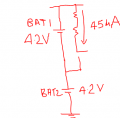
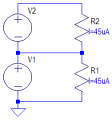
e.g. if a 2000maH Li Ion battery total charging time is 4hours and during charging is being discharged with 45uA as per below resistor divider. So lets say battery is being charge 4 hours in day and 200 days in year (365days) so how many dis-balance appear in the BAT1 w.r.t BAT2.

Could anybody help me to find calculation !
1598205809174.png
 

ci139

Joined Jul 11, 2016
1,993
i've opened up one such at near the end of it's life - the one end of the electrode-pair-ribbons was literally falling appart and was partially missing the coating

each battery is unique - there is no warranty which one ages faster

but the aging speed has to do with the number of charge/discharge cycles , how it's charged and how it's discharged , and the temperatures the battery gets either exposed to or what it developes during charging and discharging

i have NiMH-s that have lasted some 6y for now !!! while the "improved" newer model of the same product line (same manufacturer) barely lasted 6 months

it's all quite RANDOM -- but the statistical average for the speciffic manufacturer and it's product-line (brand) ((the average of)) likely "holds" -- means nothing good for you as you still need to (constanly) pair (and re-pair) your batteries (while recyling more than one set through your application continuously) . . . . . . . . . and still after some period the reached match may develop differences
 

Thread Starter

mishra87

Joined Jan 17, 2016
1,063
i've opened up one such at near the end of it's life - the one end of the electrode-pair-ribbons was literally falling appart and was partially missing the coating

each battery is unique - there is no warranty which one ages faster

but the aging speed has to do with the number of charge/discharge cycles , how it's charged and how it's discharged , and the temperatures the battery gets either exposed to or what it developes during charging and discharging

i have NiMH-s that have lasted some 6y for now !!! while the "improved" newer model of the same product line (same manufacturer) barely lasted 6 months

it's all quite RANDOM -- but the statistical average for the speciffic manufacturer and it's product-line (brand) ((the average of)) likely "holds" -- means nothing good for you as you still need to (constanly) pair (and re-pair) your batteries (while recyling more than one set through your application continuously) . . . . . . . . . and still after some period the reached match may develop differences
Thanks !

My intention to do some math here for above data.
Plz do let me know if anyone need any further data for this calculation !

Application specification i can do if some one explain me above calculation !
 

Thread Starter

mishra87

Joined Jan 17, 2016
1,063
I do not think that is possible. Can you explain your expectation a bit further?
My expectation !
example-
I have two Li Ion series battery.
BAT1 is having resistor divider for battery voltage measurement with 45uA discharge current flowing through it.
BAT2 do not have any measurement circuit.

Lets say if i have 2000mAh battery with charging current of 500mA(CC Mode) so i assume battery will charge in 4hours. During these 4 hours i will read battery voltage so surely it will have some discharge comparatively to BAT2.

Say 45uA discharge for 4 hours from BAT1 and Measurement will be done in every 1sec cycle for 1ms. So in a year lets say 200 days battery charging will be done. So how much is the disbalance voltage from BAT1 to BAT2 for a year ?

Assume BAT2 is in ideal charging state.
 
Last edited:

Papabravo

Joined Feb 24, 2006
22,084
My expectation !
example-
I have two Li Ion series battery.
BAT1 is having resistor divider for battery voltage measurement with 45uA discharge current flowing through it.
BAT2 do not have any measurement circuit.

Lets say if i have 2000mAh battery with charging current of 500mA(CC Mode) so i assume battery will charge in 4hours. During these 4 hours i will read battery voltage so surely it will have some discharge comparatively to BAT2.

Say 45uA discharge for 4 hours from BAT1 and Measurement will be done in every 1sec for 4 hours. So in a year lets say 200 days battery charging will be done. So how much is the disbalance voltage from BAT1 to BAT2 for a year ?

Assume BAT2 is in ideal charging state.
What happens if it is not possible to charge the battery back to the same voltage after each discharge? What happens if you can only recharge the battery to a lower voltage each time you discharge it.?
 

OBW0549

Joined Mar 2, 2015
3,566
Now how do i convert this to battery voltage ?
You cannot.

There is no formula, simple or complex, that will allow you to convert between battery voltage and remaining battery life; the relationship between the two is complex and depends on many factors.

Instead of peppering the people here with questions neither they, nor anybody else, can answer, try educating yourself. This web page might be a good starting point in getting a clue.

One more time, for emphasis: THERE IS NO FORMULA FOR ANY SUCH CONVERSION.
 

Thread Starter

mishra87

Joined Jan 17, 2016
1,063
My expectation !
example-
I have two Li Ion series battery.
BAT1 is having resistor divider for battery voltage measurement with 45uA discharge current flowing through it.
BAT2 do not have any measurement circuit.

Lets say if i have 2000mAh battery with charging current of 500mA(CC Mode) so i assume battery will charge in 4hours. During these 4 hours i will read battery voltage so surely it will have some discharge comparatively to BAT2.

Say 45uA discharge for 4 hours from BAT1 and Measurement will be done in every 1sec cycle for 1ms. So in a year lets say 200 days battery charging will be done. So how much is the disbalance voltage from BAT1 to BAT2 for a year ?

Assume BAT2 is in ideal charging state.
For this data , i did math and i found the discharge will be 0.03616mAh out of 200mAH for 200 days.
Now i do not how do i convert this to into voltage ?
 

Thread Starter

mishra87

Joined Jan 17, 2016
1,063
You cannot.

There is no formula, simple or complex, that will allow you to convert between battery voltage and remaining battery life; the relationship between the two is complex and depends on many factors.

Instead of peppering the people here with questions neither they, nor anybody else, can answer, try educating yourself. This web page might be a good starting point in getting a clue.

One more time, for emphasis: THERE IS NO FORMULA FOR ANY SUCH CONVERSION.
Thanks !
 

Thread Starter

mishra87

Joined Jan 17, 2016
1,063
What happens if it is not possible to charge the battery back to the same voltage after each discharge? What happens if you can only recharge the battery to a lower voltage each time you discharge it.?
Yes there is several permutation and combination but at the moment i am not looking for any other thing.

BAT1 discharge current is 45uA while BAT2 is 0uA.
So if discharge condition is 1ms in every 1sec for 4hours in a day and 220days in a year.
How much BAT1 voltage fall down after one year ?

Hope this clarify my assumption !
 

ci139

Joined Jul 11, 2016
1,993
about https://en.wikipedia.org/wiki/Self-discharge

assuming https://www.researchgate.net/figure...s-The-layer-LMO-represents-the_fig1_272741446
about https://lygte-info.dk/review/batteries2012/UltraFire BRC18650 4000 mAh (Brown-Gold) UK.html

( to compare https://www.ineltro.ch/media/downloads/SAAItem/45/45958/36e3e7f3-2049-4adb-a2a7-79c654d92915.pdf )

say - for the self-discharge ratio of 3% per month the 4000mA·h would loose 0.03×4A·h=120mA·h = [equivalent uniform discharge current of] =
\(= 5mA\ per\ day = \left({\frac57\ mA}\right)≈714µA\ per\ week\ \left({7\ days}\right) = \boxed{\left({\frac5{\left({\frac{365.2425}{12}}\right)}\ mA}\right)≈\mathbf{164µA\ per\ "average\ month"}}=\)
\(=\left({\frac5{365.2425}\ mA}\right)≈13.7µA\ per\ "average\ year"\) -- the last one is a not realistic as the battery looses more charge during one month !!!
at the above the uniform amount of charge - !!! the average monthly loss of 164µA !!! - is converted to different discharge current rates

\(\uparrow\) read for your own interest \(\uparrow\)

Ask more questions . . .
 
Last edited:
Top