Battery Charger with Auto Cut-off Project

Thread Starter

tphuogg

Joined Apr 24, 2021
19
Your BJT is trying to regulate by shunting the excess current to ground which will cause high current and power dissipation.
You need to put the BJT in series with the output with the emitter towards the battery and the Zener connected from the base to ground.
The emitter output voltage to the battery would then be about 0.7V greater than the Zener voltage.
You would also need a base current bias resistor between the collector and emitter to provide the necessary base and Zener current.

Sample circuit below:
You need to calculate the value of R1 to give a nominal Zener current of perhaps 5mA and a base current which is the maximum charging current divided by the minimum current gain (beta or hFE) of the transistor you are using.
You can do that using Ohm's Law, Using the Pwr and D1 voltages to give the voltage across R1.

View attachment 237327
It works perfectly. Thank you so much for saving me :( I got Vbattery = 14.5 with a floating current of 95 mA when the battery is full. The Lm317 is less hot. Once again, thank you
 

MrAl

Joined Jun 17, 2014
13,722
Hi,
I need help with my 12V battery charger project.

The requirement of this project is that the battery charging current has to be between 400 mA - 500 mA. Once the battery is fully charged (13V - 14.6V), the Iout has to be reduced around 150 mA and below. V no load ( before plugging the battery) = 18-20V.

Please suggest me a circuit that can satisfy those requirement. I was trying a the circuit below, but the result was not as expected.
Thank you so much.
View attachment 237286
Taken word for word, what you are describing is a two stage charging algorithm with two distinct charging regimens. That would require detecting when the battery reaches a certain state and then switch the control to a different mode. The two modes would be very distinct with basically nothing in common except that they both provide some level of current.

That is the case with the two distinct modes so we can say that it is partially discrete and therefore nonlinear. However, many chargers in the past did not want to have to deal with this as they wanted to keep it very simple, so they went with a complete linear type of control. Rather than 'switch' to a different mode and stay that way, they implemented a 'taper' control that gradually decreases the current from maximum to minimum. It was so easy to implement that many chargers just used that method until microcontroller chips (and other types of chips) became popular for these kinds of designs.

The key to the simpler linear design is so simple that it is no wonder why they did it. If you add a small value resistor to the output of a perfect voltage regulator, you get a lead acid battery charger with a tapered current profile. It starts from some max and gradually decreases until it reaches some minimum. The resistor sets the maximum current and as the battery voltage rises the difference between the output of the perfect regulator and the battery voltage decreases and thus the charge current decreases (Ohm's Law). Since the current decreases the battery does not charge much after that. In fact, there is an LM317 design just like that on the web somewhere. It's really just a regulator with a small value resistor on the output to make the very output voltage "soft". The more it is loaded, the higher the current, the less it is loaded (as the battery voltage increases) the lower the current.

I am not sure if you are allowed to use a purely linear circuit but if so i thought i would mention that type of charger because it has been around for a very, very long time.
 

MrAl

Joined Jun 17, 2014
13,722
Would that be the one in post #16?
Yes that's the basic idea although i recommend the extra small transistor addition to limit current because i dont think the 0.2 Ohm resistor is adequate for the task entirely and a small transistor and two resistors isnt that much of an addition really. That means we get a hard limit rather than a soft limit.
Of course if the LM317 can naturally limit the current to a level that is required then maybe the extra transistor isnt needed.

I have also used an LM2576 (Simple Switcher) which is almost the same except it is a switcher so the efficiency during charge is much better. Just an extra inductor which isnt too costly either.
Still i add the extra transistor too for current limit. Works really nice and does not get hot no matter what the charge level vs input voltage happens to be.
 

crutschow

Joined Mar 14, 2008
38,549
It seems like my 2n2222 can’t handle the current, as it gets hot very fast.
It's not that it can't handle the current, it can't handle the heat from the current times the voltage drop across it.
That will occur with any transistor.
You need one you can mount on a heat sink.
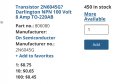
Should I switch to the one with 8 amp?
That is a Darlington, which has a base-emitter voltage of about 2.8V, so you would have to use a lower voltage Zener to get the desired output voltage.

You might consider a 2N3055 or other high current standard BJT, which you will have to mount it on a heat-sink to keep its temperature within limits.
 

Thread Starter

tphuogg

Joined Apr 24, 2021
19
It's not that it can't handle the current, it can't handle the heat from the current times the voltage drop across it.
That will occur with any transistor.
You need one you can mount on a heat sink.
That is a Darlington, which has a base-emitter voltage of about 2.8V, so you would have to use a lower voltage Zener to get the desired output voltage.

You might consider a 2N3055 or other high current standard BJT, which you will have to mount it on a heat-sink to keep its temperature within limits.
Thank you so much. Now I know how to choose a transistor correctly.
 
Top