Battery charger module (BMS)

Thread Starter

drjackool

Joined May 23, 2021
62
Hi
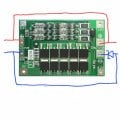
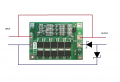
I want use my batteries while them are in charge (I made a mini-UPS for WIFI modem). But my BMS is 3S60A and has 2 ports, one for charge and another for discharge is my wiring correct?! I placed a high amp schottky diode to prevent connect discharge port to charge port. Is that fine or needs two diodes for both + - lines? I think positive lines connected together on PCB!
Thanks
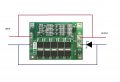
bms.png
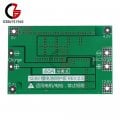
s-l1200.jpg
 

Attachments

Last edited:

Thread Starter

drjackool

Joined May 23, 2021
62
Didyou get any instructions or data sheet with that module?? Any information about how to connect it??
I know how to connect, but my old BMS was 10A and has same port for charge and discharge,for this new one, on Internet says donnot connect charge and discharge ports toghether but i think placing diode solves this problem.
 

MisterBill2

Joined Jan 23, 2018
27,164
I know how to connect, but my old BMS was 10A and has same port for charge and discharge,for this new one, on Internet says donnot connect charge and discharge ports together but i think placing diode solves this problem.
From the response it seems that THE ANSWER IS NO!. There were no instruction!
Of course it may also be that the TS decided to ignore whatever instructions were provided.
What seems certain is that bypassing a Battery Management System will prevent it from having much effect.

So, as the TS is asking if the connections are correct, my answer is "NO!! The connections are CERTAINLY NOT CORRECT!!" I see that marked on both
the top side and the underside of the module are different voltages. Those markings must be for some purpose, such as connection to the battery pack.

It seems that the TS DOES NOT know how to connect this module!!
 
Last edited:

schmitt trigger

Joined Jul 12, 2010
2,027
@TS:
You could be correct, the diode might be an answer.
But….
But unless one has a detailed circuit diagram or a full understanding of the module itself, no one here can provide a definitive answer.
You would have to experiment it yourself.

Normally on other cheap Chinese modules experimenting is not an issue. The worst that could happen is that the module is damaged and a few dollars are lost. But lithium batteries can burst and cause damage.
Thus no one here can tell you, “go ahead, it will be fine.”
 

MisterBill2

Joined Jan 23, 2018
27,164
@TS:
You could be correct, the diode might be an answer.
But….
But unless one has a detailed circuit diagram or a full understanding of the module itself, no one here can provide a definitive answer.
You would have to experiment it yourself.

Normally on other cheap Chinese modules experimenting is not an issue. The worst that could happen is that the module is damaged and a few dollars are lost. But lithium batteries can burst and cause damage.
Thus no one here can tell you, “go ahead, it will be fine.”
I will respond with the opposite answer: NO, STOP!! The connections shown are not at all correct!!!
 

Ya’akov

Joined Jan 27, 2019
10,226
Hi
I want use my batteries while them are in charge (I made a mini-UPS for WIFI modem). But my BMS is 3S60A and has 2 ports, one for charge and another for discharge is my wiring correct?! I placed a high amp schottky diode to prevent connect discharge port to charge port. Is that fine or needs two diodes for both + - lines? I think positive lines connected together on PCB!
Thanks
Welcome to AAC.

Two of the critical functions of a BMS are overcurrent and overdisharge protection. They are just what they sound like—they prevent discharging the battery below a critical voltage that can make it dangerous to recharge, and discharging the battery at a rate that produces dangerous currents.

Each of these fault conditions carries the risk of fire, and it is not hard to find many videos of failed BMSs resulting in catastrophic fires leading to property damage, injury, and even death.

You are correct that the charge and discharge high side (+) connections are physically common. This is because the board uses low side (-) switching. That is, it turns the 0V/negative connection on or off through the 10 N-Channel MOSFET transistors (the biggest squarish components on the board). There are 10 in order to be able to dissipate enough heat to handle 60A.

The high side connection in your wiring diagram is redundant and irrelevant—it already exists on the board, but the low side connection completely bypasses the protection the BMS is supposed to provide by making it impossible for the BMS to disconnect the battery from the load.

If the battery voltage drops below the overdischarge threshold, the BMS will try to turn on the discharge output with no effect and it will continue to discharge until the battery's/cell's internal protection shuts it down.

At that point the battery may well appear completely dead and become useless—or worse, it will have no internal protection and dendrites will form in the cells.

This can create short circuits that will cause overheating during an attempt to charge the battery, resulting in an electrolyte fire that is basically a self-oxygenating flame thrower that is extremely hard to extinguish.

Similarly the overcurrent protection will be ineffective, and best case things will melt, but the worst case is another thermal runaway fire involving the cells of the battery.

In any case, your goal of creating an online UPS this way is a naive error. Instead, find a board that actually supports the operation—usually called pass-through charging. Or, you can get a pre-built 12V UPS. But please, don't risk this it is playing with fire—literally.
 

MisterBill2

Joined Jan 23, 2018
27,164
I ask now: What about the four corner terminals and the three voltages there?? My guess is that they would be the connection points for different series connections of batteries. But the TS never mentioned nor asked about what they might be for. It also seems that nobody else noticed them either.
So if the TS is so much smarter than the rest of us, why bother posting,
 

Thread Starter

drjackool

Joined May 23, 2021
62
.... but still enabling a potentially lethal fire-starter. Didn't you read post #7 ?
I want just share the load and battery charging, I ask ChatGPT and she said it possible and has two way one by diode is simpler like my circuit and another by mosfet is very small voltage drop. So i use diode voltage drop at mV is not matter for my usage
 

MisterBill2

Joined Jan 23, 2018
27,164
Did the TS discover that the charge and discharge ports are not at all to be connected?? AND WHERE did the TS connect the batteries?? Really, it is indeed all very puzzling, especially about tying the charge and discharge terminals like that.
I have connected both a load and a charger to a battery at the same time, but that was a large, lead-acid rechargable battery and also a low current charger. Other battery technologies are much more demanding of gentler treatment.

Especially for ( DELETED........) Batteries, current, voltage, and power were covered in the first semester basic electricity class. First semester first year.
 

Alec_t

Joined Sep 17, 2013
15,101
I ask ChatGPT and she said it possible
ChatGPT is quite capable of hallucinating and warns "ChatGPT can make mistakes. Check important info."
How to use Lithium batteries safely is important info. What you are trying to do bypasses safety features.
 

Ya’akov

Joined Jan 27, 2019
10,226
If the battery you are using has internal protection (per cell or for the battery) using the DWO1 protection IC or a functional equivalent, then you can "safely" use your scheme but that doesn't mean it is a good idea.

I believe the four corner pads labeled with voltages are balancing inputs. If you don't use them you will eventually end up with a non-functional battery—long before the cells are actually worn out.

In general, this is an expensive—in terms of total cost and in time—"cheap", pseudo-solution. You really should do things correctly.

If there is no protection, this is a foolish shortcut that you may come to regret rather extremely; though I hope not. I can tell you I wouldn't do it, and I do things with lithium batteries some folks would call "dangerous". (I don't believe what I choose to do is dangerous based on both knowledge and track record.)
 

Attachments

kaindub

Joined Oct 28, 2019
176
The labelling of the board is misleading. A BMS has no charge or discharge function.
Using my logic and knowledge of BMS, connect the battery to the terminals labelled Discharge
The charger and the load is connected to the terminals called Charge.
BTW this does not look like a true BMS. I think its an active balancer with a low volts cutout
 

MisterBill2

Joined Jan 23, 2018
27,164
The labelling of the board is misleading. A BMS has no charge or discharge function.
Using my logic and knowledge of BMS, connect the battery to the terminals labelled Discharge
The charger and the load is connected to the terminals called Charge.
BTW this does not look like a true BMS. I think its an active balancer with a low volts cutout
Given that the TS has not mentioned at all anything about any information received with the device, I am guessing that the board assembly came with no data sheet, nor any information at all.

It will do the rest of us a good service, if the TS tells us what supplier sold this device shown, so that we can avoid dealing with that seller.
 

Ya’akov

Joined Jan 27, 2019
10,226
The labelling of the board is misleading. A BMS has no charge or discharge function.
Using my logic and knowledge of BMS, connect the battery to the terminals labelled Discharge
The charger and the load is connected to the terminals called Charge.
BTW this does not look like a true BMS. I think its an active balancer with a low volts cutout
You are mistaken.

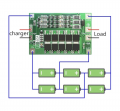
As can be seen by this example wiring diagram, this BMS uses a dedicated charger port, and it is the charger that provides the CC/CV charge profile for the battery while the BMS is providing balancing and OV, OD, and OC protection.

1755263459648.png
The load and battery are connected to the load pads and the three other balancing pads (0V, 4.2V, 8.4V). Note that the 12.6V pad is on a large shared float with the + discharge pad. It would "work" to connect only the battery out put to that pad but disable balancing.

Logically:

  1. The bank of NMOS must be able to disconnect the battery from the charger and load to provide the protection it is designed for. That being the case, the charge and load low side must have a path through the array. Connecting the load - to the 0V pad does this.
  2. The 12.6V balancing pad is common to the discharge pad. This means the high side of the battery, and consequently the load, must be connected to the discharge side.​
 

MisterBill2

Joined Jan 23, 2018
27,164
You are mistaken.

As can be seen by this example wiring diagram, this BMS uses a dedicated charger port, and it is the charger that provides the CC/CV charge profile for the battery while the BMS is providing balancing and OV, OD, and OC protection.

View attachment 354264
The load and battery are connected to the load pads and the three other balancing pads (0V, 4.2V, 8.4V). Note that the 12.6V pad is on a large shared float with the + discharge pad. It would "work" to connect only the battery out put to that pad but disable balancing.

Logically:

  1. The bank of NMOS must be able to disconnect the battery from the charger and load to provide the protection it is designed for. That being the case, the charge and load low side must have a path through the array. Connecting the load - to the 0V pad does this.​
  2. The 12.6V balancing pad is common to the discharge pad. This means the high side of the battery, and consequently the load, must be connected to the discharge side.​
The circuit that I see in post #17 is the first one that is from one who actually has a clue.
Making the guess that all assemblies are the same is really an incredibly poor choice. I asked about what went to all of those corner connections quite a ways back. The TS ignored them totally. That seldom works.
 
Top