Facebook
 Google
 GitHub
 Linkedin
Let:
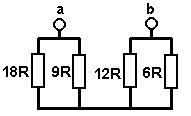
\(R1 = 18\Omega\\R_2 = 12\Omega\\R_3 = 9 \Omega\\R_4 = 6\Omega\\\)
If I assume \(R_1 & R_2\) are in series and \(R_{12}\) in parallel with \(R_{34}\) the equivalent resistance is correct but I have no solid reasoning behind this conclusion. As I see it the current in the top node connecting \(R_1 & R_2\) has two paths to choose from?
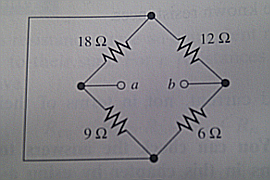
\(R1 = 18\Omega\\R_2 = 12\Omega\\R_3 = 9 \Omega\\R_4 = 6\Omega\\\)
If I assume \(R_1 & R_2\) are in series and \(R_{12}\) in parallel with \(R_{34}\) the equivalent resistance is correct but I have no solid reasoning behind this conclusion. As I see it the current in the top node connecting \(R_1 & R_2\) has two paths to choose from?