Basic Battery Question

Thread Starter

DC_Kid

Joined Feb 25, 2008
1,242
this is basic Q, if i have 12v lead acid batt that is at exactly 12v (basically depleted) and i attach a charger to recharge the batt, the charger must be at a higher voltage then the batt so amps (energy) flow into the batt. question is, when you attach the charger leads to batt and then put a voltage meter on the terminals, does the meter read batt voltage (increasing over time as the batt charges) or does the meter read the charger open circuit voltage?
 

Thread Starter

DC_Kid

Joined Feb 25, 2008
1,242
when car is off the batt reads about 12.6v, when the car is running the batt reads ~14.4v, but if i take +wire off the car batt while car is running i still read about 14.4v on the charger (alternator), the alternator voltage.

this is why i asked the Q, what exactly am i reading ?
 
Last edited:

dl324

Joined Mar 30, 2015
18,326
when car is off the batt reads about 12.6v, when the car is running the batt reads ~14.4v, but if i take +wire off the car batt while car is running i still read about 14.4v, the alternator voltage.
You're reading the battery voltage. If you measure the voltage later, it will have dropped due to the internal resistance of the battery.

The alternator feeds the voltage regulator...
 

Thread Starter

DC_Kid

Joined Feb 25, 2008
1,242
You're reading the battery voltage. If you measure the voltage later, it will have dropped due to the internal resistance of the battery.

The alternator feeds the voltage regulator...
i am still not following.

car running, meter on batt reads 14.4v
i then take alternator off the batt (car running), alt reads 14.4v on meter, but the batt reads ~12.6v on meter

from that it appears the meter reads charger voltage when charger is attached to the batt.

lets say the batt is at 12.00v, i do the same test, alt on batt i read ~14.4v, let it run like that for say 20min, i read again and see 14.4v, but now i take the alt off batt, alt reads 14.4v and the batt now a tad higher, say 12.10v.
 

crutschow

Joined Mar 14, 2008
38,503
When the charger is connected to the battery you obviously can only read one voltage.
That's the battery voltage while being charged by the charger (or alternator).

If they are not connected, then you are obviously reading the voltage of each separately.

Don't understand why that's confusing. :confused:

Note that you can damage your car's electronics if you operate it without a battery connected (and that can be expensive to fix).
 

Thread Starter

DC_Kid

Joined Feb 25, 2008
1,242
When the charger is connected to the battery you obviously can only read one voltage.
That's the battery voltage while being charged by the charger (or alternator).

If they are not connected, then you are obviously reading the voltage of each separately.

Don't understand why that's confusing. :confused:

Note that you can damage your car's electronics if you operate it without a battery connected (and that can be expensive to fix).
why is it i am measuring batt voltage and not charger voltage? if the batt by itself is 12.4v and then i hook to it the alternator and now the voltage reads 14.4, isnt that voltage the alternator voltage, because in reality the batt will by itself never get up to 14.4v

lets take a simple ckt, a 12v batt, 14.4v wall wart, and a 1k resistor between batt + and charger +.

i turn it on, meter now on batt, meter should read 12v. meter now on charger, meter should read 14.4v. all at the same time we have amps going into the batt via the 2.4v diff across 1k ohms (batt and charger ohms left out here).

but now lets take the resistor out, what exactly should my meter read when wall wart is direct on batt. should i read 12v or 14.4v ??

the Q is not "is it batt or charger", the Q is "does it read 12.4v, or 14.4v"

if the answer is 12.4v then it would appear that the meter is reading batt voltage. if the answer is 14.4v then it would appear that the meter is reading the charger voltage.

look at it from a differential view, i put 14.4v onto a 12v batt, my meter should read 14.4. but now i put 16.6v onto the same 12v batt, my meter reads 16.6v. thus i am measuring the higher of voltages, the charger voltage.

how about a variable voltage supply on a 12v batt. i raise voltage above 12v to 18v, my meter reads the voltage supply of 18v, but now i drop the supply to 11v, my meter reads 12v of batt.

always reads the higher of voltages, yes?
 
Last edited:

crutschow

Joined Mar 14, 2008
38,503
but now lets take the resistor out, what exactly should my meter read when wall wart is direct on batt. should i read 12v or 14.4v ??
It will read whatever the voltage is when the wall wart maximum current is charging the battery.
You can't know that without actually doing the measurement.
It's not an either/or answer.
 

wayneh

Joined Sep 9, 2010
18,104
why is it i am measuring batt voltage and not charger voltage?
When they're connected, it's both. The part that may be confusing you is that when current is flowing, the voltage you measure at the poles of the battery becomes a function of that current. Under a load (say, headlights), the voltage will be lower than when the lights are turned off. When a battery is under charge, the current is flowing 'backwards' and the voltage seen at the poles has to be higher than the resting voltage in order to drive the current through the battery.

In both cases, the lager the effect of current on voltage, the more likely your battery may be failing by high internal resistance.
 

MrChips

Joined Oct 2, 2009
34,807
You are ignoring the fact that the battery is an electro-chemical cell, not just a voltage source.

When the battery is being charged, the voltage measured is both the battery voltage and the charger voltage. You also have to take into account the internal resistance of the battery as well as that of the charger.

The battery gets a voltage assist from the charger at the same time it is being charged. When you remove the charger the battery voltage falls.
 

WBahn

Joined Mar 31, 2012
32,823
when car is off the batt reads about 12.6v, when the car is running the batt reads ~14.4v, but if i take +wire off the car batt while car is running i still read about 14.4v on the charger (alternator), the alternator voltage.

this is why i asked the Q, what exactly am i reading ?
You are reading the voltage at the terminals of each when they are connected together. That voltage will be the voltage that corresponds to the current that needs to flow to satisfy KVL and KCL.

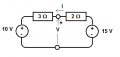
Imagine that the battery is actually an ideal battery with a series resistor. For simplicity, let's say that it is a 10 V battery and has a 3 Ω resistor in series with it. Now let's say the charger behaves like a 15 V battery with a 2 Ω resistor in series with it.

Your circuit looks like this:

charge.png

There will be 1 A of current flowing and the voltage you will read will be 13 V.
 

ian field

Joined Oct 27, 2012
6,536
The charger is not connected to an open circuit. It is connected to a battery. It's that simple.
That's not always entirely accurate.

In a discharged battery, most of the acid is in the plates and the electrolyte is heading in the general direction of pure distilled water - if it ever made it all the way to completely 100% pure distilled water, you wouldn't be able to get any charge current to flow. IOW: an open circuit.

Some smart chargers go up as high as 30 or 40V to get things moving when the electrolyte is depleted acid wise.

AFAIK: the old iron cored transformer type were; "impedance wound" - they have horrendously lousy regulation. The voltage is pretty high with not much load, but soon pulls down once the charge current starts moving.
 

#12

Joined Nov 30, 2010
18,224
That's not always entirely accurate.

In a discharged battery,
Sorry, I was answering this Thread with this particular question and these particular voltages with no intent to give the Universal Truth for All Cases and Conditions. That level of answer usually comes after the T.S. clarifies the range and quality of answers that he wants and he can understand.;)
 

ian field

Joined Oct 27, 2012
6,536
Sorry, I was answering this Thread with this particular question and these particular voltages with no intent to give the Universal Truth for All Cases and Conditions. That level of answer usually comes after the T.S. clarifies the range and quality of answers that he wants and he can understand.;)
It was a wide open question, the correct answer depends on the state of the battery and the type of charger.

My answer was the basic foundations on which everything else is built.

It explains why a flat but recoverable battery might be close to an open circuit. A sulphated battery is highly likely to be open, and frequently not recoverable. A standing terminal voltage of 12V could well be the borderline with not recoverable, I can usually get them up - but often not with a commercial charger.
 

Thread Starter

DC_Kid

Joined Feb 25, 2008
1,242
in my setup, APEX 100Ah AGM's and a MinnKota PC230 smart charger.
my Q was related to a batt monitor i made using lm358, after is goes into alarm state was needing it to stop alarming once the batt is on the charger.
 

ian field

Joined Oct 27, 2012
6,536
in my setup, APEX 100Ah AGM's and a MinnKota PC230 smart charger.
my Q was related to a batt monitor i made using lm358, after is goes into alarm state was needing it to stop alarming once the batt is on the charger.
A flat battery will go way above the recommended 14.4V on charge, it sinks down as charge current recovers and may sink under 10V.

Most smart chargers detect the drop in current at full charge and throttle back to about 13.6V to minimise gassing.
 
Top