Facebook
 Google
 GitHub
 Linkedin
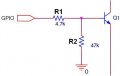
When I'm to calculate the needed base resistor in order to insert the transistor into saturation (where its VCE is minimal), I'm using only one resistor, connected between the voltage-source and the base (R1 for example).
I saw in several applications that a second resistor is between the base and ground.
I'd like to ask please some questions:
1. About Configuration:
Is it aimed to be connected between base and ground or in parallel to the BE junction? (In case the Emitter isn't grounded).
2. About Purpose:
Why is it used?
3. About Calculation:
What are the guidelines for calculating each of the two resistors?
I'd appreciate if you could treat each question separately for clearance.
Thank you very much.

I saw in several applications that a second resistor is between the base and ground.
I'd like to ask please some questions:
1. About Configuration:
Is it aimed to be connected between base and ground or in parallel to the BE junction? (In case the Emitter isn't grounded).
2. About Purpose:
Why is it used?
3. About Calculation:
What are the guidelines for calculating each of the two resistors?
I'd appreciate if you could treat each question separately for clearance.
Thank you very much.
Attachments
-
 10.6 KB Views: 95