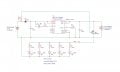
Here's the updated schematic. Does anyone know what the PNP base resistor value should be? I'm coming up with 3.2K, but I'm not quite sure if that is correct.
How is it redundant? Here is the scenario... Battery gets charged all day. Night comes and you decide to flip the switch and light up the cockpit. Well, after a few drinks and some great conversation you get tired and head into the cabin to sleep... completely forgetting to flip the light switch off. Thankfully, when the sun rises the next morning the PNP transitor has cuttoff the LEDs and the solar panel continues to charge the battery.
When it’s sunny, the output of the solar cell is high at the transistors base, which opens the transistor and switches off the LEDs.
When it gets dark, the solar cells voltage drops to zero, the current flows out the transistors base and through the solar cell to ground, this closes the transistor letting the current flow through the LEDs.
Your total LED current is 150mA. When a transistor is used as a switch, the rule of thumb is to assume a current gain of 10, to ensure the transistor switches on hard. Therefore the required base current will be 15mA, hence the base resistor will be (3.7-.7)V/15mA = 200Ω. Use 220Ω (as ES suggested in post #22).
What is the maximum voltage output of the solar cell? There is a risk that it could cause reverse breakdown of the transistor base junction unless the voltage is clamped (with, say, a zener diode from base to ground).
When it’s sunny, the output of the solar cell is high at the transistors base, which opens the transistor and switches off the LEDs.
When it gets dark, the solar cells voltage drops to zero, the current flows out the transistors base and through the solar cell to ground, this closes the transistor letting the current flow through the LEDs.
Your total LED current is 150mA. When a transistor is used as a switch, the rule of thumb is to assume a current gain of 10, to ensure the transistor switches on hard. Therefore the required base current will be 15mA, hence the base resistor will be (3.7-.7)V/15mA = 200Ω. Use 220Ω (as ES suggested in post #22).
What is the maximum voltage output of the solar cell? There is a risk that it could cause reverse breakdown of the transistor base junction unless the voltage is clamped (with, say, a zener diode from base to ground).
You can have zener's work down to close to 1V, but you need to also be aware that zeners tend to require at least 10mA in order to function. Also, are you preventing too much current from flowing into your LEDs? a 1-ohm resistor won't protect them.
I agree, you learn more by doing, but so far, you seem to be letting others kind of build it for you. But, you have what's most important, the desire, and you are asking questions, so keep going. But I *urge* you to get this book:
Understanding Basic Electronics
(Publication No. 159 of the Radio Amateur's Library) 1st Ed.
Author: Larry D. Wolfgang
ISBN-13: 978-0872593985
ISBN-10: 0872593983
It is a very fun text, and will answer literally all the questions you have, with examples and problems. Not only will it give you a means to learn in an organized way, it will give you a valuable reference you can go back to, again and again.
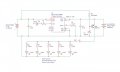
Thanks dl324, the specs clearly state that the base max voltage for transistor 2N4403 is indeed 5V. As suggested, I've added a zener diode (1N4732) to the circuit which has a breakdown voltage of 4.7V. Here's an updated schematic. If anyone sees any issues, please let me know. Thank you all for your help!
An alternative to using a zener would be to connect a normal silicon diode in series with the 220Ω resistor. This would have the advantage of not wasting solar cell power in the zener.

 Facebook
 Google
 GitHub
 Linkedin