Bandwidth and MB/s i don't understand

Thread Starter

Motanache

Joined Mar 2, 2015
652
I don't understand why bandwidth is related to baudrate or MB/s?

A simple example:
I have a transmitter that emits a sine wave with a very small bandwidth. Let's say 433Mhz with 25KHz bandwidth.
And I want to transmit with 460kbps

This would mean a spectral efficiency of ~20 bits per Hz, impossible according to theory, especially for amplitude modulation.


But I imagine a sinusoid modulated in amplitude, mathematically. A graph.

We make this function mathematically FFT (Fast Fourier Transform) and get the bandwidth.

I don't find a clear connection between the bandwidth and the amount of information transmitted because amplitude modulation can change the sinusoid very little!

Maybe I will test this somehow!
 

crutschow

Joined Mar 14, 2008
38,316
With a 25kHz bandwidth, there are a maximum of 25k sinewave cycles per second of information.
How do you propose amplitude modulating them at a 460k per second rate?
 

nsaspook

Joined Aug 27, 2009
16,249
The common way to see the relationship between bandwidth and MB/s is to understand and look at Digital Modulation Constellation Diagrams.
AM is primarily a analog modulation that's not efficient in directly encoding digital signals. ~20 bits per Hz is possible with efficient digital modulation methods.

https://nuwaves.com/wp-content/uploads/AN-005-Constellation-Diagrams-and-How-They-Are-Used1.pdf

In any signal modulation scheme, there are three variables by which a carrier signal can
be manipulated to convey information: amplitude, frequency, and phase. Amplitude
modulation (AM) varies the magnitude (or amplitude) of a signal, while frequency
modulation (FM) and phase modulation (PM) both alter the phase angle of a signal. This
is because frequency is a measure of the rate of change of the phase, while phase is
measured relative to a reference angle (typically 0° relative to carrier signal in digital
modulation)


Ya’akov

Joined Jan 27, 2019
10,226
Bandwidth isn’t sufficient to calculate the Shannon capacity of a channel. The formula is:
\[{C = B \cdot \log_2 \left(1 + \frac{S}{N}\right)} \\
{where:} \\
C = \text{Channel capacity in bits per second (bps)} \\
B = \text{Bandwidth of the channel in hertz (Hz)} \\
S = \text{Signal power (average)} \\
N = \text{Noise power (average)}
\]
This formula characterizes the maximum date rate of a Shannon Channel as you can see the SNR (Signal to Noise Ratio) has a direct effect on capacity. Higher data rates use more power and noisier channels have less capacity.

But this is theoretical. Simple modulation schemes such as ASK (Amplitude Shift Keying) can utilize less of the Shannon capacity than more sophisticated schemes such as QPSK (Quadrature Phase Shift Keying)

The difference lies in how many bits per symbol the scheme provides. The symbol rate (bud rate) is the the number of transitions per second—that is, how quickly you can switch the state of the data.

Each symbol can transmit one or more bits. The ASK scheme has a modulation order of 1, or 1 bit per symbol which QPSK doubles this to 2. 16-QAM (Quadrature Amplitude Modulation) has 16 symbols giving it 4 bits per symbol and 64-QAM with 64 symbols has 6 bits per symbol.
 

nsaspook

Joined Aug 27, 2009
16,249
In addition to what nsaspook mentioned, all of the digital modulation schemes utilize some form of compression. Lossless or lossy.
Well, there is content-independent compression (pre-processing data with a program like zip or with manual/mechanical coding systems) and content-dependent compression (MPEG and various codecs). Long before modern digital systems we could send pre-compressed information blocks using analog based, single EM wave variable (usually amplitude or frequency) modulation systems.

https://www.navy-radio.com/rtty.htm

And there is the classic example of analog color TV signal content-dependent compression.
https://en.wikipedia.org/wiki/Analog_television
U and V signals
A color signal conveys picture information for each of the red, green, and blue components of an image. However, these are not simply transmitted as three separate signals, because: such a signal would not be compatible with monochrome receivers, an important consideration when color broadcasting was first introduced. It would also occupy three times the bandwidth of existing television, requiring a decrease in the number of television channels available.

Instead, the RGB signals are converted into YUV form, where the Y signal represents the luminance of the colors in the image. Because the rendering of colors in this way is the goal of both monochrome film and television systems, the Y signal is ideal for transmission as the luminance signal. This ensures a monochrome receiver will display a correct picture in black and white, where a given color is reproduced by a shade of gray that correctly reflects how light or dark the original color is.

The U and V signals are color difference signals. The U signal is the difference between the B signal and the Y signal, also known as B minus Y (B-Y), and the V signal is the difference between the R signal and the Y signal, also known as R minus Y (R-Y). The U signal then represents how purplish-blue or its complementary color, yellowish-green, the color is, and the V signal how purplish-red or its complementary, greenish-cyan, it is. The advantage of this scheme is that the U and V signals are zero when the picture has no color content. Since the human eye is more sensitive to detail in luminance than in color, the U and V signals can be transmitted with reduced bandwidth with acceptable results.
 
Last edited:

schmitt trigger

Joined Jul 12, 2010
2,027
Indeed. Color TV is an excellent example of compression.
In addition to the IQ (or UV) color signals, the interlaced scanning also reduces the bandwidth requirements.
 

Thread Starter

Motanache

Joined Mar 2, 2015
652
Thank you very much!

Here I found the answer:
https://forum.allaboutcircuits.com/threads/bandwidth-and-mb-s-i-dont-understand.203780/

My question started after I studied the old phone As I put in my signature,:
https://digamyhobbyen.weebly.com/

I preferred this phone because it is the last one where I can find datasheets on the Internet for most of the components for free on the Internet.

I thought wrongly that I/Q quadrature modulation can only have 4 points in the I/Q graph,

Now it's clear to me and I can ask you other curiosities!
 

nsaspook

Joined Aug 27, 2009
16,249
Indeed. Color TV is an excellent example of compression.
In addition to the IQ (or UV) color signals, the interlaced scanning also reduces the bandwidth requirements.
For digital data transmission using analog systems this old guy was one of the best.
https://forum.allaboutcircuits.com/...-on-the-fourier-transform.156589/post-1353608

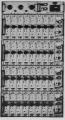
All of those tty channels (8-per rack modulation rack with up to 4 racks) were on one HF 3kHz side-band.
1731079382611.png
https://www.navy-radio.com/rtty-mux-ucc1.htm
 

Thread Starter

Motanache

Joined Mar 2, 2015
652
For modern devices bought from regular stores, what is the frequency, the maximum power, the bandwidth of a channel and the spectral efficiency of that? (MB/S) la 3G, 4G si 5G?


If I understand well the reason for keeping the spectral efficiency low, is that increasing the spectral efficiency would lead to an increase in reception errors. Is that correct?

I would take a mathematical example to convince myself.


And I could measure the bandwidth in practice with my old Stivk RTL SDR that I don't know why it doesn't work anymore.


We could even measure the bandwidth.

I have a ham radio license!
 
Last edited:
Top