Automatic water level control involving two tanks

MisterBill2

Joined Jan 23, 2018
27,574
The state of the floatless switch being latched does not matter, since it is not required after it triggers the latching control circuits to either start the pump to run until the upper tank is filled and it is stopped by the upper float switch, or it senses the lower tank being empty and stops the pump until the lower tank is full.
 

sghioto

Joined Dec 31, 2017
8,634
In short, how do I connect a float switch for supply tank and floatless relay switch for drainage tank in a water level control circuit involving two tanks?
First thought without Timer.
Assuming Float switches are open when submerged.
The operation starts with the Kill switch open and both Tanks full.
At this juncture the relay in the C61F-GP floatless sensor is closed = Pump OFF...... see Note.
Kill switch ON.
As water level drops in the Upper Tank the Upper Float switch closes first. Relay RL1 OFF and Pump still OFF.
When the water level drops below the Lower Float switch Relay RL1 is activated and latched by contact RL1B.
This starts the Pump through the Kill switch, relay contact RL1A and the contacts inside the C61F-GP sensor.
When the water level rises above the Upper float switch in the Upper Tank relay RL1 drops out and the pump shuts OFF.
When the pump is running and the water level drops below the lower probe in the Lower Tank the relay in the C61F-GP sensor deactivates shutting OFF the Pump.
The Lower Tank must be refilled to the upper probe level on the C61F-GP sensor to continue the operation.

1734555979502.png
 
Last edited:

kaindub

Joined Oct 28, 2019
179
I’m sorry to say that the solution to this problem is really a trivial one.
Anyone with any skills in relay logic would knock out a circuit in a few minutes.
Could the original poster at least attempt to draw out such aA circuit and post it.
What they are asking in fact is for one of the contributors to do the whole design.
 

Thread Starter

Cuteajax

Joined Jan 31, 2021
15
First thought without Timer.
Assuming Float switches are open when submerged.
The operation starts with the Kill switch open and both Tanks full.
At this juncture the relay in the C61F-GP floatless sensor is closed = Pump OFF...... see Note.
Kill switch ON.
As water level drops in the Upper Tank the Upper Float switch closes first. Relay RL1 OFF and Pump still OFF.
When the water level drops below the Lower Float switch Relay RL1 is activated and latched by contact RL1B.
This starts the Pump through the Kill switch, relay contact RL1A and the contacts inside the C61F-GP sensor.
When the water level rises above the Upper float switch in the Upper Tank relay RL1 drops out and the pump shuts OFF.
When the pump is running and the water level drops below the lower probe in the Lower Tank the relay in the C61F-GP sensor deactivates shutting OFF the Pump.
The Lower Tank must be refilled to the upper probe level on the C61F-GP sensor to continue the operation.

View attachment 338362
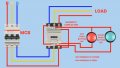
Thank you. I have a strong feeling that you have a strong hang on this design. Just one more favour: could you please redraw your diagram but in a form like in the diagram below. I'm kinda a rookie in the kind of your electronic notations. Thanks in advance.maxresdefault (2).jpg
 
Hi Cuteajax, Could you let me know if you resolved your request? I can help you with a simple relay logic circuit to do what you need.
You do not need a timer to top up the upper water tank level, just place the float switch at the required level.
You can use the timer to debounce the float switch when filling up the tank.
RPSV
 

sghioto

Joined Dec 31, 2017
8,634
Thank you. could you please redraw your diagram but in a form like in the diagram below. I'm kinda a rookie in the kind of your electronic notations. Thanks in advance.
Is that diagram representative of what you actual have in place?
What are the details on the float switches for the upper tank?
 

Thread Starter

Cuteajax

Joined Jan 31, 2021
15
Is that diagram representative of what you actual have in place?
What are the details on the float switches for the upper tank?
No, it is not. I just tend to understand when circuits are represented in this kind of pictures rather than the standard schematic diagrams
 
Top