Audio Signal VU Meter

Thread Starter

Aedan

Joined Feb 27, 2025
5
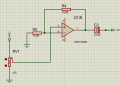
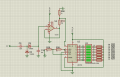
Hi there, I am creating an audio headset tester and need to add a vu meter to display the amplitude of the output waveform, the signals amplitude can get changed with a potentiometer earlier in the circuit. I have it set up so far that the audio signal goes into a diode and capacitor to push it into the positive range and then into a peak detector that will be displayed on the vu meter, I am using a LM3914 to drive a bargraph, the signal input to pin 5 is 5v max so I have a voltage divider to get the output from the detector to 5v max, the problem is that since it is a resistor and capacitor it is creating a filter that it altering my audio signal output. To try fix this I have a op amp acting as a buffer and then the divider after. I am wondering if there is a easier way to do this, also proteus seems to bug quite a bit as when I change the potentiometer the bargraph doesn't change until I restart the simulation.
1740687032050.png
 

MrChips

Joined Oct 2, 2009
34,628
You should use a single supply op amp such LM324 or LM358 to buffer the signal first then amplify it.
You should also be using an LM3915 instead of LM3914 for a VU meter.
 

Thread Starter

Aedan

Joined Feb 27, 2025
5
You should use a single supply op amp such LM324 or LM358 to buffer the signal first then amplify it.
You should also be using an LM3915 instead of LM3914 for a VU meter.
The signal from the potentiometer goes through an amplifier that is outputting my signal. Are you saying to add the buffer before the diodes and capacitors? SWC is a switch that is swapping between a test signal generated by a schmitt trigger and a microphone signal. I can post the whole circuit if its any better.
Also I was thinking of using the 3915 but I only had 3914 with me, the range that it has now seems to work but if I can find a 3915 I may end up switching it out.
1740687846262.png
 

schmitt trigger

Joined Jul 12, 2010
2,027
the problem is that since it is a resistor and capacitor it is creating a filter that it altering my audio signal output.
View attachment 343359
A filter? Where, which components are acting like a filter?
All I see is a peak detector, to convert the audio signal into a DC voltage which varies with the signal strength (correct), which is then fed into the bar graph driver (correct).
 

Thread Starter

Aedan

Joined Feb 27, 2025
5
A filter? Where, which components are acting like a filter?
All I see is a peak detector, to convert the audio signal into a DC voltage which varies with the signal strength (correct), which is then fed into the bar graph driver (correct).
Before adding the buffer, I had R13 and R40 connected to C10 and D4, with the center going into pin 5 and r40 to ground
 

MrChips

Joined Oct 2, 2009
34,628
Buffer the signal before driving C9 and D4.
C10 is a peak detector. You need a resistor across C10 otherwise C10 will not discharge.
 

Thread Starter

Aedan

Joined Feb 27, 2025
5
Buffer the signal before driving C9 and D4.
C10 is a peak detector. You need a resistor across C10 otherwise C10 will not discharge.
Thats working better now, thanks for the help. I was trying to modify the vu meter thats shown in this video so that I wouldn't have to put a bunch of transistors and figure out the different dividers.
 

Ramussons

Joined May 3, 2013
1,567
Hi there, I am creating an audio headset tester and need to add a vu meter to display the amplitude of the output waveform, the signals amplitude can get changed with a potentiometer earlier in the circuit. I have it set up so far that the audio signal goes into a diode and capacitor to push it into the positive range and then into a peak detector that will be displayed on the vu meter, I am using a LM3914 to drive a bargraph, the signal input to pin 5 is 5v max so I have a voltage divider to get the output from the detector to 5v max, the problem is that since it is a resistor and capacitor it is creating a filter that it altering my audio signal output. To try fix this I have a op amp acting as a buffer and then the divider after. I am wondering if there is a easier way to do this, also proteus seems to bug quite a bit as when I change the potentiometer the bargraph doesn't change until I restart the simulation.
View attachment 343359
How does C10 discharge? D4 will charge the capacitor to a maximum, then what happens when the O/P reduces ....?
 

MisterBill2

Joined Jan 23, 2018
27,186
Aside from the issues of making the ten segment display function, consider the actual resolution of a ten element display. Certainly the accuracy is limited by the resolution. That is unavoidable in a display of this type.
I suggest using an analog meter to see the amplitude of the signal supplied to the headphones being checked. The resolution of the readings can be much better.
 

MisterBill2

Joined Jan 23, 2018
27,186
In addition, to measure the response of headphones, a log-scale VU meter is the wrong choice. A LINEAR display of the applied voltage will provide a much more useful indication. And still, the resolution will probably not be adequate for a serious evaluation
 

Audioguru again

Joined Oct 21, 2019
6,826
Your 1N4004 high current rectifiers are too slow for audio. Use 1N4148 diodes instead.
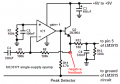
You do not have a peak detector, your diodes have a very low input impedance that charges your capacitor slowly and missies low frequencies.
My peak detector uses a transistor as a diode with current gain and a single-supply opamp with a high input impedance driving the transistor.
 

Attachments

Top