Atomic Clock disciplined with Rubidium

AnalogKid

Joined Aug 1, 2013
12,142
It needs to divide by 10^7 which is (2^7)*(5^7).
Two chips. One 7-bit binary counter followed by one of these:

MC14534 if you can find it - 5 decades in 1 chip.

CD4536 - 24 bits, 1 chip. Stock at Digi-Key

MC14521 - 24-bit counter part that brings out the last 8 bits. Stock at Digi-Key.

Rather than an 8-bit gate, I like using diodes to decode non-binary trigger values, mainly because I have lotsa diodes.

ak
 
Last edited:

Ian0

Joined Aug 7, 2020
13,132
Two chips. One 7-bit binary counter followed by one of these:
MC14534 if you can find it - 5 decades in 1 chip.
and how do you detect when it gets to 78125?
You would be better off prescaling it with a 74HC390 (but first you have to find a MC14534)
CD4536 - 24 bits, 1 chip. Stock at Digi-Key
MC14521 - 24-bit counter part that brings out the last 8 bits. Stock at Digi-Key.
Nice idea, but the outputs you need are not pinned out.
 

AnalogKid

Joined Aug 1, 2013
12,142
For the 14534, you would not need a binary counter (my error). Two of them in series gets you the entire 7 decades. Holding the scanner in continuous reset forces the ten-thousands counter to the output. The test mode will get the count configuration needed.

This is better: Since only 7 decades are needed, one 14534 and one dual-BCD counter does everything in two chips with no decoding.

A 3-chip solution is two MC14553 3-decade counters plus one fast decade counter in the front. Again, no decoding and no race conditions.

ak
 

Thread Starter

truetime320

Joined Aug 5, 2023
6
Before we can determine how best to convert the 10MHz sinewave to a square-wave, we need to know what the amplitude of the 10MHz sinewave is (state whether the answer is peak, peak-to-peak, or RMS).
My apologies on the late reply. I've been following what everyone's been saying but I feel like some of it is over my head! I have access to my oscilloscope, and I measured 6.09V~ PK-PK.
 

Thread Starter

truetime320

Joined Aug 5, 2023
6
That seems rather high.
Were you using a 10:1 probe when you measured that?
I was not using a 10:1 probe.
To measure the output of the device, there is only one port coming out of the device. It is an SMA(f) port. I used an SMA(m) cable with a SMA to BNC connector to connect to my oscilloscope (Keysight DSOX6004A).
After your comment I thought, I might try using a better cable with less loss. I also realized I wasn't looking at the average PK-PK measurement. So after doublechecking I came up with an average of 5.1V PK-PK.
I hope that is any better...
 

crutschow

Joined Mar 14, 2008
38,522
I used an SMA(m) cable with a SMA to BNC connector to connect to my oscilloscope (Keysight DSOX6004A).
You should set the oscilloscope to have a 50Ω input impedance when doing the measurement.

The output should also be terminated with 50Ω when connected to the divider circuit.
 

Thread Starter

truetime320

Joined Aug 5, 2023
6
You should set the oscilloscope to have a 50Ω input impedance when doing the measurement.

The output should also be terminated with 50Ω when connected to the divider circuit.
I see.. I just added 50Ω input impedance and got an average reading of 3.1V PK-PK.
 

AnalogKid

Joined Aug 1, 2013
12,142
I see.. I just added 50Ω input impedance and got an average reading of 3.1V PK-PK.
Surprisingly huge. Since you don't care about phase alignment between the 10 MHz output and an internally generated 1 pps, I think 50 ohm termination just wastes signal amplitude.

Is the sine output centered about GND? If so, you'll want an AC coupling network to get a larger signal into the CMOS input, and protect that input from excessively negative voltages.

ak
 

crutschow

Joined Mar 14, 2008
38,522
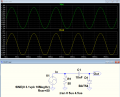
Below is the sim of a circuit that basically does what AK suggested in post #31.
The Schottky diode clamps the signal so it doesn't go more than a tew tenths of a volt below ground, which will not damage any inputs, and the capacitor coupling generates a DC bias from the clamp so that most of the signal is positive.
The output should then work connected to the input of you frequency divider circuit.

If you use 5V logic then you may want to increase the value of R1 to give about a 5Vpp signal.

1691462901094.png
 

Ian0

Joined Aug 7, 2020
13,132
Alternatively, put 100Ω to 5V and 100Ω to ground and capacitively coupled it. That would give a range of 0.95V to 4.05V which would work nicely with a 74HC schmitt trigger input.
 

AnalogKid

Joined Aug 1, 2013
12,142
Alternatively, put 100Ω to 5V and 100Ω to ground and capacitively coupled it. That would give a range of 0.95V to 4.05V which would work nicely with a 74HC schmitt trigger input.
Or adjust the resistor values so the input is terminated below the lower Schmitt threshold voltage when the source is removed. Not as big a problem with Schmitt inputs, but still . . .

ak
 

Ian0

Joined Aug 7, 2020
13,132
Or adjust the resistor values so the input is terminated below the lower Schmitt threshold voltage when the source is removed. Not as big a problem with Schmitt inputs, but still . . .

ak
Good point.
Even Schmitt inputs draw current from the supplies when the input voltage is at an intermediate level.
 

Thread Starter

truetime320

Joined Aug 5, 2023
6
Below is the sim of a circuit that basically does what AK suggested in post #31.
The Schottky diode clamps the signal so it doesn't go more than a tew tenths of a volt below ground, which will not damage any inputs, and the capacitor coupling generates a DC bias from the clamp so that most of the signal is positive.
The output should then work connected to the input of you frequency divider circuit.

If you use 5V logic then you may want to increase the value of R1 to give about a 5Vpp signal.

View attachment 300053
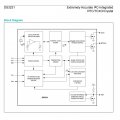
Wow this really helps visualizing, thanks for the sim. With this could I integrate it into something like an RTC (Real Time Clock)? The RTC I'm looking at in particular, the DS3231, has an oscillator but with what you've given me maybe I can just insert myself in place of the given oscillator.snip.JPG
 

Ian0

Joined Aug 7, 2020
13,132
Wow this really helps visualizing, thanks for the sim. With this could I integrate it into something like an RTC (Real Time Clock)? The RTC I'm looking at in particular, the DS3231, has an oscillator but with what you've given me maybe I can just insert myself in place of the given oscillator.View attachment 300087
Most RTC ICs use a 32768kHz crystal. If you can find one that uses a 10MHz oscillator then you have your solution. You'll have to read a lot of datasheets!
 

Janis59

Joined Aug 21, 2017
1,894
Principially, rubidium clocks are giving the same order of magnitude stability used in GPS system. Thus just download the CLK from there and it will be zillion-fold cheaper as to maintain the precision time standard. Here is article about one such research showing few 1E-12 deviance and best case near the 1E-14, while the quartz gives 1E-6 order of magnitude!!!!! For the comparison, russian glonass gives the coordinates sometimes jumping without of any reason by 3 km off the right place - solely the timing instability the reason. Once played in the Krimea observatory before occupation, GPS shows accurate +/- 3 meters place but cannot in the montain abyss, because transmitter is on the horizon. Glonass then is on the Zenith and still works but with overwhelming mistake. So... nothing to look for into cliff abysses https://tf.nist.gov/general/pdf/890.pdf :)
 
Last edited:
Top