If the battery can supply that current without dropping much yes. But I seriously doubt that is the case. You said before that the battery could supply 50A. Battery packs of this kind are highly likely to have an overcurrent protection circuit. If your battery has a limit of 50A you could easily be tripping the protection circuit. I suspect that is exactly what is happening.
The other problem is that drawing large currents from a battery WILL drop the voltage. What kind of a 5V regulator do you have? If it is a standard 7805 type regulator, it needs 7V to regulate. So, you are right on the edge of supplying enough voltage to the regulator with your 7.4V battery. Drawing 50A would certainly drop the voltage to the regulator enough to stop it regulating. You might get away with it with sufficient capacitance, but this is not a robust design.
If the battery can supply that current without dropping much yes. But I seriously doubt that is the case. You said before that the battery could supply 50A. Battery packs of this kind are highly likely to have an overcurrent protection circuit. If your battery has a limit of 50A you could easily be tripping the protection circuit. I suspect that is exactly what is happening.
The other problem is that drawing large currents from a battery WILL drop the voltage. What kind of a 5V regulator do you have? If it is a standard 7805 type regulator, it needs 7V to regulate. So, you are right on the edge of supplying enough voltage to the regulator with your 7.4V battery. Drawing 50A would certainly drop the voltage to the regulator enough to stop it regulating. You might get away with it with sufficient capacitance, but this is not a robust design.
Is it possible, to collapse the voltage of the Battery 1 by drawing a high current from the Battery 2?
Thank you...
P.S.: The usual RC batteries do not have a protection circuitry in them and it is of course true that the battery voltage will drop to a certain amount if you draw a too high current.
Is it possible, to collapse the voltage of the Battery 1 by drawing a high current from the Battery 2?
Thank you...
P.S.: The usual RC batteries do not have a protection circuitry in them and it is of course true that the battery voltage will drop to a certain amount if you draw a too high current.
The batteries are sharing grounds ... inevitably any EMI produced by one circuit will travel to the other one. What I do is use a DC to DC converter so as to split those grounds, and then use an opto to trigger the mosfet's driver (I don't see one in your schematic).
Okay, I missed that fact that you had separated the batteries. In that case, it is most likely EMI caused by switching these huge currents. In which case, using a switching regulator to lower the voltage to the glow plug instead of using PWM would still fix the problem. For that matter, putting a properly sized inductor in the path the glow plug would make it a switching regulator and probably also fix the problem.
What is your PWM frequency? With that I could model the circuit to come up with the value of the inductor.
The batteries are sharing grounds ... inevitably any EMI produced by one circuit will travel to the other one. What I do is use a DC to DC converter so as to split those grounds, and then use an opto to trigger the mosfet's driver (I don't see one in your schematic).
Okay, I missed that fact that you had separated the batteries. In that case, it is most likely EMI caused by switching these huge currents. In which case, using a switching regulator to lower the voltage to the glow plug instead of using PWM would still fix the problem. For that matter, putting a properly sized inductor in the path the glow plug would make it a switching regulator and probably also fix the problem.
What is your PWM frequency? With that I could model the circuit to come up with the value of the inductor.
The PWM frequency is 980 Hz. The same circuit is working in my portable and onboard glow drivers witohut any problems for a couple of years. They use an Attiny85 as the MCU. I really would like to try it with an inductor because the problem seems not to be a voltage collapse problem but an EMI problem due to fast switching of a high current.
ooooookey... I'll just stand here by the sideline and wait how this whole thing develops ... I too, am interested on seeing how you solve this ... good luck!
ooooookey... I'll just stand here by the sideline and wait how this whole thing develops ... I too, am interested on seeing how you solve this ... good luck!
I have already solved (?) it using 1k gate resistors and the system works OK for now. I have written a great (! ) piece of code too. But I have to confess that I am interested too.
@sumeryamaner I appreciate you giving the update. It's frequently the case that you get newcomers to the thread and so on where you have to restate some things. That's to be expected and yeah, you have to go along with it because, well, because you are the one with the project...your English is fine.
I do hope this keeps going as I enjoy the thread as an excellent learning opportunity. As noted earlier, I participated in a couple of your early threads (to this day I can't duplicate that first read A2D error).
@sumeryamaner I appreciate you giving the update. It's frequently the case that you get newcomers to the thread and so on where you have to restate some things. That's to be expected and yeah, you have to go along with it because, well, because you are the one with the project...your English is fine.
I do hope this keeps going as I enjoy the thread as an excellent learning opportunity. As noted earlier, I participated in a couple of your early threads (to this day I can't duplicate that first read A2D error).
I have already solved (?) it using 1k gate resistors and the system works OK for now. I have written a great (! ) piece of code too. But I have to confess that I am interested too.
And I too, thought I had solved my problem using 1.5k resistors at the gate... only to find that the problem had been diminished, but not completely gone
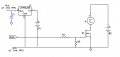
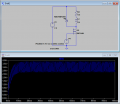
Here you go. To make it a buck converter, you need to add an inductor and a Shottky diode rated at 5A.
1mH is a fairly large inductor due to your low PWM frequency, and it still has a ripple of about an Amp, which is not a problem for the glow plug.
Note that this circuit reduces the max draw from the battery to about 4A, a far sight better than 50.
Note also, that this simulation gets an average current of about 3.2A assuming as resistance of 0.3 Ohms for the glow plug, which corresponds to the voltage and current you mentioned before.
Third note, the duty cycle has been set at 200u / 1020u or 0.19 or 50 / 255 to get the approximate current you want.
If you don't have a scope, but like projects like this, a scope might not be a bad investment. You could scope the gate pins and other pins on the processor to see if you're getting any spikes, perhaps caused by EMI. Just be careful about using the half circle probe clips as they can be great antennas for EMI and spikes you see might actually be caused by those clips picking up the EMI. The pointy end of the probe is better in cases where EMI can be an issue. Great project by the way, I'm pulling for you.
If you don't have a scope, but like projects like this, a scope might not be a bad investment. You could scope the gate pins and other pins on the processor to see if you're getting any spikes, perhaps caused by EMI. Just be careful about using the half circle probe clips as they can be great antennas for EMI and spikes you see might actually be caused by those clips picking up the EMI. The pointy end of the probe is better in cases where EMI can be an issue. Great project by the way, I'm pulling for you.
Thank you very much. I already have a scope (of course not a professional one) but I have been too lazy to connect it to the circuit (because I doubt that it would show eventual spikes ). I will try it.
Here you go. To make it a buck converter, you need to add an inductor and a Shottky diode rated at 5A.
1mH is a fairly large inductor due to your low PWM frequency, and it still has a ripple of about an Amp, which is not a problem for the glow plug.
Note that this circuit reduces the max draw from the battery to about 4A, a far sight better than 50.
Note also, that this simulation gets an average current of about 3.2A assuming as resistance of 0.3 Ohms for the glow plug, which corresponds to the voltage and current you mentioned before.
Third note, the duty cycle has been set at 200u / 1020u or 0.19 or 50 / 255 to get the approximate current you want.
Thank you very much. I have added a series inductor of about 1.5 mH to the glow plug. As I didn't have a Schottky diode at hand I used a 1N4001. I tried to test this setup using a 75 ohm gate resistor but I immediately burnt out the glow plug (the PWM value was set too high). I didn't have time to repeat the test with a new glow plug and I reverted to the 1k gate resistor because today was our test day. My friend who built the turbine came from a very long way (about 150 miles) just for testing.
Good news: The tests were satisfactory.
Now a question: This schematic with the series inductor and the Schottky diode is actually a buck converter right? So... If we connect a DC motor instead of the glow plug which has a significant inductance, do we need the series inductance? (This can be a stupid question,so please appologize).
A motor will probably be fine with just PWM, that is how they are normally run.
The problen with the glow plug, I think, is the huge current it drew during the on period to get the desired average current 17 times smaller than it would get directly from the battery.
A motor will probably be fine with just PWM, that is how they are normally run.
The problen with the glow plug, I think, is the huge current it drew during the on period to get the desired average current 17 times smaller than it would get directly from the battery.

 Facebook
 Google
 GitHub
 Linkedin