Atmega AutoRange Ohmmeter

Thread Starter

Daniel Gouvêa

Joined Feb 19, 2025
28
If it were me, I'd design a precision programmable current source tied to addressable DUTs (using analog switches).

In this way, you could test any number of thermistors across a broad range of currents very quickly. The entire test process could be automated, and the tester could automatically choose the proper test current for each DUT, regardless of value.
I started this project planning to use constant voltage sources, but after talking to all of you, I decided to use a constant current source. It will actually make the project more elegant (I don't know if that term is used in English in this context). Even in the early stages, while I was considering using constant voltage, I considered using analog switches to switch between the different measurement ranges, but I ended up giving up. I decided against using analog switches due to the price and the resistance while on. Even if I do this compensation in software, I'm not sure it would be worthwhile. Regarding the current ranges, all the thermistors to be tested are the same model, so they can be tested with the same current intensity.
 

Thread Starter

Daniel Gouvêa

Joined Feb 19, 2025
28
I'm currently leaning toward using the REF200 to generate a 100uA current. If you could recommend an analog switch model that supports this current, I'll do the math to see which option is more viable: quadrupling the test circuit or switching the same circuit across the four DUTs.
 

joeyd999

Joined Jun 6, 2011
6,302
I'm currently leaning toward using the REF200 to generate a 100uA current. If you could recommend an analog switch model that supports this current, I'll do the math to see which option is more viable: quadrupling the test circuit or switching the same circuit across the four DUTs.
Fyi, if using a current source, analog switch resistance is irrelevant. Also, speed really doesn't matter as this is a DC application.

You can go cheap on the switches.
 

Thread Starter

Daniel Gouvêa

Joined Feb 19, 2025
28
Hi Daniel.
Do you have a specification sheet you could post for this therm model?
E

Added: I would not use Analog switching.

Link:
https://www.google.com/search?clien...ure+effects+when+using+analogue+switching+ICs
This thermistor's function is to monitor the temperature of aircraft batteries, so it comes preinstalled. The battery manufacturer's manual only provides instructions for testing the thermistor, but no further details. The instructions only state the thermistor's resistance range at 0°C (+32°F), which is approximately 7355Ω, and at 71°C (+160°F), which is approximately 382Ω.
 

ericgibbs

Joined Jan 29, 2010
21,443
hi Dan,
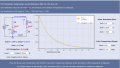
Using one of my interactive calculators, I estimate.
At +25C, R0=2200 ohms, with a Beta value of 3900

If you are to design an accurate testing method, I would advise confirming these figures with the Thermistor manufacturer.

Is it required that you only test measure at the two quoted values of 0C= 7355 Ohms and at 71C= 382 Ohms.???

E
 

Attachments

Thread Starter

Daniel Gouvêa

Joined Feb 19, 2025
28
hi Dan,
Using one of my interactive calculators, I estimate.
At +25C, R0=2200 ohms, with a Beta value of 3900

If you are to design an accurate testing method, I would advise confirming these figures with the Thermistor manufacturer.

Is it required that you only test measure at the two quoted values of 0C= 7355 Ohms and at 71C= 382 Ohms.???

E
For this specific test, the manual requires that the test be performed at these two temperatures. There is another, less rigorous, initial test that the manual requires to be performed as soon as the battery arrives at the workshop. In this test, we need to ensure that the thermistor resistance must be between 1854Ω and 3116Ω, for an ambient temperature between 22.8 ±5°C (+73 ±9°F).
 

MrChips

Joined Oct 2, 2009
34,818
Thermistor resistances are normally quoted at 25°C.
Depending on the specific temperature range of the application, it would make sense to test the thermistor at three temperatures,
0, 25, and a higher temperature, for example, 65-70°C.
 

MisterBill2

Joined Jan 23, 2018
27,540
Whatwe have that I recognize is two resistance values at two different temperatures. And the voltage divider scheme seems rather odd when it would be very simple to do a resistance check with an accurate ohm meter.
OR, are you willing to describe what sort of test is required. NOT what circuit you want to use to check it. What function of the thermistor is to actually be tested?? At how many temperatures?? A programmable current source is a poor choice because it will accidentally be mis-calibrated.
The choice for resistance measurement is a regulated one milliamp current source with an adequate compliance voltage, and an accurate voltmeter.
Of course, all of the measurement connections will need to be the 4-wire KELVIN arrangement.
 
Last edited:

ericgibbs

Joined Jan 29, 2010
21,443
hi,
For clarity, a summary of what the TS has posted

I plan to use eight ranges for this measurement, with values chosen according to my points of interest.

A constant current source. The same operating principle as four-wire milliohmmeters. Perhaps this is a more interesting approach. I need to measure up to about 10KΩ. If I use an external ADC, such as the ADS1115, and use the 2.048V scale, I would need a current of 200uA (10KΩ x 200uA ≈ 2V). Is it easy to obtain such a low current with inexpensive components?

What is the test range resistance value of your Thermistors.?
10Ω - 10kΩ.

Regarding the current ranges, all the thermistors to be tested are the same model, so they can be tested with the same current intensity.

This thermistor's function is to monitor the temperature of aircraft batteries, so it comes preinstalled. The battery manufacturer's manual only provides instructions for testing the thermistor,

The instructions only state the thermistor's resistance range at 0°C (+32°F), which is approximately 7355Ω, and at 71°C (+160°F), which is approximately 382Ω.

For this specific test, the manual requires that the test be performed at these two temperatures. There is another, less rigorous, initial test that the manual requires to be performed as soon as the battery arrives at the workshop. In this test, we need to ensure that the thermistor resistance must be between 1854Ω and 3116Ω, for an ambient temperature between 22.8 ±5°C (+73 ±9°F).

Conclusion.
From the above, I would assume that the battery with the preinstalled thermistor will have to be cooled to 0Cdeg and heated to 71Cdeg, for the required resistance values???

I would suggest the TS [thread starter] posts a simple flow chart, showing the test sequence and the number of batteries in each test batch.

E
 

MisterBill2

Joined Jan 23, 2018
27,540
An adequate current source can be created using a 78L05 regulator with a 5K resistor between the common and the output, as I recall. Then use a 24 volt supply and you get one millivolt per ohm, allowing a high input resistance digital voltmeter to display resistance directly. Feed the BCD digital output from that meter into the control logic.

HOW ACCURATE does the testing system need to be??
 

Thread Starter

Daniel Gouvêa

Joined Feb 19, 2025
28
hi,
For clarity, a summary of what the TS has posted

I plan to use eight ranges for this measurement, with values chosen according to my points of interest.

A constant current source. The same operating principle as four-wire milliohmmeters. Perhaps this is a more interesting approach. I need to measure up to about 10KΩ. If I use an external ADC, such as the ADS1115, and use the 2.048V scale, I would need a current of 200uA (10KΩ x 200uA ≈ 2V). Is it easy to obtain such a low current with inexpensive components?

What is the test range resistance value of your Thermistors.?
10Ω - 10kΩ.

Regarding the current ranges, all the thermistors to be tested are the same model, so they can be tested with the same current intensity.

This thermistor's function is to monitor the temperature of aircraft batteries, so it comes preinstalled. The battery manufacturer's manual only provides instructions for testing the thermistor,

The instructions only state the thermistor's resistance range at 0°C (+32°F), which is approximately 7355Ω, and at 71°C (+160°F), which is approximately 382Ω.

For this specific test, the manual requires that the test be performed at these two temperatures. There is another, less rigorous, initial test that the manual requires to be performed as soon as the battery arrives at the workshop. In this test, we need to ensure that the thermistor resistance must be between 1854Ω and 3116Ω, for an ambient temperature between 22.8 ±5°C (+73 ±9°F).

Conclusion.
From the above, I would assume that the battery with the preinstalled thermistor will have to be cooled to 0Cdeg and heated to 71Cdeg, for the required resistance values???

I would suggest the TS [thread starter] posts a simple flow chart, showing the test sequence and the number of batteries in each test batch.

E
This was a really good summary. As requested, I'll provide a more detailed test flow below...
 

Thread Starter

Daniel Gouvêa

Joined Feb 19, 2025
28
The manual suggests a digital multimeter with 2000 counts and 1% accuracy or better and a digital thermometer.

The exact test sequence is as follows:
The initial, less rigorous test is performed upon arrival at the battery shop: [+22.8 ± 5°C (+73 ± 9°F)] -> [1854Ω to 3116Ω]
The main test is performed as follows:
* The thermistor is immersed in a beaker containing a mixture of water and ice: [0°C ± 1.7°C (+32°F ± 3°F)] -> [7355 ± 672Ω]
* The water temperature is slowly increased to the following point: [+71 ± 1.7°C (+160 ± 3°F)] -> [382 ± 23Ω]

As you can see, two devices are currently used to perform the tests (multimeter and thermometer). Currently, I test one thermistor at a time.

My final idea is to build a device that reads the water temperature and thermistor resistance, displaying this data on a screen. Considering the volume of batteries the workshop receives, it would be very interesting to be able to test four thermistors simultaneously.

My initial idea was to use a voltage divider, but after reading all the comments and, at the same time, reading several articles from experts at Texas Instruments (among other companies), I decided to change my approach to constant current.

I received many cool ideas for generating constant current, but since I'm still new to electronics and the device needs to be robust and reliable, I prefer to use a more specific solution for generating constant current, such as the REF200, for example.
 

Thread Starter

Daniel Gouvêa

Joined Feb 19, 2025
28
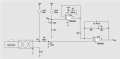
I found an article called "Thermistor temperature transducer-to-ADC application," written by an applications specialist at Texas Instruments named John Bishop (https://www.ti.com/lit/pdf/slyt156).
In this article, the author implemented a circuit based on the REF200, the TLV2472 OPAMP, and the TLV2544 ADC. Below is the circuit schematic.

slyt156.png
 

Thread Starter

Daniel Gouvêa

Joined Feb 19, 2025
28
This ADC has 12 bits, which seems sufficient for this case. I know there are ADCs with higher resolution and much cheaper, such as the famous 16-bit ADS1115, but, as I said before, I don't yet have the expertise to analyze the disadvantages of using the 1115 in this circuit. If you're curious and have the time to review the article and give me suggestions, feel free to do so.
 
Top