Facebook
 Google
 GitHub
 Linkedin
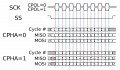
Thank you; this means data always transfers or is received at the edge of the clock signal.
In the SPI protocol, data is transferred on the rising edge of the clock and received on the falling edge of the clock pulse.
In the I2C protocol, when pull-up resistors are used, the sender transfers data on the falling edge of the clock, and the receiver receives data on the rising edge of the clock pulse.
In the SPI protocol, data is transferred on the rising edge of the clock and received on the falling edge of the clock pulse.
In the I2C protocol, when pull-up resistors are used, the sender transfers data on the falling edge of the clock, and the receiver receives data on the rising edge of the clock pulse.