Are these transformers defective?

strantor

Joined Oct 3, 2010
6,875
I had issues with saturation when dealing with 120V microwave oven transformers. I found that by placing 3 of the transformers in series across 240 (2/3 voltage across each primary) the saturation problems went away. I was then able to put the secondaries in parallel to get close the voltage i needed (I was winding my own secondaries so the 2/3 voltage wasn't a problem)

In your case you could try putting two primaries in series and also put the secondaries in series. Half the voltage across each primary should stop the saturation. Then the output is also halved, but added back by the 2nd tranformer.

Not sure if you want to have two transformers in your design, I would recommend getting a better transformer, but this is something you could try just to move forward for now, since you have several of them.

EDIT: you could also experiment with primaries in series and secondaries in parallel, if that gets you closer to your desired rectified voltage.
 
Last edited:

Ian0

Joined Aug 7, 2020
13,132
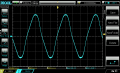
The odd shape to the waveform out of the transformer is odd harmonic distortion that results because of a combination of the magnetizing current driving the core and an IR or IZ drop in the primary. These safety transformers are usually "impedance limited" so they cannot supply large currents because of the large impedance between the primary input and the secondary output.

I ordered a dozen of them once without realizing how poor the performance would seem. I still have all of them unused.
They are linear up to about 110V AC on the primary.
They also run very warm.
 

DickCappels

Joined Aug 21, 2008
10,661
I can see the scope graticule in all of the waveform photos. Those who cannot see it might want to check their display brightness setting.
 

Deleted member 115935

Joined Dec 31, 1969
0
Id suggest that waveform looks very different
almost like its the incoming mains that has the distortion
 

s14rs4

Joined Sep 15, 2016
75
If the TS is in the UK then the standard mains voltage is 240V, (230V +/- 10% to conform with European standards) my local supply is about 245V-247V. As for the waveform I would consider that a clean supply for mains. The spec also says the regulation is about 44%. He does not say what his application is, but if he wants a perfect rectified sine wave he would be better generating it from an oscillator.
 

Ian0

Joined Aug 7, 2020
13,132
In answer to the original question "Are these transformers defective?" I'd say "No, they're just not very good".
If you want a very low VA transformer to use as a measurement transformer there are some 1.6VA toroids by Nuvotem Talema, and they really are very linear.
 

Thread Starter

hypersonik

Joined Oct 26, 2020
13
He does not say what his application is, but if he wants a perfect rectified sine wave he would be better generating it from an oscillator.
A zero crossing detector as a part of a dimmer, so an oscillator won't work.
I'm doing this just for fun, so my goal is not only something functional or a workaround, but something well done, at least as much as I could (even my poor electronics knowledge).
I also need to feed an opamp and some MOSFETs, so I'm not happy with a dirty supply.

In answer to the original question "Are these transformers defective?" I'd say "No, they're just not very good".
If you want a very low VA transformer to use as a measurement transformer there are some 1.6VA toroids by Nuvotem Talema, and they really are very linear.
That fully answers my original question.
I need to find better components. Those toroids sound interesting; I'll take a look.
 

s14rs4

Joined Sep 15, 2016
75
A zero crossing detector as a part of a dimmer, so an oscillator won't work.
I'm doing this just for fun, so my goal is not only something functional or a workaround, but something well done, at least as much as I could (even my poor electronics knowledge).
I also need to feed an opamp and some MOSFETs, so I'm not happy with a dirty supply.
OK that is a valid reason, but I would not consider this a dirty supply. Mains voltage supply can be full of switching noise and spikes, it is seldom a clean waveform. Maybe you can look at how they do it with zero crossing solid state relays.

Are you switching the transformer output or the mains directly I would look at phase shifts between the two, they may not be the same.

Good luck with your project.
 

Thread Starter

hypersonik

Joined Oct 26, 2020
13
You're not that late - it got to post #30 before we knew it was a zero-crossing detector!
I'm sorry. I didn't want to bore you with unnecessary details.

I am a bit late to the party but maybe an opto-coupler would be suitable.
Was my first try.
However, even it works, it is too much power hungry. I've found much more efficient an Schmitt trigger built with an opamp.
 

Audioguru again

Joined Oct 21, 2019
6,826
Thanks that worked great, what did you do to make them show up? On the original image even if i turned my brightness up to max on macbook 17pro, all i could barely see was light gray Major Tick marks around the edges and thru the middle.
In Windows 10 I clicked on the photo and it opened on the screen with an Edit button, then an Adjustment button then a "Light" slider.
I slid the Light slider to maximum twice.
 

Deleted member 440916

Joined Dec 31, 1969
0
Opto-couplers work for me, the droppers dissipate about 1.5W on 240V and thats probably less than your transformer magnetization current. If you don't need a very narrow deadband and wide operating range you can reduce the power even more.
 

Thread Starter

hypersonik

Joined Oct 26, 2020
13
Are you switching the transformer output or the mains directly I would look at phase shifts between the two, they may not be the same.
I'm doing phase control with mains directly. A pair of MOSFETs do the job.
I measured the time between the raise edge of the ZC and the real zero. ZC signal goes to an ESP32, which waits that time and turns on signal for the MOSFETs.
All these experiment are done, for now, with the 12V RMS from my old transformer. I don't want my eyebrows burned.
 

s14rs4

Joined Sep 15, 2016
75
I would not be too worried about the waveform above and below the crossing point, as long as the zero crossing is equally spaced and consistent with load it should not matter. I would be more concerned about noise spikes giving you a false crossing.
 
Top