Are These Ovals or Not (potato)?

Thread Starter

MrAl

Joined Jun 17, 2014
13,680
Hi,

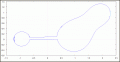
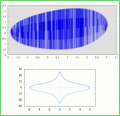
In the attachment there are two closed curves drawn. The top one is shaded, sort of poorly, so the valid curve is the outline of that shape which looks like a potato :)
The bottom one is not shaded so that shape is more straightforward.

The question is, is either one of these or both really ovals?

It turns out that i think the definition of an oval is a bit loose, but i think they are both ovals mostly because of the equation that describes them.

Note how the top curve is very unsymmetrical with the top side being a little flatter than the bottom and the whole thing sort of lop sided.

So what do you think, ovals or not, or something else perhaps?
Ovals_ThreePoint-1.gif
 

wayneh

Joined Sep 9, 2010
18,095
The definition of "oval", as you can see from the root of the word, is literally something that resembles an egg. I don't think most people would confine themselves to any mathematical definition that might require symmetry or some particular shape. So I think the potato could be described as an oval. There is no word "potatal", so we are left with oval.

No normal person would call the bottom figure an oval, because it certainly doesn't resemble an egg. More like a toy top.
 

Papabravo

Joined Feb 24, 2006
22,065
An oval is not a precise mathematical concept. Are you asking if one of those curves is an ellipse? If you show me the form of the equation, then I can tell you. The second one is definitely not an oval or an ellipse.

You might find this paper instructive:

http://math.oregonstate.edu/~math_reu/proceedings/REU_Proceedings/Proceedings1999/1999Gulde.pdf
I guess there are ovals that can be found. They are the Cartesian Oval and the Cassini Oval.
http://mathworld.wolfram.com/CartesianOvals.html
http://mathworld.wolfram.com/CassiniOvals.html
 

Thread Starter

MrAl

Joined Jun 17, 2014
13,680
The definition of "oval", as you can see from the root of the word, is literally something that resembles an egg. I don't think most people would confine themselves to any mathematical definition that might require symmetry or some particular shape. So I think the potato could be described as an oval. There is no word "potatal", so we are left with oval.

No normal person would call the bottom figure an oval, because it certainly doesn't resemble an egg. More like a toy top.
Hi,

Well that's interesting but check out my next post.
 

Thread Starter

MrAl

Joined Jun 17, 2014
13,680
An oval is not a precise mathematical concept. Are you asking if one of those curves is an ellipse? If you show me the form of the equation, then I can tell you. The second one is definitely not an oval or an ellipse.

You might find this paper instructive:

http://math.oregonstate.edu/~math_reu/proceedings/REU_Proceedings/Proceedings1999/1999Gulde.pdf

Hello again,

Well guess what? They both use the same equation but with different constant parameters.

They are both what i am calling "3 point ovals" rather than the 2 point ones like the Cassini Ovals.

They are formed by starting with three constant points in the x,y plane, call them a, b, and c, and a fourth constant K, and projecting three radii one from each point a,b,c, and the three radii can meet at a point because they cross each other for certain radii angles, and the curve is the locus of those crossing points formed when the product of the all the radii lengths equals the constant K.

For the Cassini variety this is:
r1*r2=K

and for this three point variety this is:
r1*r2*r3=K

The only difference between the two curves shown in the previous attachment is that one uses constant points that are always located on either the x axis or on the y axis (the bottom one) and the other one (the top) uses one point that is not on any axis, so it is more variable. However, they are both still degenerate forms of a more complex form that has possibly no points on either axis. They both do satisfy the three product curve equation above.

If this isnt enough information i can supply more. Note however that the two curves drawn in the previous attachment dont necessarily represent the entire complete solution set of curves that are possible, in the same way that a single Cassini oval (that looks somewhat like an ellipse) does not properly represent all possible Cassini Oval curves.

Thanks for looking into this, and i'll check out that pdf in more detail too.

I guess the more general question is should these curves be classified based on their equations rather than their shape. I was leaning toward calling the bottom curve (looks like a star) an 'asteroid' curve, but then i realized it has rounded end corners so it's not exactly that, so maybe the equation itself is a better basis for calling it one thing or another.
 
Last edited:

wayneh

Joined Sep 9, 2010
18,095
A single equation can produce a shape we call oval, or another shape if we change the parameters. So? That doesn't mean that other shape is an oval.

Oval is defined by the shape, whether it looks like an egg, not the formula or process that produced the shape.

I think "ellipse" has a more precise definition that doesn't include a potato.
 

Thread Starter

MrAl

Joined Jun 17, 2014
13,680
A single equation can produce a shape we call oval, or another shape if we change the parameters. So? That doesn't mean that other shape is an oval.

Oval is defined by the shape, whether it looks like an egg, not the formula or process that produced the shape.

I think "ellipse" has a more precise definition that doesn't include a potato.

Hi,

Yes an ellipse is more well defined and i am well aware of that, similar to the circle but with more variation.

But your conclusion about only the shape affecting the nature of what we call the curve is what i am bringing into question here. For one, when we examine the Cassini Ovals we see that they do not always produce an egg shape. That leads me to think that maybe we should call it by the equation. However the counter point is that once we get into more and more complicated equations we can draw almost anything, so what do we call that.
Maybe we would just call that the 'anything' curve. But that would be nothing like the curves being looked at here. These are still relatively simple. I have to say though that i have not yet pursued trying to find out every possible shape possible as has been done with the Cassini Ovals.
Another point is that with that lower shape parameters, if the parameters are changed i can get a true 'football' looking curve, you'd never want to call it anything else, but does that mean we have to call it a football curve?

So there are points and counter points, but please feel free to bring up any on either side of the debate.
 

wayneh

Joined Sep 9, 2010
18,095
This conflict always happens when there is a larger common usage of a term than its more limited technical usage. Scientists, mathematicians and engineers can agree to be precise about the meaning of a term, such as "ohm". But in the population, the meaning of a word is defined by the way people use it, even if they misuse it.

We've had discussions here about whether an amplifier with a gain less than one is still an amplifier. To an electrical engineer, it might be. But not to your man on the street.
 

Thread Starter

MrAl

Joined Jun 17, 2014
13,680
This conflict always happens when there is a larger common usage of a term than its more limited technical usage. Scientists, mathematicians and engineers can agree to be precise about the meaning of a term, such as "ohm". But in the population, the meaning of a word is defined by the way people use it, even if they misuse it.

We've had discussions here about whether an amplifier with a gain less than one is still an amplifier. To an electrical engineer, it might be. But not to your man on the street.

Hi again,

Oh ok then it is settled, we'll call this curve an amplifier :)

I guess we dont have to be too precise here, but it's interesting to look into.
 

Thread Starter

MrAl

Joined Jun 17, 2014
13,680
Hello again,

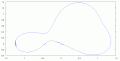
Here is another one generated with the locus of points again from that same formula r1*r2*r3=K
Amazing how varied this simple concept can be for generating curves. I can see now that i have only just begun to see some of the many forms this can take.
You can ignore the two straight horizontal lines and fill in the missing parts of the two closed curves. I left them in temporarily for dramatic effect but they are just artifacts of the graphing process.
This set makes it more apparent what x related constants were used as the constants are almost in the middle of the lobes: -1, 1, and 2.

I can see the left side looks egg-ish, but the right side curve looks potato-ish again.

Oval_3-point-1.gif
 

WBahn

Joined Mar 31, 2012
32,747
I guess the more general question is should these curves be classified based on their equations rather than their shape. I was leaning toward calling the bottom curve (looks like a star) an 'asteroid' curve, but then i realized it has rounded end corners so it's not exactly that, so maybe the equation itself is a better basis for calling it one thing or another.
Why can't an "asteroid" curve have rounded corners? What is required to qualify as "exactly" an "asteroid" curve?

The form of the equation, by itself, doesn't determine what the shape is called. For instance, consider

\(
ax^2 \; + \; by^2 \; = \; 1
\)

This equation is capable of generating a circle, but not every curve this equation can generate is a circle.
 

Thread Starter

MrAl

Joined Jun 17, 2014
13,680
Hi,

I think what you are saying makes a lot of sense, and that's one of the counter points.
A counter-counter point would be simply that the equation:
x^2+y^2=1
is ALWAYS a circle.
That's not the best example though.

So i think what we are seeing here is that sometimes the equation defines the shape and sometimes it doesnt. But there's another corollrary i see here and that is sometimes the equation defines what we call the the actual generated shapes independent of the shape itself.

Also it is interesting that you chose the example you did:
a*x^2+b^y^2=1

as that brings up another interesting issue and that is that this area seems to be an area of geometry that is still evolving. When i had looked at astroids in the past they all had sharp points which are referred to as singularities or cusps. However, now there may be asteroids with rounded points. The question is, can you find one anywhere? Keep in mind we dont know yet if that curve i drew can be called an asteroid for sure, so we cant include that one yet.

There are good reasons for the sharp points, but if you can find one with rounded points that would help too and possibly broaden the definition.

I am starting to think there is no golden rule here.

Here is another curve from the same equation. Ignore the artifacts.
A ghost, just in time for Halloween :)


Oval_ThreePoint-20161029-1.gif
 
Last edited:

WBahn

Joined Mar 31, 2012
32,747
Go down to the end of the Wolfram page on the astroid to see the envelope of a family of ellipses looks like an astroid with rounded corners.

http://mathworld.wolfram.com/Astroid.html

Equation (39)
The astroid in question does NOT have rounded corners. The astroid is the envelope itself, not any of the ellipses that are being enveloped. The envelope goes to infinity very sharply on both axes (as c approaches either 0 or 1). The sharpness can be seen by considering the derivative when approached from opposite sides.
 

Papabravo

Joined Feb 24, 2006
22,065
I didn't say it was an astroid with rounded corners. The TS has not told us how he created the second figure in his original post. I said: "the envelope looks like an astroid with rounded corners". I made the contribution as a possible clue to how the original was created.
 

Thread Starter

MrAl

Joined Jun 17, 2014
13,680
Go down to the end of the Wolfram page on the astroid to see the envelope of a family of ellipses looks like an astroid with rounded corners.

http://mathworld.wolfram.com/Astroid.html

Equation (39)
Hi,

As WBahn keenly noted, that graph is deceiving as are many graphs because graphs are always imperfect depictions of solutions. That makes the ends pointed as WBahn said. Iit's not the early picture that he was talking about, but i understand what you are saying about that picture too and i dont think that is too unreasonable myself.
My main point was that the Cassini Ovals are called by the guys name, so maybe that has something to do with this too. If someone came up with an equation that generates mostly ovals then maybe it is OK to call the equation an oval.

If you want the details, here is the equation:
(x^2+c^2)*(y^2+(x-a)^2)*(y^2+(x+a)^2)=K

Note that i may have made a mistake in depicting it as equivalent to r1*r2*r3=K i'll have to look into this again but anyway that's the actual equation.
The constants were actually c small and K larger:
a=1
c=0.1
K=2 through 100 or so.


LATER:
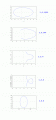
This is the family of curves i meant to look at, but since i stated with the previous set i am a little more interested in that now. This set shown in the attachment is really the set that satisfies r1*r2*r3=K and that is with two points on the x axis and one point on the y axis. The points on the x axis are at x=1 and x=-1, and on the y axis y=2, and K is varied from 1000 down to 2 as shown. The evolution of the curve is interesting because it changes from a horizontal oval (what i think we all would agree on for that one) into an egg into a blip into a loop into a vertical oval. What i am not sure of yet is if these curves may be mirrored in the lower half plane (note the y axis is horizontal in these plots) or continues to close the loop in some of them.
There are lots of other variations i did not try yet either.
 

Attachments

Last edited:

WBahn

Joined Mar 31, 2012
32,747
This is the family of curves i meant to look at, but since i stated with the previous set i am a little more interested in that now. This set shown in the attachment is really the set that satisfies r1*r2*r3=K and that is with two points on the x axis and one point on the y axis. The points on the x axis are at x=1 and x=-1, and on the y axis y=2, and K is varied from 1000 down to 2 as shown. The evolution of the curve is interesting because it changes from a horizontal oval (what i think we all would agree on for that one) into an egg into a blip into a loop into a vertical oval. What i am not sure of yet is if these curves may be mirrored in the lower half plane (note the y axis is horizontal in these plots) or continues to close the loop in some of them.
There are lots of other variations i did not try yet either.
What are r1, r2, and r3? How do these map to x and y?
 

Thread Starter

MrAl

Joined Jun 17, 2014
13,680
What are r1, r2, and r3? How do these map to x and y?
Hello again,

Well those are the radii, from whatever pivot points are chosen to a point on the curve, and the curve is the entire set of points that satisfy r1*r2*r3=K.

For example if we chose one point to be at (a,0) then any point swept out by that radius r1 would be given by:
r1^2=(x–a)^2+(y–b)^2

and since b=0 we have only:
r1^2=(x-a)^2+y^2

and to keep it a little more simple we can set the other point at (-a,0) and so we have a second radius:
r2^2=(x+a)^2+y^2

and since the constant b would be always zero there we can use b for the third radius but since this time we (might) want x=0 and some constant y, we end up with:
r3^2=x^2+(y-b)^2

and now set the product of all three of those equal to K^2 we have:
r1^2*r2^2*r3^2=K^2

and taking the square root we would have:
r1*r2*r3=K

In solving, we can stick to:
r1^2*r2^2*r3^2=K^2

and solve for all x and y that satisfy this relationship.

Because that equation ends up being a sixth degree equation in y and fourth degree in x, it makes sense to solve for x instead of y, but i find that we might loose some solutions doing it that way so i went back to solving for y even though it is harder to do. Doing that i get the whole curve rather than just part of it and so dont have to guess what the other half or whatever might be.

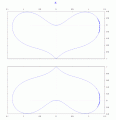
One of the outcome of this process is graphed in the attachment, but again ignore any artifacts and any partial shading. Both graphs are the same but the top one is inverted. Looking at the bottom one, as K is varied the tip of that 'heart' moves away from the main body and becomes it's own little egg. First the egg forms and then it detaches from the lower part of the body as it moves upward. That's as K decreases in value.

The more variable curve comes from r3^2=(x-c)^2+(y-b)^2 and that is where that third point is allowed to be anywhere in the plane and that is one of the first graphs shown in this thread, but making c=0 produces some interesting curves also and one of which appears in the attachment.

I guess what makes these curves interesting is that they seem to mimic real life objects with a simple elegance of a sort. The family of curves seems to indicate some sort of movement; some sort of process where different objects emerge out of other objects. I'll try to show graphs later which illustrate this process. And this all happens by just varying K alone.

The practical significance, taken to extreme, would be a set of stored graphics constants and tables that allow drawing many real life objects where the library is stored on the host computer and the constants make up the drawing. The program would look up the curves from the set of constants and draw whatever it was that the original drawing author had in mind. So it is similar to an advanced fractal compression algorithm, but of course taken to extreme and possibly with simpler line drawn shapes.
For my own purposes though i just wanted to see what some of these curves looked like, then possibly move on to forms that included more points to allow more variability in the shapes. The Cassini Ovals BTW use only two constant points.

The drawings in the attachment may be a little too early for next Valentines Day :)


Oval_Heart-2.gif
 
Last edited:
Top