Are such Residual Current Devices manufactured?

Thread Starter

Pyrex

Joined Feb 16, 2022
501
Hi all,
As far as I could see, all Residual Current Devices were designed to disconnect both phase and neutral. However, if we use such an RCD for a three-phase system, one serious problem arises.

If the neutral contact of such a 4-pole RCD does not provide good contact and there are two or more single-phase electrical consumers downstream of it, high voltage will appear on one of them.
If the neutral contact were to break completely, a voltage of up to 400V would appear on the load if a 400/230V system is used.

Such an accident could be avoided if the RCD did not disconnect the neutral, but only the phase conductors.

This issue was discussed on a local forum, and one participant wrote that he had found a RCD in a catalog that did not disconnect the neutral.
Unfortunately, he didn't remember the exact name of it, he only wrote that it was an Eaton product.

Maybe someone has seen such RCDs and could tell me their exact type or name?
 

Thread Starter

Pyrex

Joined Feb 16, 2022
501

ronsimpson

Joined Oct 7, 2019
4,647
It appears you are concerned that the RCD's Neutral leg might open while the other legs are closed. The braker box or the meter box also has the possibility of opening and causing the same high voltage.
 

Thread Starter

Pyrex

Joined Feb 16, 2022
501
It appears you are concerned that the RCD's Neutral leg might open while the other legs are closed. The braker box or the meter box also has the possibility of opening and causing the same high voltage.
As for the circuit breaker, we use a three-pole circuit breakers, and they do not break the neutral.

Once, a foreign made panel was installed in a factory, which had two large 315A circuit breakers for the panel input, both 4-pole, L1, L2,L3,N. And then we had some problems with voltage drop in the neutral pole on those circuit breakers. The voltage drop across the circuit breaker neutral pole was not constant, and sometimes reached as much as 10-15V .At the same time, the voltage drop across the phase poles was small, about 1 volt.
It wasn't a critical situation, but such a large and unstable voltage drop is not good.
After turning the circuit breaker off and on several times, the voltage drop stabilized and decreased to 1 volt, but after a while the voltage drop increased again.

We rearranged the power circuits of the panel and connected the neutral conductor of the input cable directly to the neutral bus , leaving one pole of the circuit breaker unused
 

nsaspook

Joined Aug 27, 2009
16,250
As for the circuit breaker, we use a three-pole circuit breakers, and they do not break the neutral.

Once, a foreign made panel was installed in a factory, which had two large 315A circuit breakers for the panel input, both 4-pole, L1, L2,L3,N. And then we had some problems with voltage drop in the neutral pole on those circuit breakers. The voltage drop across the circuit breaker neutral pole was not constant, and sometimes reached as much as 10-15V .At the same time, the voltage drop across the phase poles was small, about 1 volt.
It wasn't a critical situation, but such a large and unstable voltage drop is not good.
After turning the circuit breaker off and on several times, the voltage drop stabilized and decreased to 1 volt, but after a while the voltage drop increased again.

We rearranged the power circuits of the panel and connected the neutral conductor of the input cable directly to the neutral bus , leaving one pole of the circuit breaker unused
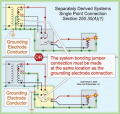
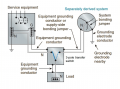
Usually you switch neutral when switching between separately derived system energy sources.
https://www.mikeholt.com/technical-...ems-Transformers-Generators-etc-(4-10-2K).php
The purpose and objective of bonding separately derived* systems is to insure that the electrical system is safe from electric shock and fires from ground-faults. In addition, separately derived systems are grounded to stabilize the phase-to-ground voltage during normal operation [250-2].

* A separately derived system derives its power from a transformer, generator, converter winding, batteries (UPS), or from a solar photovoltaic system. The wiring (including the grounded (neutral) conductor) of separately derived systems does not have any direct electrical connection to the supply conductors [Article 100 and 250-20(d)]. Transformers - All transformers (except autotransformers) are considered a separately derived system because the primary supply does not have any direct electrical connection to the secondary.
Other Systems - Generator, converter winding, UPS systems, or power from solar photovoltaic system are only considered to be a separately derived system, when the grounded (neutral) conductor in the transfer switch is switched, Figure 1.

https://www.ecmweb.com/national-ele...-and-bonding-of-separately-derived-ac-systems
1757860598525.png
1757860711062.png

https://www.fluke.com/en-us/learn/b...u5cU9OIIpgxcYknqg5gSDkhhYor5FefYyvPhkNivItrP2
 
Top