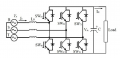
Guys currently I'm working on making a 3 phase Ac to Ac bidirectional converter. I'm in a bit trouble in making the rectifier part of the converter. Can you give me an arduino code for pwm signal generation of rectifier.
This looks like a three phase AC to DC converter.
In what sense is this circuit bi-directional?
In what sense is this an AC to AC converter?
Don't you need some feedback so that the controls for the IGBT devices can be synchronized to the AC waveforms?
Control circuit is not shown. Network voltage can be measured so that IGBT control can be synced to network voltage. There are also systems where phase current measurements between IGBTs and Ls (and perhaps DC voltage measurement) are used to estimate network voltage well enough that separate network voltage measurement is not required.
Excuse me, but you said in your original post that it was an AC to AC converter. But, never mind that. So what you need to develop is a schedule that says an IGBT is turned on at some phase angle [ or time since the last zero crossing ] and is turned off at some other phase angle. You have six IGBT's and I guess you need to know which way the power flow is going since in the DC to AC case you are not creating a sinewave.
Since I can't see your control and measurement circuits I am left to speculate on what you should do.
Excuse me, but you said in your original post that it was an AC to AC converter. But, never mind that. So what you need to develop is a schedule that says an IGBT is turned on at some phase angle [ or time since the last zero crossing ] and is turned off at some other phase angle. You have six IGBT's and I guess you need to know which way the power flow is going since in the DC to AC case you are not creating a sinewave.
Since I can't see your control and measurement circuits I am left to speculate on what you should do.
This is only the rectifier part. Inverter must be connected through the DC link. It is not shown in the image. I just need an arduino code to generate switching pulses of the rectifier. As you said IGBts must turn on and off during a zero crossing. Because this is the rectifier i think power flow is going from AC to DC.
Power flow can be from AC to DC, or from DC to AC.
It is not an AC to AC converter. There is AC on the network side and DC on the rectified DC bus.
Control circuit is not shown. Network voltage can be measured so that IGBT control can be synced to network voltage. There are also systems where phase current measurements between IGBTs and Ls (and perhaps DC voltage measurement) are used to estimate network voltage well enough that separate network voltage measurement is not required.
are @tsan and @Himz the same person?
Because @tsan seems to have some inside info on @Himz circuit. So much so that I think @Papabravo assumes they are the same person. Is this true?
So is the problem you are having that you don't understand how to set up the schedule of turning the IGBTs on and off, or is it that you don't know anything about using the Arduino peripherals to make a PWM signal?
So is the problem you are having that you don't understand how to set up the schedule of turning the IGBTs on and off, or is it that you don't know anything about using the Arduino peripherals to make a PWM signal?

 Facebook
 Google
 GitHub
 Linkedin