There can be some residual magnetism, but not much. And that magnetism depends very much on the alloy and the condition of the metal. Heat is indeed the longer term persisting effect.
What you are trying to build is basically a DC motor with a permanent magnet as the rotor. Design of motors is quite different than that of lifting magnets. The electrical behavior depends on inductance and back EMF, not on Ohm’s law.
The coils (solenoids) pictured are not what is needed to do your job. Using coils like that only have one pole doing the work. Electromagnetic lifting or work holding magnets use a*pot* type core, one that allows both poles to hold or attract what needs to be done. https://www.red-magnetics.com/en/product-groups/others/pot-magnets/
Take a look at this video that I made the other week ... realize that the white Teflon coated pill that is spinning inside the water has a north and south pole ... and so when it does a 180 turn, the poles switch and so I have to switch the current in the coils to continue pulling on the correct pole of the magnet...
It would be nice to be able to calculate the wire gauge, the number of turns, and total height, based on desired strength, core material and available voltage, but I can imagine that coming up with such an equation would be damn difficult.
It is, but I've done it. You can input whatever gauge (of magnet wire) and turns you want and then calculate the layers, total length, resistance and impedance. I'm not sure this is the right path to pursue but I can share it with you if you like.
How about using a driver circuit of a brushless DC motor? And possibly even the coil assembly, with some pole extensions? That could be mechanically much simpler and no moving parts.
How about using a driver circuit of a brushless DC motor? And possibly even the coil assembly, with some pole extensions? That could be mechanically much simpler and no moving parts.
Those with a permanent magnet rotor are one kind that would bear consideration, at least.
Perhaps you should enlighten all of us as to how you think that they work.
Those with a permanent magnet rotor are one kind that would bear consideration, at least.
Perhaps you should enlighten all of us as to how you think that they work.
I apologize for the delay in my replies. I've had issues with my laptop which is almost 10 years old. Ultimately, I fixed the problem by shoving the motherboard into an oven for 7 minutes to re-flow the solder. The lead-free crap that the EPA forced onto corporations doesn't hold as well as leaded solder over time.
It is, but I've done it. You can input whatever gauge (of magnet wire) and turns you want and then calculate the layers, total length, resistance and impedance. I'm not sure this is the right path to pursue but I can share it with you if you like.
I am keenly interested in the equations you used. If not applicable to this project, then surely something new I can learn. But, at this point I have material to build coils ... I even made an Arduino driven stepper motor controlled spinner with a foot pedal for speed control to make some coils, so I think the math might come in handy instead of guessing like I have been doing.
How about using a driver circuit of a brushless DC motor? And possibly even the coil assembly, with some pole extensions? That could be mechanically much simpler and no moving parts.
I've had success with a standard stepper motor driver (the DRV8825 to be exact). The geometry layout in this application is different than a stepper motor, but in terms of where the north and south poles need to be at any given time is identical to a stepper motor so it seems to work.
Thank you for that, I spent some time looking at that and others and though they seem to spend more time designing a document intended to confuse, I think some useful info can be had from them.
I'm not putting mains voltage to the coils. The only point I was trying to make when I said it should run on standard home electricity was that I am not a corporation with the ability to pay for some unusual electric source so the solution to my problem should not require some expensive and unusual source of power.
But being able to plug it in to a home electric service (as you would do with a home stereo or television) should be sufficient and provide enough energy to make this design spec work.
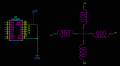
In fact, here is a rough schematic showing how I have the coils connected. The DRV8825 is controlled by an Arduino Nano and the 19 Volts that is being fed to the coils come from a standard AC to DC power supply (A laptop power brick that I had laying around in this case).
OK, here it is in spreadsheet form. It was developed for personal use so it's not real well documented and spiffy, but I think you'll figure out most of it. It's geared toward toroids, specifically a gapped toroid, but you can think of a torrid as merely a curved cylinder. The inner circumference is equivalent to the length of a straight cylinder.
I'll try to answer any questions you have. And in the meanwhile I'll try to find my derivation of how you can estimate the length of wire required for a given coil. It's not as simple as you might think, and so the derivation is a bit ugly.
Sorry but that is incorrect when the wire forms a coil. A typical DC motor when running draws 1/4 or less than Ohm’s law would calculate due to both inductance and back EMF, and your design will do the same.
The degree of current in a DC motor depends on the load, i.e. degree of difference between the applied voltage and the BEMF.
Generated BEMF obviously being higher at a higher RPM
Max.

 Facebook
 Google
 GitHub
 Linkedin