antique matchbox circuit? wha? :-)

Thread Starter

chrisbitz

Joined May 6, 2009
2
I recently cleared out a deceased 96 Year-old relative's house, and found this bizzare item.

It's built in a wooden matchbox, and has that really old cloth-covered wire.

The transistors are both labelled MAT 100, and the red things (dunno if they're resistors or capacitors) are both labelled 5000 20%.

There's space for a 1.5v AA battery.


I can't imagine what it could be for, having a mono male jack on it. maybe it was a tone generator, that you plugged into a mic socket or something?

I appreciate you can't see the other side, but the jack plug is so corroded, I think it would damage the box to turn the circuit over?

Anyway, I was hoping someone here could figure out what it was?

Many thanks!

Chris.
 

bertus

Joined Apr 5, 2008
22,922
Hello,

I think it is indeed some kind of signal generator.
I think it is build like a multivibrator.
It will probably give a squarewave as output.
The red things are 5000 pF capacitors.
The MAT100 will be some transistors.

Greetings,
Bertus
 

gryskop

Joined Mar 1, 2008
26
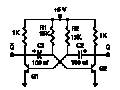
From the amount of components there it looks like a simple astable multivibrator circuit. The collector resistors are the same value, the base resistors the same value and both caps the same as well
 

Attachments

bertus

Joined Apr 5, 2008
22,922
Hello,

You are right gryskop.
The transistors will be PNP types and the powersupply turned around.

Greetings,
Bertus
 

Thread Starter

chrisbitz

Joined May 6, 2009
2
Wow! Thanks very much for teh replies guys...

umm, what's an astable multivibrator? What's it used for, and why might an old man have one? :)

He was a bit of an engineer, and had loads of tools, but nothing like a soldering iron, solder or wires.... so I don't think he was an elecronics enthusiast... so maybe he bought it from a friend or something?

Thanks very much for helping me with my family puzzle!

Chris.
 
That's really neat, hang on to that. Those 2-transistor astables were very popular in the 60s and 70s as crude but effective signal sources for basic diagnostics, especially of audio equipment. The 555 timer didn't appear until 1971, and it was initially expensive compared to the two transistor circuit. My father built a germanium PNP version too, as a signal injector. I still have it.

There's a chance the one in the OP was built for testing musician-type equipment, judging by the 1/4" jack plug. It'd be interesting to turn it on to see what happens. I don't know if the battery polarity is marked, but if it isn't, then the way to tell is that only the emitters of the transistors are tied directly together, and that node is battery positive. There may be some DC bias on the output of your matchbox circuit, as there doesn't seem to be a cap for DC blocking.

Your circuit will look a bit like the one on the right here, if you ignore the LEDs.
 

Wendy

Joined Mar 24, 2008
23,798
Could you put a ruler next to that picture? It looks like it takes a "AA" battery, but without a size comparison. I tend to go with the consensus, it was used as a tone generator.

Square waves, such as multivibrators produce, were also useful for RF signal generators. Is it possible your relative was a HAM or into electronics.
 

bertus

Joined Apr 5, 2008
22,922
Hello,

I have found this on the MAT100 transistor:

In 1962, Sinclair Radionics of Cambridge, Clive Sinclair's company, started selling the 'Sinclair Micro-Amplifier'. I quote here from their advertisement in 'The Radio Constructor':
'This microscopic amplifier, the smallest of its type in the world, out-performs amplifers 20 times as large'.
The text goes on to describe its 60dB power gain, frequency response of 30Hz - 20KHz +/- 1 dB, and power 'sufficient to drive ANY type of earpiece or even a loudspeaker'. It is claimed that the amplifier is only made possible by the 'remarkable micro-alloy transistors it uses'. These were also available separately, comprising four types: MAT100 cost 7/9d, MAT101 cost 8/6d, MAT120 cost 7/9d, and MAT121 cost 8/6d.
As well as the advertisement, I have booklet number 181 from the series "Bernard's Radio Manuals" entitled '22 Tested Circuits using Micro Alloy Transistors' by Clive Sinclair. This gives the characteristics of these four devices: the MAT100 is a low-gain 60 MHz type, the MAT101 a high-gain 60 MHz type, the MAT120 a low-gain 120 MHz type, and the MAT121 a high-gain 120 MHz type.


Greetings,
Bertus
 
Top