Facebook
 Google
 GitHub
 Linkedin
Anti Static Humidity Sensitive Air Tight Container
- Thread starter Secan
- Start date

Scroll to continue with content
drjohsmith
- Joined Dec 13, 2021
- 1,649
That looks like one of the boxs i mentioned , used by film crews etc ,Why did you mention half the protection is in place. Is it not if you put dessicant inside anti-static plastic zip-sealable bags. Both protection is in place. Why do you mention half only?
I was tackling this problem a couple of days ago when I was figuring out the best to protect my $20000 Raman spectrometer. If I put dessicant inside the case, the humidity can go below 10% and static would be a problem. But the metal case would serve as Faraday cage and since it is not connected to ground, static can build up around the metal casing. And the problem is there is USB and power socket in the box, so the static may get inside the socket to the pcb. So I just removed the dessicant so humidity won't go below 10% atttracing static storm. I originally put dessicant to prevent molds from building in the optics.
View attachment 352869
Keep the silica gell in the case , it's there to keep the moisture down, just remember it does not have an infinite life, once had a store keeper that took all the desicznt pouches out of their plastic bag, to fit better in the draws . After a while, we started to get complaints .
If your worried, and that looks like some nice kit , their are indicator straps you can get, that change colour , for heat, humidity, radiation, uv .
Re having to bin components because of excessive humidity , yes the leads on chips , transistors oxidise over time, and turn white instead of shiny.
They are then very hard to solder, essecialy with the reality of a acid fluxs now days , but they have their own problems.
Can any humidity react with a metal and cause corrosion, yes. Thats why they are shipped and stored in sealed plastic bags with silica gell desicant .
But, electrical gear when on , runs warm, so drives off humidity.
Just what are you trying to fix ?
Last edited:
Its solved already. I thought you said humidity without condensation couldnt cause rust or corrode so you verified it could. So its clear.That looks like one of the boxs i mentioned , used by film crews etc ,
Keep the silica gell in the case , it's there to keep the moisture down, just remember it does not have an infinite life, once had a store keeper that took all the desicznt pouches out of their plastic bag, to fit better in the draws . After a while, we started to get complaints .
If your worried, and that looks like some nice kit , their are indicator straps you can get, that change colour , for heat, humidity, radiation, uv .
Re having to bin components because of excessive humidity , yes the leads on chips , transistors oxidise over time, and turn white instead of shiny.
They are then very hard to solder, essecialy with the reality of a acid fluxs now days , but they have their own problems.
Can any humidity react with a metal and cause corrosion, yes. Thats why they are shipped and stored in sealed plastic bags with silica gell desicant .
But, electrical gear when on , runs warm, so drives off humidity.
Just what are you trying to fix ?
Ill settle with my dehumidifier. I wont use silica gel inside plastic bec it can make humidity fall below 10% and after sometime can reach very high when saturated.
Thanks to all the useful tips here.
I am still going to correct you and still give you my advice.
Humidity is a problem.
ESD is a problem.
High humidity causes corrosion. Low humidity encourages ESD. You need to find a balance between the two extremes.
Two small packets of silica gel will not likely reduce the RH to 10%.
The likelihood of ESD with 80% ambient RH is very low.
Solution
Put one or two small packets of silica gel with the unit in a sealed antistatic bag.
Renew the silica gel on a regular schedule.
Humidity is a problem.
ESD is a problem.
High humidity causes corrosion. Low humidity encourages ESD. You need to find a balance between the two extremes.
Two small packets of silica gel will not likely reduce the RH to 10%.
The likelihood of ESD with 80% ambient RH is very low.
Solution
Put one or two small packets of silica gel with the unit in a sealed antistatic bag.
Renew the silica gel on a regular schedule.
drjohsmith
- Joined Dec 13, 2021
- 1,649
@Secan
What are you actualy trying to achieve ?
What are you actualy trying to achieve ?

drjohsmith
- Joined Dec 13, 2021
- 1,649
You probably get surface condensation as the temperatures change.High humidity in my garage definitely accelerates corrosion compared to my dry (dehumidified) basement. To my knowledge I don't get actual condensation happening in the garage.
Is the rust more likely on flat surfaces?
It's interesting though,
Read up on people with tools in sheds, and how they try to stop tools rusting. It's a long set of reading.
Tools rusting in sheds and workshops is caused by fine wood dust. The dust absorbs moisture from the air and accelerates corrosion.
The worst I have found is the dust from cutting laminate flooring.
I vacuum up the fine dust off the tools soon after laying the flooring.
The worst I have found is the dust from cutting laminate flooring.
I vacuum up the fine dust off the tools soon after laying the flooring.
MisterBill2
- Joined Jan 23, 2018
- 28,231
Iwas thinking about temperature control. My error. I have had surface rust develop in closed toolbox drawers, never any wood dust in the whole building.
Your concern seems to be mostly centered around damage to your equipment caused by ESD, along with a question about 80% humidity being bad for electronics. While high (or low) humidity can affect ESD specifics, they are TWO SEPARATE FACTORS. I’ll first address the effect of humidity on electronics, exclusive of ESD.
Typical electronics has a relative humidity (RH) specification that typically reads 20% to 80% non-condensing. (This is different than the operating environment must be between 40% and 60% RH to hold a particular specification, common in laboratory equipment). That means that as long as the humidity in the air does not condense into droplets of water, you are OK with RH levels between 20% and 80%. Condensing moisture generally occurs when a device is quickly moved from a warm moist environment into a cool environment. If the temperature stays nearly the same, there is no condensation. Modern electronic components are inherently moisture proof to a very large degree, so RH specifications really apply to physical layout and construction (i.e. PC board), not so much the components themselves.
Above the 80% limit you could have problems caused by leakage between high impedance points of the circuit. (There can also be issues for long-term storage (6 months or more), but these do not appear applicable in your case.) Below the 20% limit you could have an increased ESD sensitivity or the drying out of electrolytic capacitors. Since you are in a humid environment, that should not be a concern either.
You may have noted that I used both the term “humidity” and “relative humidity”. They are NOT the same. Humidity refers to the absolute amount of moisture in the air. Relative humidity refers to the potential amount of moisture the air can absorb and is temperature dependent.
Regarding air-tight plastic containers with silica gel to control moisture. These are for long-term storage. The larger the container, the more silica gel is required to absorb the moisture in the air inside the container. A silica gel manufacturer can tell you how much is required for the size and type container you are using. To precisely control the amount of humidity in a storage container, you would have to know the exact air volume, the starting RH of both the air and the silica gel and seal everything in a METAL container with soldered seams (plastics do allow the passage of moisture through the material). I have only seen this done for some military purposes.
Because humidity absorption is a slow process, for short-term storage you don’t have to worry about humidity causing any damage. From a performance specification perspective, you may want to consider allowing an extended “warm up” period (~30 minutes) so that internal heating of the device removes any humidity that might affect it.
Now for ESD. First a few facts, simplified for practical purposes:
Although this is probably overkill, you could also wear an ESD wrist strap (properly installed to earth (conduit) ground through a 1 Megohm resistor) when making your connections.
Typical electronics has a relative humidity (RH) specification that typically reads 20% to 80% non-condensing. (This is different than the operating environment must be between 40% and 60% RH to hold a particular specification, common in laboratory equipment). That means that as long as the humidity in the air does not condense into droplets of water, you are OK with RH levels between 20% and 80%. Condensing moisture generally occurs when a device is quickly moved from a warm moist environment into a cool environment. If the temperature stays nearly the same, there is no condensation. Modern electronic components are inherently moisture proof to a very large degree, so RH specifications really apply to physical layout and construction (i.e. PC board), not so much the components themselves.
Above the 80% limit you could have problems caused by leakage between high impedance points of the circuit. (There can also be issues for long-term storage (6 months or more), but these do not appear applicable in your case.) Below the 20% limit you could have an increased ESD sensitivity or the drying out of electrolytic capacitors. Since you are in a humid environment, that should not be a concern either.
You may have noted that I used both the term “humidity” and “relative humidity”. They are NOT the same. Humidity refers to the absolute amount of moisture in the air. Relative humidity refers to the potential amount of moisture the air can absorb and is temperature dependent.
Regarding air-tight plastic containers with silica gel to control moisture. These are for long-term storage. The larger the container, the more silica gel is required to absorb the moisture in the air inside the container. A silica gel manufacturer can tell you how much is required for the size and type container you are using. To precisely control the amount of humidity in a storage container, you would have to know the exact air volume, the starting RH of both the air and the silica gel and seal everything in a METAL container with soldered seams (plastics do allow the passage of moisture through the material). I have only seen this done for some military purposes.
Because humidity absorption is a slow process, for short-term storage you don’t have to worry about humidity causing any damage. From a performance specification perspective, you may want to consider allowing an extended “warm up” period (~30 minutes) so that internal heating of the device removes any humidity that might affect it.
Now for ESD. First a few facts, simplified for practical purposes:
- All items have the potential to hold a static electric charge – even metal. The higher the “bulk resistance” an item has, the easier and longer it has to hold a charge.
- A static charge can only be generated where there is MOVEMENT between two items. The faster the movement, the greater the generated charge.
- The voltage of a charge HAS TO BE MEASURED IN RELATION TO ANOTHER OBJECT. It is an electric circuit after all.
- A material that is “anti-static” simply means it has a low potential to generate a static charge. It does not mean that it shields a device from a static discharge or is able to dissipate a static charge.
- “Static dissipative” means that it can and generally does generate a static charge, but that it SLOWLY dissipates the charge, limiting the maximum current during the discharge. Current control is a key aspect of ESD protection.
- A relatively conductive material (metals, carbon-impregnated plastics, etc.) have the ability to “shield” a device from a static discharge. By their nature, they are generally “anti-static”, but can allow high current flow from a discharge. That is why aluminum foil has not been used for ESD protection since the early 1970s.
- All three of these properties need to be considered when protecting a device from ESD. This is why ESD packaging is almost always multi-layer.
- With only a few exceptions, once an ESD-sensitive electronic component is connected with other electronic components, forming a circuit, it is no longer ESD-sensitive (human body model). The notable exceptions are input and output connectors.
Although this is probably overkill, you could also wear an ESD wrist strap (properly installed to earth (conduit) ground through a 1 Megohm resistor) when making your connections.
I'm still waiting for the chemists and physicists to give molecular details if high humidity without condensation can rust electronic parts or not. But one of them said " Given that there are well defined tests (e.g. for microelectronics) for corrosion in non-condensing conditions, the answer is that condensation is not required.".Your concern seems to be mostly centered around damage to your equipment caused by ESD, along with a question about 80% humidity being bad for electronics. While high (or low) humidity can affect ESD specifics, they are TWO SEPARATE FACTORS. I’ll first address the effect of humidity on electronics, exclusive of ESD.
Typical electronics has a relative humidity (RH) specification that typically reads 20% to 80% non-condensing. (This is different than the operating environment must be between 40% and 60% RH to hold a particular specification, common in laboratory equipment). That means that as long as the humidity in the air does not condense into droplets of water, you are OK with RH levels between 20% and 80%. Condensing moisture generally occurs when a device is quickly moved from a warm moist environment into a cool environment. If the temperature stays nearly the same, there is no condensation. Modern electronic components are inherently moisture proof to a very large degree, so RH specifications really apply to physical layout and construction (i.e. PC board), not so much the components themselves.
Above the 80% limit you could have problems caused by leakage between high impedance points of the circuit. (There can also be issues for long-term storage (6 months or more), but these do not appear applicable in your case.) Below the 20% limit you could have an increased ESD sensitivity or the drying out of electrolytic capacitors. Since you are in a humid environment, that should not be a concern either.
You may have noted that I used both the term “humidity” and “relative humidity”. They are NOT the same. Humidity refers to the absolute amount of moisture in the air. Relative humidity refers to the potential amount of moisture the air can absorb and is temperature dependent.
Regarding air-tight plastic containers with silica gel to control moisture. These are for long-term storage. The larger the container, the more silica gel is required to absorb the moisture in the air inside the container. A silica gel manufacturer can tell you how much is required for the size and type container you are using. To precisely control the amount of humidity in a storage container, you would have to know the exact air volume, the starting RH of both the air and the silica gel and seal everything in a METAL container with soldered seams (plastics do allow the passage of moisture through the material). I have only seen this done for some military purposes.
Because humidity absorption is a slow process, for short-term storage you don’t have to worry about humidity causing any damage. From a performance specification perspective, you may want to consider allowing an extended “warm up” period (~30 minutes) so that internal heating of the device removes any humidity that might affect it.
Now for ESD. First a few facts, simplified for practical purposes:
With the above in mind, when you have finished using the device it would make sense to store your device in a conductive plastic storage container with a lid and put it on a shelf. The container will keep dust and other contaminants away from the device. It will not generate static charges, and it will shield the device from any external ESD events. When handling the device, avoid touching any input or output connectors until all related equipment has been connected to its power source (thereby bringing all equipment to the same potential through grounding).
- All items have the potential to hold a static electric charge – even metal. The higher the “bulk resistance” an item has, the easier and longer it has to hold a charge.
- A static charge can only be generated where there is MOVEMENT between two items. The faster the movement, the greater the generated charge.
- The voltage of a charge HAS TO BE MEASURED IN RELATION TO ANOTHER OBJECT. It is an electric circuit after all.
- A material that is “anti-static” simply means it has a low potential to generate a static charge. It does not mean that it shields a device from a static discharge or is able to dissipate a static charge.
- “Static dissipative” means that it can and generally does generate a static charge, but that it SLOWLY dissipates the charge, limiting the maximum current during the discharge. Current control is a key aspect of ESD protection.
- A relatively conductive material (metals, carbon-impregnated plastics, etc.) have the ability to “shield” a device from a static discharge. By their nature, they are generally “anti-static”, but can allow high current flow from a discharge. That is why aluminum foil has not been used for ESD protection since the early 1970s.
- All three of these properties need to be considered when protecting a device from ESD. This is why ESD packaging is almost always multi-layer.
- With only a few exceptions, once an ESD-sensitive electronic component is connected with other electronic components, forming a circuit, it is no longer ESD-sensitive (human body model). The notable exceptions are input and output connectors.
Although this is probably overkill, you could also wear an ESD wrist strap (properly installed to earth (conduit) ground through a 1 Megohm resistor) when making your connections.
Guys. Please give the details about these well defined tests (e.g. for microelectronics) for corrosion in non-condensing conditions.




drjohsmith
- Joined Dec 13, 2021
- 1,649
Electronic parts do not rustI'm still waiting for the chemists and physicists to give molecular details if high humidity without condensation can rust electronic parts or not. But one of them said " Given that there are well defined tests (e.g. for microelectronics) for corrosion in non-condensing conditions, the answer is that condensation is not required.".
Guys. Please give the details about these well defined tests (e.g. for microelectronics) for corrosion in non-condensing conditions.
To have rust you need iron
Oxygen is a strong oxidiser !
Any reactive material in an oxygen atmosphere will oxidise.
Air is around 20 percent oxygen
Water is as my professor used to say, an enabler , be it microbial or chemical reaction.
So yes , metals on parts will oxidise .
Hence , stuff we want to keep , such as the July 4th declaration is kept in a dry , nitrogen atmosphere , no water and no oxygen. . the inks won't then oxidise.
But , if I can be so bold , that's not the question .
Electronic semiconductors are packaged in moisture resistant materials , and the active silicon is covered in silicon oxides, to make it very immune to oxygen and moisture.
Parts like electrolytic capacitors are not so well sealed , as they vent when working hard , so are more prone to environmental concerns . But these are designed for a service life , normally around 25 years , some cheap imports much less, some much more.
As mentioned , the atmosphere is an oxidizer to the leads of electronic components, they can turn white and hard to solder.
The electronics is still going to be fine , and the use of an acid flux ( please ensure to clean properly) allows percent soldering .
Electronic parts are shipped in anti static bags , hemeticsly sealed .
This is because of moisture and soldering .
The package of chips absorbs moisture to a small degree .
Not a problem , even under water
But when commercial soldering , you pre heat the assembled board to around 150 C . If there is moisture in the packaging , there is a chance of "out gassing"
To avoid this , chips that have been taken out of their packaging for a few days , are first dried in a dehumidifier.
But
Your question seems to be jumping all around different topics
.
What are you actually trying to achieve ,
There are some specialized tests designed to test how well paints, coatings and connectors stand up to harsh corrosive environments. One is what is known as a "Salt-Fog" test and the other is known as a “Salt-Spray” test. The specifics are contained in ASTM B117. It is a general misconception that they are the same test, but they are very different from each other, use very different test chambers and detect different ‘flaws’ in a design.I'm still waiting for the chemists and physicists to give molecular details if high humidity without condensation can rust electronic parts or not. But one of them said " Given that there are well defined tests (e.g. for microelectronics) for corrosion in non-condensing conditions, the answer is that condensation is not required.".
Guys. Please give the details about these well defined tests (e.g. for microelectronics) for corrosion in non-condensing conditions.
The Salt-Fog test subjects a test subject to a warm (35°C) fog created by atomizing a 5% saltwater solution. Since the temperature does not change, there is no condensation, but the atmosphere is corrosive. As I remember, this test is typically 240 hours long. It is primarily used when you want to know how well the plating, or paint applied to the surface of metal brackets and panels holds up.
The Salt-Spray test is a test performed in a test chamber that has an elaborate temperature, salt-spray, drying profile taking 24 hours to complete. Ten cycles were generally specified, so the test lasts 240 hours. With this test the device is essentially bathed in a 5% saltwater solution, then allows the water component to evaporate off the surface leaving only a fine layer of salt crystals. The saltwater builds up in any small opening and as the salt crystals form, forces the openings to expand. With each repeated cycle, the opening gets larger and larger. When a failure occurs, it is generally because saltwater, a conductive fluid, gets inside the electronics and literally shorts it out. Because of this evaporation cycle, it is technically a non-condensing test, but it is a ‘wet’ test. This test is used when the integrity of seals needs to be evaluated, but it is a brutal test to pass.
While both of these tests are designed to create corrosion under non-condensing conditions, neither test would be appropriate for any kind of ‘open’ electronic product, even under non-operating storage conditions.
There is another type of accelerated life test that uses a temperature/humidity chamber where a device is subjected to very high (>95%) humidity levels (non-condensing) at elevated temperatures (typically 50°C) for several hours (≥ 8 hours). With this type of test, the pass/fail results are always determined by measuring a CHANGE in specifications before and after the test, usually conducted at normal room temperature and humidity conditions.
This kind of test is appropriate to evaluate the effect of moisture on non-operational equipment under storage conditions. If you are measuring the dimensional change of nylon due to moisture absorption, only a couple of hours are needed. If you are looking to find defects in plastic semiconductor housings, the test period must be in the order of months.
The early plastic-cased semiconductors (back in the germanium days of the 1960’s) were very subject to moisture contamination and the only fix at that time was to use a metal case with a glass seal. But modern plastic semiconductors are nearly immune to moisture, and metal-cased transistors are all but non-existent today.
I have an old solid state amplifier that uses plastic germanium transistors. It went unused and stored in a basement crawlspace for 30 years. When I put it back into service, I noted the phono input was VERY NOISY. After just a couple of hours of use, the noise went away. This is because the self-heating at the junction evaporated the moisture that had migrated through the transistor case. I have also seen this same characteristic with silicon transistors from the 1970 time period, but not on any equipment built after 1980 or so. Is that because of better epoxy formulations or because they were not stored away as long, I don’t know.
But honestly, I don’t think you have to worry about creating a controlled humidity environment for electronic equipment that is in regular but cycled use. An ESD storage bin is all the protection it needs. If you store it away for a year or two, then put it in a sealed ESD bag with silica gel inside the ESD storage bin.
The reason I'm concerned about all this is because of the following comments (see bottom after photo) I received from other forum. Background. I have a computer motherboard I stored in attic in 2019. 2 months ago, I got it to try running a software that can only run in Windows 7. After a few days, the motherboard got defective probably from the corrosion (caused by average of 80% humidity for many years) shorting a component causing permanent damage. Note the attic has no salts source.
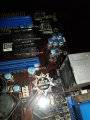
These are the comments I received after first posting them. If it can happen to that motherboard, why can't it happen to other device:
"The solder joints all have a dull look due to corrosion. The crystal resonator case is nicely corroded. So are the metal straps on the VGA connector. Parts of the USB or PS/2 connector shield have rust on them. The capacitors have corroded aluminum shells as you have observed. That board is in a poor, poor shape. The only exposed metal that looks nice is gold-plated or gold-flashed. So it wasn't exposed to abrasive dust blowing around, since that would destroy the plating and cause those to corrode too."
"The board has been in corrosive environment, and there can be traces that are intermittent due to pinholes in the solder mask and localized corrosion. We're talking about corroded areas say 0.005" by 0.005", or about 0.13mm x 0.13mm in size. Finding those can be a very tiring and long task, and you're not guaranteed that you'll find all of them. They can be hidden in the inner layers.
To actually fix such a board after exposure to corrosive environment, you'd would need to set up a flying probe electrical test of the board, and use a fairly high current to identify wonky traces. Since you likely don't have a schematic of the board, a "known good" board of the same type would be needed as a reference to reverse-engineer a netlist.
Reverse-engineering a board of this complexity on a flying probe tester takes a long time - potentially days. That's because connectivity between all combinations of probe points has to be tested. I.e. for N pads on the board, the flying prober has to do N^2 resistance measurements. You would also need to desolder chips whose pads are not accessible, e.g. any BGAs if present.
In other words: fixing this to be reliable may cost several thousand USD in labor and materials, and that's for a lab that's experienced in doing such work. Unless it's a simpler problem, and that may be so too."
-------------
With comments like them. Of course one needs to be familiar with what caused them and try to make sure it won't happen again. Hence this thread. Anyway I already resolved it with a permanent dehumidifier that continuously runs all day. The only problem is if the dehumidifier gets broken and needs a week of service. I need to have backup plan. You can't just store them inside air tight conttainer with silica gel because I have tested it by putting a humidity detector inside sealed container wth silica gel (2 big ones at back of detector in photo below). And guess what. The humidity inside gets to 30% from 80% and after it goes below 30%. the static inside the container got formed and the detector got damaged by static. so puttting device inside container with silica gel can get the humidity below 20% and damage your device so I won't do it again:

These are the comments I received after first posting them. If it can happen to that motherboard, why can't it happen to other device:
"The solder joints all have a dull look due to corrosion. The crystal resonator case is nicely corroded. So are the metal straps on the VGA connector. Parts of the USB or PS/2 connector shield have rust on them. The capacitors have corroded aluminum shells as you have observed. That board is in a poor, poor shape. The only exposed metal that looks nice is gold-plated or gold-flashed. So it wasn't exposed to abrasive dust blowing around, since that would destroy the plating and cause those to corrode too."
"The board has been in corrosive environment, and there can be traces that are intermittent due to pinholes in the solder mask and localized corrosion. We're talking about corroded areas say 0.005" by 0.005", or about 0.13mm x 0.13mm in size. Finding those can be a very tiring and long task, and you're not guaranteed that you'll find all of them. They can be hidden in the inner layers.
To actually fix such a board after exposure to corrosive environment, you'd would need to set up a flying probe electrical test of the board, and use a fairly high current to identify wonky traces. Since you likely don't have a schematic of the board, a "known good" board of the same type would be needed as a reference to reverse-engineer a netlist.
Reverse-engineering a board of this complexity on a flying probe tester takes a long time - potentially days. That's because connectivity between all combinations of probe points has to be tested. I.e. for N pads on the board, the flying prober has to do N^2 resistance measurements. You would also need to desolder chips whose pads are not accessible, e.g. any BGAs if present.
In other words: fixing this to be reliable may cost several thousand USD in labor and materials, and that's for a lab that's experienced in doing such work. Unless it's a simpler problem, and that may be so too."
-------------
With comments like them. Of course one needs to be familiar with what caused them and try to make sure it won't happen again. Hence this thread. Anyway I already resolved it with a permanent dehumidifier that continuously runs all day. The only problem is if the dehumidifier gets broken and needs a week of service. I need to have backup plan. You can't just store them inside air tight conttainer with silica gel because I have tested it by putting a humidity detector inside sealed container wth silica gel (2 big ones at back of detector in photo below). And guess what. The humidity inside gets to 30% from 80% and after it goes below 30%. the static inside the container got formed and the detector got damaged by static. so puttting device inside container with silica gel can get the humidity below 20% and damage your device so I won't do it again:
Your computer mother board stop working for any number of reasons.
You have no idea where the fault lies.
You don’t require condensation or salts for corrosion to occur.
We have already told you many times. Put the device in anti-ESD bags with silica gel and be done with it.
You have no idea where the fault lies.
You don’t require condensation or salts for corrosion to occur.
We have already told you many times. Put the device in anti-ESD bags with silica gel and be done with it.
drjohsmith
- Joined Dec 13, 2021
- 1,649
@Secan
What is your aim here ?
You stored a naked PCB in an attic, for may years, presumable at high temperatures, and varying humidity ,
condensation was likely on the items.
Yes, if you store any item, it will degrade over time.
Electrolyte Capacitors are classic, store them in any environment at a warm temperature , and they degrade.
its not corrosion,
that's the probable first reason your board failed.
Second, your board has evident white marks around the crystal oscillator, probably caused by the high humidity and temperatures and the board probably having flux residue. The circuit for the crystal has to be very high impedance, and the white residue is unlikely to be in the M ohm range needed, so the oscilator is liable not to work . Another good reason your board did not work.
That green you see on the board looks to me more "biological" then chemical, some bug has been living off the flux residue , helped by the high humidity, and temperatures.
New boards are shipped in sealed anti static bags, with silica gel for a reason,
Working boards in a normal environment, get warm, this lowers any humidity in the area of the board.
If you want to store boards, best practice is to remove any batteries on the board, and put them into a sealed anti static bag ( not one of the black ones , one of the silvered or pink ones )
Any working equipment around the house, provided it does not have condensation on it is just fine.
What do you actually want to achieve ?
What is your aim here ?
You stored a naked PCB in an attic, for may years, presumable at high temperatures, and varying humidity ,
condensation was likely on the items.
Yes, if you store any item, it will degrade over time.
Electrolyte Capacitors are classic, store them in any environment at a warm temperature , and they degrade.
its not corrosion,
that's the probable first reason your board failed.
Second, your board has evident white marks around the crystal oscillator, probably caused by the high humidity and temperatures and the board probably having flux residue. The circuit for the crystal has to be very high impedance, and the white residue is unlikely to be in the M ohm range needed, so the oscilator is liable not to work . Another good reason your board did not work.
That green you see on the board looks to me more "biological" then chemical, some bug has been living off the flux residue , helped by the high humidity, and temperatures.
New boards are shipped in sealed anti static bags, with silica gel for a reason,
Working boards in a normal environment, get warm, this lowers any humidity in the area of the board.
If you want to store boards, best practice is to remove any batteries on the board, and put them into a sealed anti static bag ( not one of the black ones , one of the silvered or pink ones )
Any working equipment around the house, provided it does not have condensation on it is just fine.
What do you actually want to achieve ?
| Thread starter | Similar threads | Forum | Replies | Date |
|---|---|---|---|---|
| M | Anti-Static Protection | General Electronics Chat | 11 | |

|
Ionizing anti-static air guns. | Off-Topic | 30 | |
| J | Is my anti static mat damaged? | General Electronics Chat | 5 | |

|
Anti-static electricity circuit | General Electronics Chat | 14 | |

|
Where to Connect Anti-Static Mat to Leviton (no screw) Outlet? | General Electronics Chat | 17 |