Anti Static Humidity Sensitive Air Tight Container

MrChips

Joined Oct 2, 2009
34,889
What I mean to say by condensation is this. When you have very cold glass of water, the air outside can condense on the external surface of the cold glass. What happens if you bring out from cabinet a device into a very cold aircon room, wouldn't the internal part of the device condense because the air inside the device is hotter than the room?
That is not how condensation forms.

Air does not condense. It is water vapour in the air that condenses to water.
There are three interrelated parameters, temperature, relative humidity, and dew point.

At any temperature, when the air is fully saturated with moisture, the air is at 100% RH. The air cannot hold any more moisture. At this point, dew forms on the surface of objects and the dew point is the same as the ambient temperature.

The higher the ambient air temperature, the more moisture the air can hold. If the temperature of air at 100% RH is cooled, dew is formed. Thus, the dew point is the temperature at which RH rises to 100%.

Air at 30°C and 80% RH has a dew point of 26.2°C. Thus, dew will form on an object that is below 26.2°C.
Air at 30°C and 60% RH has a dew point of 21.4°C. Thus, dew will form on an object that is below 21.4°C.

Thus, if your device was stored at 30°C and 60% RH, dew will form internally if the whole device is allowed to cool to 21°C.

1752583526119.png
 

MisterBill2

Joined Jan 23, 2018
27,683
I am seriously questioning the validity of the paranoia regarding an instrument produced by a company familiar with the clinical practice environment.
Such an environment IS NEVER CONSIDERED BENIGN!
As a matter of course, this sort of equipment is assembled to survive the high humidity used to reduce hazards in surgical operations. It is also designed to handle occasional rough handling during surgical emergencies. Of course, if the system is a cheap knock-off of normal instruments, that might not be the case.
AND, we have been given no information to know otherwise.
 

Thread Starter

Secan

Joined Sep 20, 2024
205
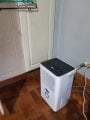
dehumidifier on.jpg


My newly installed Dehumidifier is set at 60% Relative Humidity. It turns on and off every 6 minutes because my ambient humidity is 80% plus. Is it that bad to re engage every 6 minutes? It turns on when humidity reaches 5% above set value.

Does greener PCB means medical grade or Milspec or is it just the painting?
 
Last edited:

MrChips

Joined Oct 2, 2009
34,889
Your dehumidifier would run more efficiently if the room were smaller. You can store all your electronics in a smaller room, a clothes closet for example, along with the dehumidifier. Keep your eye on the water tank because you will have to empty it frequently.

The green colour is just the colour of the solder mask. The colour is not important.
 

MisterBill2

Joined Jan 23, 2018
27,683
The green solder mask will protect the copper PCB traces, but nothing else. I see no evidence of any additional protection coating. That does not seem appropriate for clinical use equipment.
 
Last edited:

meth

Joined May 21, 2016
304
You are paranoid about water condensing inside your precious device... and you are yet opening it.. with a pocket knife?! :D
 

Thread Starter

Secan

Joined Sep 20, 2024
205
The green solder mask will protect the copper PCB traces, but nothing else. I see no evidence of any additional protection coating. That does not seem appropriate for clinical use equipment.
Did you see any ESD protection diodes in the g.Usbamp light green pcb? Asus motherboard has Asus ESD Guard feature where it can protect against ESD using some kind of ESD protection diodes where the static is said to be shunted.

The $17700 usbamp bioamplifier is not for clinical use. Only for Brain Computer Interface Research use. The reason it is so expensive is because of not much competitors. For example, none of you experts like to construct it. So all over the world. those interested in Brain Computer Interface only has the gtec g.USBamp as only option with absolutely no competition. So the price of complete setup can reach $25000 to $30000.

2 weeks ago I got my MSI motherboards from attic and I tried all week to revive the MSI motherboard damaged by humidity and corrosion. After spending so much on Isopropyl 99% alcohol to soak the entire board and spent compressed air to blow it. It still couldn't be repaired, it still reboots randomly. So I bought an old 4th gen Asus motherboard that happens to have ESD guard and read about the ESD diode protection. Does the gtec green pcb has it? pls check the earlier 2 images. What other components can protect aganst ESD? Can one design a board that can 100% protect against it? Thanks.
 
Last edited:

wayneh

Joined Sep 9, 2010
18,124
My newly installed Dehumidifier is set at 60% Relative Humidity. It turns on and off every 6 minutes because my ambient humidity is 80% plus. Is it that bad to re engage every 6 minutes? It turns on when humidity reaches 5% above set value.
It's fine for the device to cycle. That may reduce and the cycle time increase as you draw moisture out of the wood, textiles, etc. in the room. Placing the device to best circulate the room air may help also if you're now drying only a portion of the room and then it turns off until the air redistributes.

But again, I wouldn't worry about it much. In fact I'd probably set it to 50% or below. You'll notice a much lower level of mold.
 

Thread Starter

Secan

Joined Sep 20, 2024
205
It's much worse. I mean, the 6 minutes interval is when the windows were closed, but when the windows are opened. The dehumidifieris continuously on all day. Not only that. It introduced heat too to the small room. So I may just put it in the attic to dry the laundry faster.

Instead. I plan to get this. A small box that has tiny dehumidifier with refrigerant (not dessicant which is difficult to control) connected to it.

So imagine the following connected to a small box just enough to store the gtec g.USBamp. I plan to sell the other EEG. The reason I got the Brainmasters is to modify the firmware to do what the g.USBamp can do which is simultaneous EEG and EMG.

how dehumidifier work.PNG

Is dehumidifier unit that doesn't have refrigerant also effective? I saw some units where no refrigerant is used but some coils got cold and condense the humid air. This would simply it as no condenser need to used to build the tiny box dehumidifier. Also isn't there a ready dehumidifier storage box product already? This is very useful so should be available isn't it.
 

wayneh

Joined Sep 9, 2010
18,124
It's much worse. I mean, the 6 minutes interval is when the windows were closed, but when the windows are opened. The dehumidifieris continuously on all day. Not only that. It introduced heat too to the small room.
Well yeah, both those observations are predictable.
Instead. I plan to get this. A small box that has tiny dehumidifier with refrigerant (not dessicant which is difficult to control) connected to it.
That's essentially what you already have.
Is dehumidifier unit that doesn't have refrigerant also effective? I saw some units where no refrigerant is used but some coils got cold and condense the humid air. This would simply it as no condenser need to used to build the tiny box dehumidifier. Also isn't there a ready dehumidifier storage box product already? This is very useful so should be available isn't it.
A commercial device should offer a rating for how much moisture it can remove, usually expressed per day, eg. liters/day. Here in the U.S., that number has to be cited at a set of defined conditions (temp and humidity) so that you can compare across units. So yes, other technologies can remove moisture but pay attention to the specs. A Peltier or TEC-based unit would work at your high humidity. A dessicant-based device could also work but not with the windows open!
 

MisterBill2

Joined Jan 23, 2018
27,683
Justuse a fairly tight box a purge it with dry nitrogen, then seal it. Zero power consumption, zero heat generation, and greatly reduced concentration of oxygen, the gas that oxidizes stuff. In addition, it is clean and it suffocates bugs.
 

Thread Starter

Secan

Joined Sep 20, 2024
205
Well yeah, both those observations are predictable.
That's essentially what you already have.
A commercial device should offer a rating for how much moisture it can remove, usually expressed per day, eg. liters/day. Here in the U.S., that number has to be cited at a set of defined conditions (temp and humidity) so that you can compare across units. So yes, other technologies can remove moisture but pay attention to the specs. A Peltier or TEC-based unit would work at your high humidity. A dessicant-based device could also work but not with the windows open!
I was referring to a humidity controlled cabinet like this. Does it have a compressor inside? If not. How does it condense the moist air inside the cabinet?


humidity cabinet.PNG


Sirui HC-50 Electronic Humidity Control Cabinet (Excess freight applies.Please contact us for details) | Progear
 
Last edited:

MisterBill2

Joined Jan 23, 2018
27,683
There ARE some clusters of tiny components associated with what I guess are the input connections associated with the red terminals. AND there is also a PCB providing the interconnect with those terminals, which would be the preferred location for an anti-static protection scheme circuit, because it could be completely tested before installation. So there is a totally unseen PCB, except for an edge view. I can only guess what might be on that PCB.
 

MisterBill2

Joined Jan 23, 2018
27,683
OK, what I think I see is SMD capacitors in that photo.

One possible option could be a simple option would be a simple "grounding jumper harness" that would tie all of the input connections to the device common, for when it is not in use. No modifications at all, no possible interference with operation, and simple to verify proper connection. It would be a bit inconvenient, but not difficult.
 

wayneh

Joined Sep 9, 2010
18,124
I was referring to a humidity controlled cabinet like this. Does it have a compressor inside? If not. How does it condense the moist air inside the cabinet?
It's almost certainly a TEC, or Peltier device. It makes a cold surface and water condenses on it. The manual makes no mention of emptying the water and I suppose they've figured out a way to reject the water to the room so that you never need to handle it. Like your dehumidifier, all the power it draws will end up in the room as heat.
 
How about a steel box with a folding lid (somewhat sealed) and some silica gel packs?

8 x 10" Bud steel junction box: 377-1867-ND at Digikey $32.10

or more beautiful and more amusing:
Large Bread Box for Kitchen, Metal Bread Storage Bin
with Lid, 16.3"x9"x6.7" Amazon $26.99
 

drjohsmith

Joined Dec 13, 2021
1,618
Coming to this a bit late @Secan , so done a quick resume ,
You say that electronics needs to be kept in a set moisture range ,
This is generaly not true for an assembled item, it just needs to be "none condensing" for obvious reasons
Where humidifying a concern is in assembly of boards , wher heat of 200 plus C can be applied, and moisture then converts to vapour and is a real problem. Your board gently warming up to around 40 or 50 C , it's totaly different.

You mention its for a router , these are going to have lots of holes for the cables, it's going to be very difficult to make that air tight.

Your router is also going to dissipate say 20 watts, put that in a sealed box, it's going to melt. If box has ventilation in it, the increased temorature inside the box v outside is going to lower the relative humidity inside the box. ,!

A router is going to be protected from end, ethernet is inherently transformer coupled , and I cant think of a router id want that is not CE marked , so has good end protection,

You mention about the motherboard stored in the attic, which was broken by humidity.
Not certain how id identify a humidity broken board, what gave it away to you ? What I notice about the loft in even the cooler uk, is it gets real hot , then real cold, 60 C plus in summer. I'm guessing yours is even hotter. Now that sort of long term heat, kills electrolytic capacitors, a few years at 60 p.us they have little real capacitance. I took an old quad 405 amplifier out of loft after around 8 years , it failed to work, changed the electrolytic caps, and it's fine , and that's a lot cooler than where you are.

If you really want an anti static box , that's air tight, then there are expedition travel boxes that are "indestructible ". Film crews in the Amazon jungle for instance use them for the electronics , but it's going to need a bunch of holes in it.
We used them for moving delicate electro onto stuff around the world.
Hope this helps,
 

Thread Starter

Secan

Joined Sep 20, 2024
205
Coming to this a bit late @Secan , so done a quick resume ,
You say that electronics needs to be kept in a set moisture range ,
This is generaly not true for an assembled item, it just needs to be "none condensing" for obvious reasons
Where humidifying a concern is in assembly of boards , wher heat of 200 plus C can be applied, and moisture then converts to vapour and is a real problem. Your board gently warming up to around 40 or 50 C , it's totaly different.

Since the beginning of this thread. I've been studying whether water vapor alone from high humidity can cause rust or corrosion without condensation. And the answer in internet seems to be yes. Im now asking chemists and physicsts the truth about it. If you know the detail answer. Pls also share. Because I don't like my Dehumidifier which came 2 days ago. It's so noisy, it makes the room hot. I need to replace water in external jar many times a day. So if you are right that water vapor alone without condensation can't form rust, Then i'll remove my dehumidifier in my room and use it only in the laundry room when it's raining. As long as I don't make the room or device cold it won't form condensation. Or maybe condensation is part of weather changes and tied up with humidity? Remember it only takes temperature to lower to 26C before the ambient 30C and 80% humidity can condensation, so your 200 plus C before moisture converts to vapor is not the minimum factor (what you talking about here anyway about moisture converting to vapor or did you mean vapor converting to moisture?)

can rust form without condensation.jpg


You mention its for a router , these are going to have lots of holes for the cables, it's going to be very difficult to make that air tight.

Your router is also going to dissipate say 20 watts, put that in a sealed box, it's going to melt. If box has ventilation in it, the increased temorature inside the box v outside is going to lower the relative humidity inside the box. ,!

A router is going to be protected from end, ethernet is inherently transformer coupled , and I cant think of a router id want that is not CE marked , so has good end protection,

You mention about the motherboard stored in the attic, which was broken by humidity.
Not certain how id identify a humidity broken board, what gave it away to you ? What I notice about the loft in even the cooler uk, is it gets real hot , then real cold, 60 C plus in summer. I'm guessing yours is even hotter. Now that sort of long term heat, kills electrolytic capacitors, a few years at 60 p.us they have little real capacitance. I took an old quad 405 amplifier out of loft after around 8 years , it failed to work, changed the electrolytic caps, and it's fine , and that's a lot cooler than where you are.

If you really want an anti static box , that's air tight, then there are expedition travel boxes that are "indestructible ". Film crews in the Amazon jungle for instance use them for the electronics , but it's going to need a bunch of holes in it.
We used them for moving delicate electro onto stuff around the world.
Hope this helps,
 

MisterBill2

Joined Jan 23, 2018
27,683
It just came to my mind, way too late, that there are anti-static plastic zip-sealable bags. One of those with a dessicant pouch and half the protection is in place.
 
Top